
Why Your Business Can’t Afford to Ignore Mobile-First Design
What is mobile first web design? It’s a design philosophy where you build your website for mobile devices first, then improve the experience for larger screens like tablets and desktops. Instead of shrinking a complex desktop site onto a phone, you start with the core essentials on a small screen and build up. This approach prioritizes content, performance, and touch-friendly navigation from the beginning.
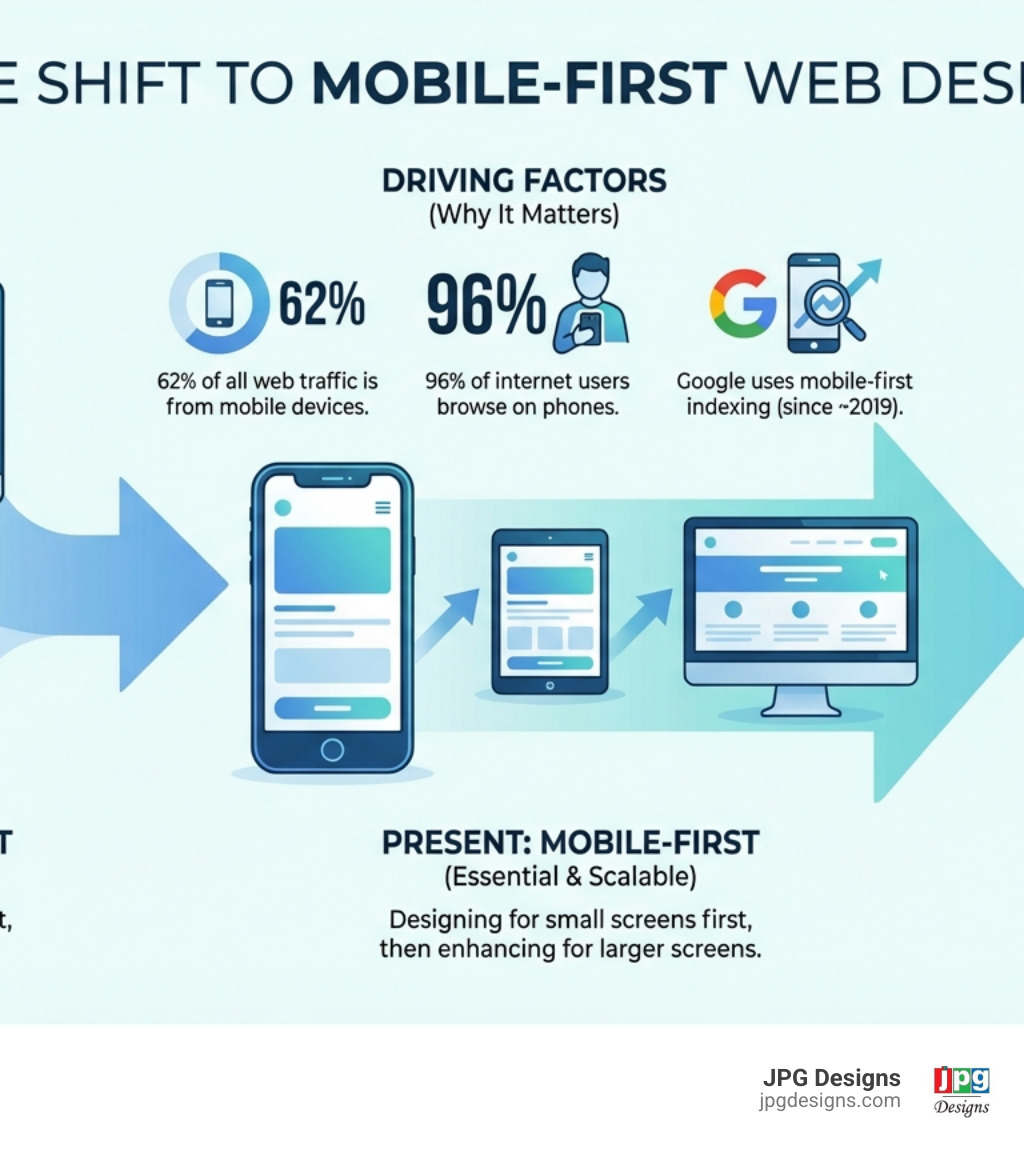
Ever tried using a website on your phone only to face tiny text and endless zooming? That frustration costs businesses money. With mobile devices accounting for 62% of all web traffic and nearly 96% of internet users browsing on their phones, a poor mobile experience drives visitors straight to your competitors. If your site was built desktop-first, you’re likely losing customers daily.
Google knows this. For years, they’ve used mobile-first indexing, ranking your site based on its mobile version. A clunky mobile site means your search rankings suffer.
I’m Jeff Pratt, owner of JPG Designs, and for years, I’ve helped businesses thrive by implementing mobile-first strategies. Understanding what is mobile first web design is key to improving search visibility, user engagement, and your bottom line.
What is Mobile-First Web Design and How Does It Work?
Think about the last time you used a clunky website on your phone—pinching, zooming, and tapping the wrong buttons. That’s what we avoid when we ask what is mobile first web design.
The simple truth is that mobile-first web design means starting your design process with the smallest screen—a smartphone—and then building up to accommodate tablets and desktops. Popularized by Luke Wroblewski, this approach forces you to focus on what’s essential. By designing for the toughest constraints first (small screens, slower connections, touch navigation), you build a solid foundation.
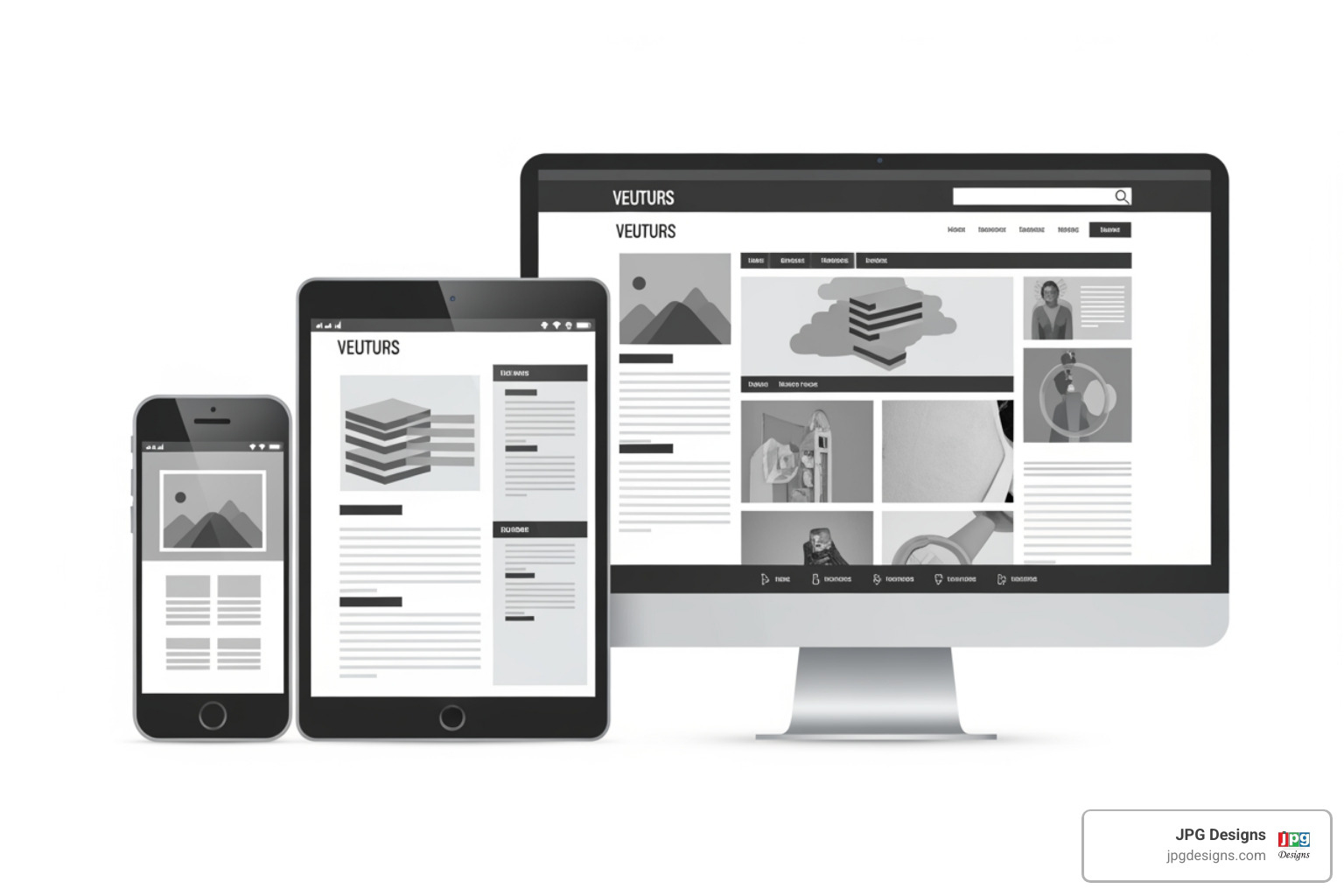
As screen sizes grow, you can improve the experience with richer layouts and more features. This is called progressive improvement—starting with a strong base and building up, rather than stripping down a desktop site. This guarantees your mobile user experience (UX) isn’t a compromised afterthought.
The Core Principles of Mobile-First Design
At JPG Designs, we’ve found that great mobile experiences are built on a few core principles. Content prioritization is key; you must identify what users absolutely need to see on a small screen. This leads to simplified navigation that is intuitive for thumbs, not a mouse. We also focus on touch-friendly elements like large buttons, performance optimization for fast load times on any connection, and scalable typography for readability on all devices. These principles, reinforced by resources like the MDN Glossary on Mobile-First, create websites that feel effortless to use.
Mobile-First vs. Traditional Desktop-First Design: Understanding the Key Difference
To truly grasp what is mobile first web design, it helps to contrast it with the old way.
-
Traditional (Desktop-First): You start with a feature-rich desktop site and then strip away elements to make it fit on mobile. The mobile experience is often a compromised, clunky afterthought. The design approach is reactive, constantly asking, “How do we make this work on smaller screens?”
-
Mobile-First: You start by building an efficient, purposeful mobile site with only the essentials. Then, you add features and complexity for larger screens. The design approach is proactive, asking, “What do users really need?” from the start.
This fundamental shift in the development workflow ensures your user experience focus is on the mobile user from day one. The result is a site that feels great on a phone, with the desktop version being an improved experience, not the other way around. It’s about being intentional rather than reactive.
The Undeniable Importance of a Mobile-First Strategy
Here’s a reality check: 96% of internet users browse on their phones, and mobile devices account for a staggering 62% of all web traffic. For any business in Rhode Island, from Providence to Warwick, these numbers represent your customers searching for you right now, phone in hand.
When someone lands on your site from their phone and encounters tiny text or slow loading, they don’t wait. They bounce to a competitor who understood what is mobile first web design. Every frustrating mobile experience is a lost opportunity. Embracing a mobile-first strategy positions your business exactly where your customers are, with an experience that welcomes them.

How Mobile-First Design Directly Impacts Your SEO and Google Ranking
Many business owners are surprised to learn that Google doesn’t care how great your desktop site looks. For years, Google has used mobile-first indexing. This means its algorithms rank your site based on your mobile version. If that experience is poor, your search rankings plummet.
A well-executed mobile-first design provides a powerful SEO advantage. It leads to improved page load speed, a key factor in Google’s Core Web Vitals. Mobile-first sites are built lean, and even a 0.1-second speed improvement can boost conversions.
Google also rewards better user experiences. When visitors stay on your site longer, it signals to Google that your content is valuable, boosting your rank. The content clarity forced by mobile-first design also helps search engines understand what your business offers. At JPG Designs, we help clients understand what is mobile-first indexing? and use it to their advantage, which is how Google ranking can help your business.
Key Business Benefits of Adopting a Mobile-First Approach
Beyond SEO, a mobile-first strategy delivers tangible benefits that drive growth for our Rhode Island clients.
- Dramatically Improved User Experience: By eliminating clutter, you create a cleaner, more intuitive experience for every visitor on any device.
- Increased Conversions: A frictionless mobile experience makes it easy for customers to contact you, schedule appointments, or make a purchase, directly boosting your bottom line.
- Better Accessibility: Emphasizing clear hierarchy, readable fonts, and large tap targets makes your site usable for a wider audience, including those with disabilities.
- Faster Load Times: Lightweight design and optimized code mean pages load quickly, keeping visitors engaged and reducing bounce rates.
- Scalable and Future-Proof: It’s easier to add features to larger screens than to strip them away for mobile. This approach protects your investment as new devices emerge.
- Cost-Efficiency: Building mobile-first avoids expensive retrofitting later on, making it a smart investment in effective web design that boosts business.
Implementing a Winning Mobile-First Strategy: A Step-by-Step Guide
Making the leap to what is mobile first web design is a systematic process. At JPG Designs, we guide Rhode Island businesses through this change, starting not with design, but with content. The process begins with a content inventory and ruthless prioritization to determine what’s essential for mobile users.
From there, we move to wireframing and prototyping, always starting with the smallest screen. We create interactive prototypes to test user flows and catch problems early. Only after the mobile foundation is solid do we use responsive techniques like CSS media queries to expand the design for tablets and desktops. Throughout this process, performance optimization is a constant priority, ensuring a fast, smooth experience on every device.
Best Practices for What is Mobile-First Web Design
After years of implementing mobile-first strategies, I’ve learned what separates good mobile experiences from great ones.
- Prioritize Content Ruthlessly: Every element on a mobile screen must serve a purpose. If it doesn’t help the user, it goes.
- Simplify Navigation: Use clear labels and intuitive patterns like hamburger menus or bottom navigation bars that work well for thumbs.
- Design for Touch: Buttons and links should be large (at least 44×44 pixels) with ample spacing to prevent accidental taps. Forget hover effects.
- Optimize Images and Media: Compress files, use modern formats like WebP, and implement lazy loading to speed up your site.
- Test on Real Devices: Simulators are helpful, but nothing beats testing on actual iPhones, Android phones, and tablets.
- Avoid Disruptive Pop-ups: On a small screen, pop-ups are frustrating and lead to high bounce rates. Use them sparingly, if at all.
- Maintain Visual Hierarchy: Use clear headings and white space to make content scannable for users who are skimming.
- Ensure Consistent Branding: Your logo, colors, and typography should be recognizable across all devices.
- Conduct User Testing: Get feedback from real users to uncover pain points. This aligns with web design using the KISS System—keeping things simple and user-focused.
Common Challenges and How to Overcome Them
Shifting to mobile-first has its problems, but every challenge has a solution.
- Simplifying Complex Features: The goal isn’t to remove features, but to prioritize them. Focus on core mobile tasks and use progressive disclosure to reveal complexity only when needed.
- Managing Client Expectations: Clients may worry about a “too simple” design. Educate them on the mobile traffic stats and SEO benefits. Use prototypes to show that functionality is improved, not lost.
- Shifting from a Desktop Mindset: Design teams need to retrain their process. Make mobile-first thinking the standard from the first sketch and review designs on mobile devices.
- Desktop Experience as an Afterthought: After nailing the mobile foundation, dedicate focused time to enhancing the desktop experience with richer interactions and layouts that use the extra space.
- Technical Implementation: Managing responsive code can be complex. Use robust frameworks and commit to rigorous testing across a wide range of devices and browsers.
Addressing these challenges is why we help clients plan and prepare for a new website design upfront, turning potential roadblocks into opportunities.
Frequently Asked Questions about Mobile-First Design
We often discuss what is mobile first web design with our clients. Here are answers to some of the most common questions from business owners across Rhode Island.
What tools and processes are essential for mobile-first design and testing?
A successful mobile-first project requires the right tools and process.
- Wireframing/Prototyping Tools (Figma, Sketch): These let us create visual blueprints, starting with the mobile view, to test ideas before coding.
- Browser Developer Tools: Built into browsers like Chrome and Firefox, these tools simulate different screen sizes and are great for initial testing.
- Real Device Testing: This is critical. We test on a collection of actual smartphones and tablets to see how the site performs in a real-world context.
- Performance Analysis Tools (Google PageSpeed Insights): We use these to measure site speed and identify bottlenecks, as every millisecond matters on mobile.
- Version Control (Git) & CSS Frameworks: These technical tools help us manage code efficiently and write clean, responsive styles that adapt across all screens.
- User Testing: Getting feedback from your target audience is invaluable for finding and fixing usability issues before launch.
If my site is mobile-first, do I still need a separate mobile solution?
For most businesses, the answer is no. A well-designed mobile-first website is all you need.
A mobile-first website provides broad reach, as anyone with a browser can find you through Google without needing to download an app. It’s also far more cost-effective to build and maintain a single, responsive site than to manage a separate website or mobile app.
Most importantly, a mobile-first website directly benefits your SEO. Google ranks sites based on their mobile version; a mobile app provides no such advantage. Our expertise at JPG Designs is in creating website design for mobile devices that delights users and climbs search rankings. While some large corporations with specific needs (like banking) may benefit from an app, a responsive website is the best solution for the vast majority of businesses.
Is it too late to switch to a mobile-first approach for my existing website?
Not at all. If you’re noticing high bounce rates or customer complaints about your mobile site, it’s the perfect time to make a change. Websites should evolve, and we’ve helped countless Rhode Island businesses transform outdated sites into sleek, mobile-first experiences.
The process starts with an audit of your current site and its analytics to identify pain points. We then work with you on content prioritization to focus on what mobile users truly need.
A redesign can be done in phases, starting with your highest-traffic pages to deliver results quickly and spread out the investment. If you’re seeing any of the 9 signs it’s time for a website redesign, making mobile-first the core of your new strategy is essential for your visibility and growth.
Conclusion: Accept the Future of Web Design
The numbers are clear: with 62% of web traffic coming from mobile devices, the web is now a mobile-first world. Understanding what is mobile first web design isn’t just about technology; it’s about meeting your customers where they are.
For your customers across Rhode Island, their phone is the primary tool for finding your services. A site not built for them is a closed door to the majority of your audience.
Mobile-first design solves multiple problems at once. It forces a user-centric focus that leads to faster load times and better experiences. It aligns perfectly with Google’s mobile-first indexing, boosting your search rankings. And most importantly, it’s future-proof, creating a flexible foundation that will serve your business for years to come.
At JPG Designs, we’ve spent years helping businesses grow through effective mobile-first strategies. Your competitors are already making this shift. The question isn’t if you should adopt mobile-first design, but how quickly you can implement it.
Don’t let an outdated website hold your business back. The future is here, and it’s mobile-first. Are you ready?
Ready to transform your online presence? Let us help you get a professional website design for mobile devices that delivers results.