
Mastering Google Ads for HVAC to Drive High-Quality Leads
Google Ads for HVAC is one of the fastest ways to get your phone ringing when homeowners need help right now. Here’s what you need to know to make it work:
How to optimize Google Ads for HVAC — quick answer:
- Target high-intent keywords like “AC repair near me” and “furnace replacement” — not broad terms
- Use Local Services Ads (LSAs) for pay-per-lead coverage at the top of search results
- Add negative keywords to block irrelevant searches like “HVAC jobs” or “DIY repair”
- Build mobile-first landing pages with click-to-call buttons — over 70% of HVAC searches happen on phones
- Set up conversion tracking so you know which ads are actually generating calls and bookings
- Adjust budgets seasonally — peak demand in summer and winter is when your budget works hardest
When a homeowner’s furnace dies at midnight in January, they’re not browsing around. They grab their phone and search Google — and they call the first credible result they see. That’s your window. Miss it, and the job goes to a competitor.
The challenge? HVAC is one of the most competitive and expensive niches in Google Ads. Clicks can cost anywhere from $8 to over $100, depending on your market and the service being searched. Running ads without a clear strategy means burning through budget fast — with little to show for it.
The good news: when HVAC Google Ads are set up correctly, they deliver some of the highest-intent leads available in digital marketing. These aren’t browsers. These are homeowners with a broken system who need help today.
I’m Jeff Pratt, owner of JPG Designs, a Rhode Island-based digital agency with over 15 years of experience running high-performance Google Ads for HVAC contractors and home service businesses. In this guide, I’ll walk you through exactly how to structure, optimize, and scale your campaigns so every dollar works harder.
Google Ads for HVAC terms to remember:
To dominate the local market in Rhode Island or Massachusetts, we first need to understand the tools at our disposal. Google doesn’t just offer one type of ad; it provides a suite of options that serve different stages of the customer journey. For an HVAC business, the “big two” are Google Search Ads and Local Services Ads (LSAs).
While Search Ads are the traditional text-based ads we see in search results, LSAs are the “Google Guaranteed” blocks that sit at the very top. If you aren’t using both, you’re leaving a massive portion of the market to your competitors.
| Feature | Google Search Ads (PPC) | Local Services Ads (LSAs) |
|---|---|---|
| Payment Model | Pay-per-click (CPC) | Pay-per-lead (CPL) |
| Placement | Top of search results | Absolute top (above Search Ads) |
| Trust Signal | Ad extensions & ratings | “Google Guaranteed” Badge |
| Lead Quality | High (if keywords are right) | Very High (direct calls/messages) |
| Average Cost | $8 – $50+ per click | $50 – $80 per lead |
| Setup Speed | Fast (hours/days) | Slower (requires background checks) |
The “Google Guaranteed” badge is the gold standard for building trust. When we help clients through the LSA setup, we’re essentially getting Google to vouch for their business. This process involves background and license checks, but the payoff is huge: you only pay when a customer actually contacts you, rather than just clicking your link.
If you’re ready to jumpstart your leads, you can Claim your Local Services Ads credit to start building that essential “Google Guaranteed” presence.
Choosing the Right Keywords for Google Ads for HVAC
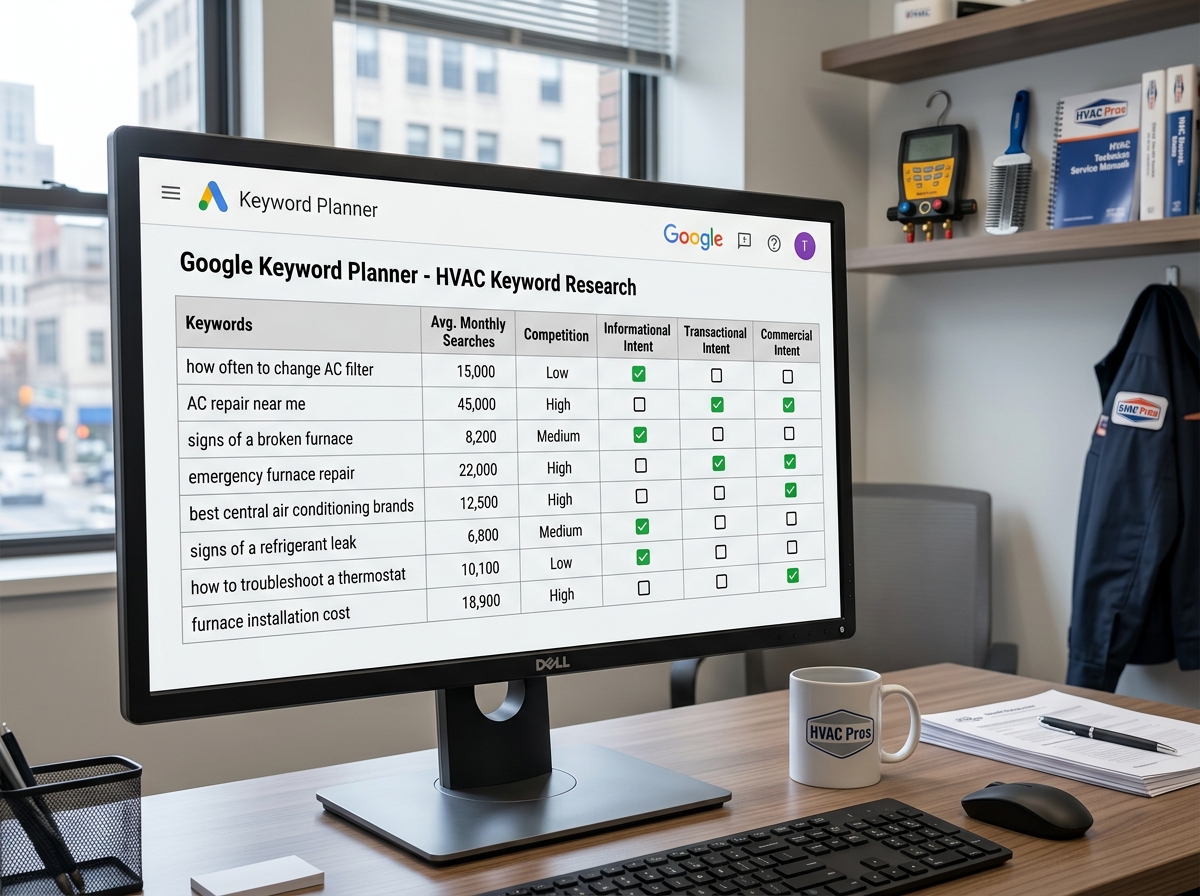
Keyword research is the backbone of any campaign. In the HVAC world, we categorize keywords by “intent.” A homeowner searching for “how to fix a leaky AC” has informational intent—they want to DIY. A homeowner searching for “emergency AC repair Providence” has transactional intent—they want to hire you right now.
We focus heavily on transactional, high-intent keywords. These include:
- Emergency Terms: “AC repair near me,” “furnace won’t turn on,” “24/7 HVAC service.”
- Service-Specific: “ductless mini-split installation,” “boiler replacement,” “heat pump maintenance.”
- Location-Based: “HVAC contractor Warwick RI,” “heating repair Worcester MA.”
Long-tail keywords (phrases with 3+ words) are often more affordable and convert better because they are more specific. Instead of just bidding on “HVAC,” we bid on “emergency furnace repair near me.” The search volume might be lower, but the likelihood of a booked job is significantly higher.
To get started with your own list, we recommend you Use Google Keyword Planner for research to identify what your local customers are actually typing into that search bar.
Eliminating Wasted Spend with Negative Keywords
One of the biggest mistakes we see HVAC companies make is using “Broad Match” keywords without a robust negative keyword list. If you bid on the keyword “HVAC,” Google might show your ad to someone searching for “HVAC jobs,” “free HVAC manuals,” or “used HVAC parts.”
Every time someone clicks those ads, you pay. And since they aren’t looking to hire a contractor, that money is effectively flushed down the drain.
To protect your budget, we implement a strict list of negative keywords. This tells Google: “Show my ad for repairs, but NEVER show it for these terms.” Common negatives for HVAC include:
- Employment: jobs, careers, hiring, salary, training, school.
- DIY: how to, parts, manual, diagram, wholesale, used.
- Irrelevant Services: window AC units (if you only do central air), automotive AC repair.
By regularly reviewing your search term reports, we can identify and block new irrelevant traffic before it eats your profit margins. This proactive cost reduction is how we help small businesses compete with the giant national franchises.
Optimizing Your Bidding Strategy for Google Ads for HVAC
Bidding is where the math meets the road. In a hyper-competitive market like New England, you can’t just set a budget and forget it. We use different strategies depending on the goal of the campaign:
- Manual CPC: This gives us the most control. We set the maximum we’re willing to pay for a click. It’s great for new campaigns where we need to gather data without overspending.
- Maximize Conversions: Once we have enough data, we let Google’s AI take over. It uses millions of signals (time of day, device, location) to bid more aggressively on clicks that are likely to lead to a phone call or form submission.
- Target CPA (Cost Per Acquisition): If we know a lead is worth $125 to you, we can tell Google to aim for that price point.
In Rhode Island and Massachusetts, seasonal adjustments are mandatory. When a July heatwave hits or a January blizzard arrives, we ramp up bidding on emergency repair terms. During the “shoulder seasons” (spring and fall), we pivot the strategy toward maintenance specials and system replacements to keep your technicians busy year-round.
Converting Clicks into Customers with Mobile-First Strategies
Getting the click is only half the battle. If that click leads to a slow, confusing website, the homeowner will hit the “back” button faster than a blown fuse. In our industry, 90% of HVAC leads happen over the phone, and about 70% of searches happen on mobile devices.
This is where JPG Designs excels. Our USP is leveraging mobile-first indexing to ensure your site isn’t just a digital brochure—it’s a lead-generation machine. If your landing page takes longer than 3 seconds to load, you’ve already lost half your potential customers.
A mobile-first strategy means:
- Click-to-Call Buttons: The phone number should be huge, sticky, and tappable.
- Thumb-Friendly Design: Forms should be easy to fill out on a small screen.
- Instant Trust: Trust badges (BBB, Google Guaranteed, NATE certification) should be visible immediately.
If your website feels like it was built in 2005, your ads will underperform regardless of how much you spend. You can find More info about web design services on our site to see how we bridge the gap between ads and bookings.
Designing High-Converting HVAC Landing Pages
A “landing page” is the specific page a user sees after clicking your ad. Sending HVAC ad traffic to your homepage is a recipe for failure. If someone clicks an ad for “Boiler Repair,” they should land on a page dedicated exclusively to boiler repair—not a general page about your company history.
High-converting landing pages for HVAC should include:
- Above-the-Fold CTAs: The “Schedule Now” button or phone number must be visible without scrolling.
- Real Photos: Skip the stock photos of smiling models. Show your actual trucks and technicians. It builds immediate rapport and proves you’re a local business.
- Online Scheduling: Integrating tools like ServiceTitan or Housecall Pro allows customers to book directly on your calendar, which is a massive conversion booster.
- Social Proof: Display 5-star reviews specifically from the town the user is searching from.
Before you spend another dime on ads, we highly recommend you Test your site with Google’s mobile-friendly tools to see how you’re performing on speed and usability.
Leveraging Local Targeting and Geo-Fencing
HVAC is a local game. You don’t want to pay for clicks from someone in Boston if you only service Southern Rhode Island. Google Ads allows us to be surgical with our targeting.
We use Geo-Fencing to set a specific radius around your office or target specific zip codes where your ideal customers live. For example, if you’re looking for high-ticket system replacements, we might target affluent neighborhoods in East Greenwich, RI, or Newton, MA.
We also use Location-Based Ad Copy. An ad that says “Best AC Repair in Warwick” will always outperform a generic ad that just says “AC Repair Near You.” It makes the customer feel like you’re right around the corner—because you are.
Furthermore, we integrate Weather-Driven Bidding. When the forecast shows a week of 90-degree weather, we can automatically increase your bids to ensure you’re at the top of the page when the AC units start failing across the state.
Scaling Your Success with JPG Designs
Managing Google Ads for HVAC is a full-time job. Between monitoring search terms, adjusting bids for the weather, and A/B testing ad copy, most business owners simply don’t have the time to do it right. That’s where we come in.
At JPG Designs, we don’t just “run ads.” We manage the entire funnel. From the moment a homeowner searches for help to the moment they book an appointment on your site, we are optimizing every step. We focus on the metrics that actually matter: Cost Per Lead and Return on Ad Spend (ROAS).
Our expertise in mobile-first indexing and local SEO means that your paid ads and organic presence work together to dominate the search results. We’ve seen that contractors who integrate their Google Ads with a high-performance website see a significant increase in revenue within their first year.
If you’re tired of “burning cash” on ads that don’t convert, it’s time for a professional approach. Contact us for a custom HVAC marketing strategy and let’s get your phone ringing with the high-quality jobs you actually want.
Final Thoughts for New England Contractors: The HVAC market in Rhode Island and Massachusetts is seasonal, competitive, and demanding. But for those who master Google Ads for HVAC, it is an endless source of high-ticket leads. By focusing on mobile optimization, high-intent keywords, and the “Google Guaranteed” badge, you can stop chasing leads and start booking jobs.
Ready to grow? We’re here to help.