Why Google SEO Is the Most Important Investment Your Website Can Make
Google SEO is the practice of optimizing your website so it ranks higher in Google’s search results — bringing in more visitors, more leads, and more revenue without paying for every click.
Here’s what you need to know at a glance:
| Google SEO Factor | Why It Matters |
|---|---|
| Ranking on page one | 75% of users never scroll past the first page |
| Top 3 organic results | Capture 68.7% of all clicks |
| Organic vs. paid conversion | Organic: 14.6% vs. PPC: 10% |
| Google’s share of web traffic | ~63% of all web referrals come from Google |
| Core components | Crawling, indexing, and serving results |
| Main SEO types | On-page, off-page, technical, local |
If Google can’t find your site, your customers can’t either.
Most business owners know they need SEO — but the rules keep changing. Algorithm updates, AI-powered search, mobile-first indexing, Core Web Vitals… it’s a lot to keep up with when you’re also running a business.
The good news? The fundamentals haven’t changed as much as you might think. Google still wants to show users the most helpful, trustworthy, and relevant results. Your job is to make sure your site clearly signals all three.
I’m Jeff Pratt, owner of JPG Designs, and I’ve spent over 15 years helping businesses across Rhode Island and beyond build Google SEO strategies that drive real, measurable growth. In this guide, I’ll walk you through everything you need — from technical setup to content to authority building — so you can compete and win in search.
Basic google seo glossary:
- what does seo stand for
- what is seo and how it works for small businesses
- seo tips for small businesses
Mastering Google SEO: From Crawling to Conversions
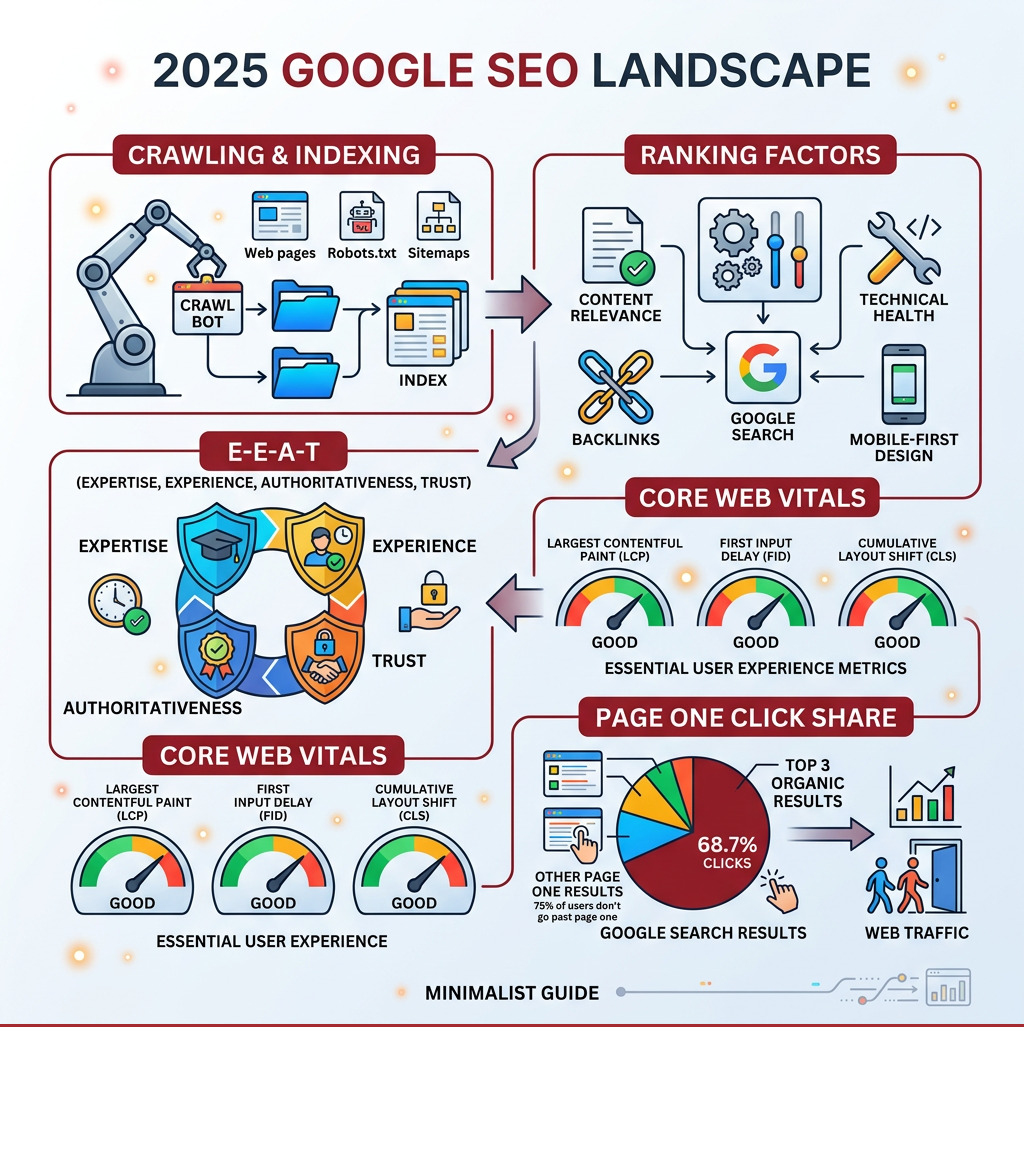
To win at google seo, we first have to understand how Google actually “thinks.” It isn’t just a giant library; it’s a high-speed matching engine. Every second, Google processes thousands of searches, trying to find the perfect answer for every user.
The process happens in three distinct stages:
- Crawling: Google uses automated programs called “crawlers” (or Googlebot) to explore the web. It finds new pages by following links from pages it already knows about.
- Indexing: Once a page is crawled, Google tries to understand what it’s about. It analyzes the text, images, and video files. This information is stored in the Google Index, a massive database.
- Serving: When someone types a query, Google searches its index for the most relevant, high-quality answers.

Why does this matter for your business in Rhode Island or Massachusetts? Because if you aren’t on page one, you’re essentially invisible. Research shows that 75% of users never scroll past the first page. Even more staggering, the top three organic results receive 68.7% of all clicks.
We often see businesses pouring money into Pay-Per-Click (PPC) ads, and while that has its place, organic search on page one boasts a 14.6% conversion rate, compared to just 10% for PPC. Investing in your SEO elements is simply a smarter long-term play for your bottom line.
Technical Foundations for Google SEO Success
Think of technical SEO as the foundation of a house. You can have the most beautiful curtains (content) in the world, but if the foundation is cracked, the whole thing is going to sink. If Google can’t crawl or index your site, you won’t rank, period.
The first thing we look at is your Crawlability. Can Googlebot get through the door?
- Sitemaps: This is a map of your site that tells Google where all your important pages are. You should always submit sitemaps and URLs for crawling via Search Console.
- Robots.txt: This file tells crawlers which parts of your site they shouldn’t visit. A common mistake is accidentally “disallowing” your entire site, which is like putting a “Do Not Enter” sign on your front door.
- URL Structure: Use descriptive URLs. Instead of
jpgdesigns.com/p=123, usejpgdesigns.com/google-seo-tips. It helps both users and search engines understand the page content.
Security is also a non-negotiable ranking factor. Google prefers HTTPS over HTTP. If your site isn’t secure, Google may flag it as “Not Secure” to users, which kills your trust instantly. If you’re wondering why your website is not attracting traffic, technical errors like broken links (404s) or slow server responses are often the culprits.
Finally, we have to talk about Core Web Vitals. These are specific speed and stability metrics Google uses to measure user experience. If your site “jumps” around while loading or takes forever to become interactive, your rankings will suffer.
Creating People-First Content for Google SEO
The mantra is “People-First.” Google has moved far beyond just counting how many times you use a keyword. Its “Helpful Content System” is designed to reward content that actually helps the reader.
To do this right, we focus on E-E-A-T: Experience, Expertise, Authoritativeness, and Trustworthiness. This is especially critical for YMYL (Your Money or Your Life) topics like health, finance, or legal advice. Google wants to know that the person writing the content actually knows what they’re talking about.
When we’re creating high-quality SEO optimized content, we follow these rules:
- Target Search Intent: Before writing, ask why the user is searching. Are they looking for information? Trying to buy something? Looking for a specific website? Your content must match that intent.
- Keyword Placement: Keywords still matter, but don’t stuff them. Place your primary keyword in the Title Tag (keep it under 60 characters), the first paragraph, and at least one subheading.
- Semantic Search: Google is smart enough to understand related topics. If you’re writing about “baking,” Google expects to see words like “oven,” “flour,” and “temperature.” We optimize for semantic search by covering a topic comprehensively, not just repeating a single phrase.
- Topical Authority: Instead of one-off blog posts, build “content clusters.” Create a main pillar page about a broad topic and link it to smaller, more specific articles. This signals to Google that you are an expert in that niche.
Mobile-First Indexing and Page Experience
Here is a fact that surprises many: Google primarily uses the mobile version of your site for ranking and indexing. This is called Mobile-First Indexing. Since over 63% of searches happen on mobile, if your mobile experience is clunky, your desktop rankings will tank too.
At JPG Designs, we specialize in optimizing your website for Google by ensuring every site we build is fully responsive. This means the layout adjusts automatically to fit any screen.
Speed is the other half of the experience equation. As page load time increases from one to three seconds, the probability of a user bouncing increases by 32%. If it takes longer than three seconds to load, more than half of your visitors will simply leave.
To keep users engaged, we focus on the three pillars of Core Web Vitals:
- LCP (Largest Contentful Paint): How fast the main content loads. Aim for under 2.5 seconds.
- FID (First Input Delay): How quickly the site responds to a user’s first click.
- CLS (Cumulative Layout Shift): Does the text move around while images are loading? A good score is below 0.1
Future-Proofing Your Strategy and Measuring Success
The world of google seo is changing rapidly due to AI and Large Language Models (LLMs). With features like AI Overviews, Google is now answering many questions directly on the search results page.
Does this mean SEO is dead? Absolutely not. It just means our strategy has to evolve. We focus on building Brand Signals. Google trusts brands that people talk about. This means being active on social media, getting mentions in local Rhode Island or Massachusetts news, and providing such a great service that people search for you by name.
Success in SEO is a marathon, not a sprint. It typically takes anywhere from a few weeks to several months to see significant movement in your rankings. To measure how we’re doing, we use a variety of tools, but the most important one is free: Google Search Console.
Leveraging Google Search Console for Growth
If you aren’t using Search Console, you’re flying blind. It is the only tool that gives you data directly from Google’s index.
Here is how we use it to drive growth for our clients:
- Performance Reports: See exactly which keywords are bringing people to your site. We look for “low-hanging fruit”—keywords where you’re ranking on page two (position 11-20). With a little optimization, these can often be pushed to page one.
- URL Inspection: If you’ve updated a page, use this tool to tell Google to “Request Indexing.” It speeds up the process of Google seeing your changes.
- Rich Results & Schema: You know those search results that show star ratings, recipe times, or FAQ dropdowns? Those are “Rich Results.” You get them by adding schema markup to your site. Implementing structured data has helped businesses like ZipRecruiter grow conversion rates by 4.5x.
- Index Coverage: This tells you if any of your pages have errors that are preventing them from appearing in search.
Building Authority Through Quality Backlinks
Off-page SEO is all about your reputation. A backlink is essentially a “vote of confidence” from one website to another. If a high-quality, relevant site links to you, Google sees you as more authoritative.
However, not all links are created equal. In the old days, people would buy thousands of cheap links from “link farms.” Today, that will get you penalized. We focus on building quality backlinks through:
- Digital PR: Sharing original research or expert insights with journalists.
- Broken Link Building: Finding broken links on other sites and suggesting your content as a replacement.
- Community Engagement: Being active in local business groups in Rhode Island or Massachusetts.
- Word of Mouth: Encouraging customers to share your site. As Nielsen reports, word of mouth is one of the most effective ways to build a lasting audience.
Google accounts for approximately 63% of all web referrals. Dominating this space requires a clean, authoritative backlink profile.
Avoiding Common Pitfalls and Myths
In our years of experience, we’ve seen a lot of “SEO experts” sell outdated or dangerous tactics. To keep your site safe, avoid these common mistakes:
- Keyword Stuffing: Writing like a robot just to fit in a keyword. “We are the best Rhode Island SEO company for Rhode Island SEO services in Rhode Island.” Don’t do this. It’s painful to read and Google hates it.
- Duplicate Content: Copying text from other sites or repeating the same text on multiple pages of your own site. Google wants unique value.
- Meta Keywords: Some people still think the “keywords” meta tag helps. Google hasn’t used this for ranking in over a decade.
- Buying Reviews: Fake reviews are easy for Google to spot and can lead to your Google Business Profile being suspended.
- Focusing on PageRank: While PageRank is still a thing, it’s just one of hundreds of signals. Don’t obsess over a single metric.
For small business owners, it’s easy to wonder if SEO is even worth it. But when you consider that organic search is the most sustainable way to grow your business, the answer is a resounding yes.
Whether you’re a local contractor in Providence or a tech startup in Boston, mastering google seo is the key to ensuring your business is found by the people who need you most. It’s about more than just algorithms; it’s about providing the best possible experience for your users.
Ready to take your search presence to the next level? From local SEO to full-scale technical audits, we’re here to help. Let’s get your site to the top of page one where it belongs.
Ready to boost your rankings?