
Why Advanced Email Marketing Is Your Most Powerful Revenue Driver
Advanced email marketing isn’t just sending newsletters; it’s using data-driven strategies, intelligent automation, and personalization to turn your email list into a consistent revenue engine. Here’s what sets it apart:
- Hyper-personalization through behavioral segmentation and progressive profiling
- Intelligent automation with trigger-based workflows (welcome series, cart abandonment, re-engagement)
- AI-powered optimization for subject lines, send times, and content
- Rigorous A/B testing to continuously improve performance
- Omnichannel integration connecting email with SMS, ads, and other channels
- Data-driven measurement focusing on ROI, not just open rates
If you’re sending the same generic message to your entire list, you’re leaving money on the table. For every $1 invested in email marketing, the return averages $36—but only if you move beyond basic tactics.
The digital landscape has changed. Subscribers expect relevant, timely messages that speak to their needs. Generic blasts get ignored. Sophisticated marketers use segmentation to achieve 760% higher revenue, while trigger-based emails generate 5x higher open rates than standard newsletters.
The gap between basic and advanced email marketing is widening. Businesses using email as a strategic growth system see 20-30% of their total revenue from automated flows alone, while companies using “spray and pray” tactics see engagement rates decline.
I’m Jeff Pratt, owner of JPG Designs. I’ve spent over 15 years helping businesses build digital systems that drive measurable growth. In this guide, I’ll show you how to transform your email program from a basic communication tool into a revenue-producing machine.
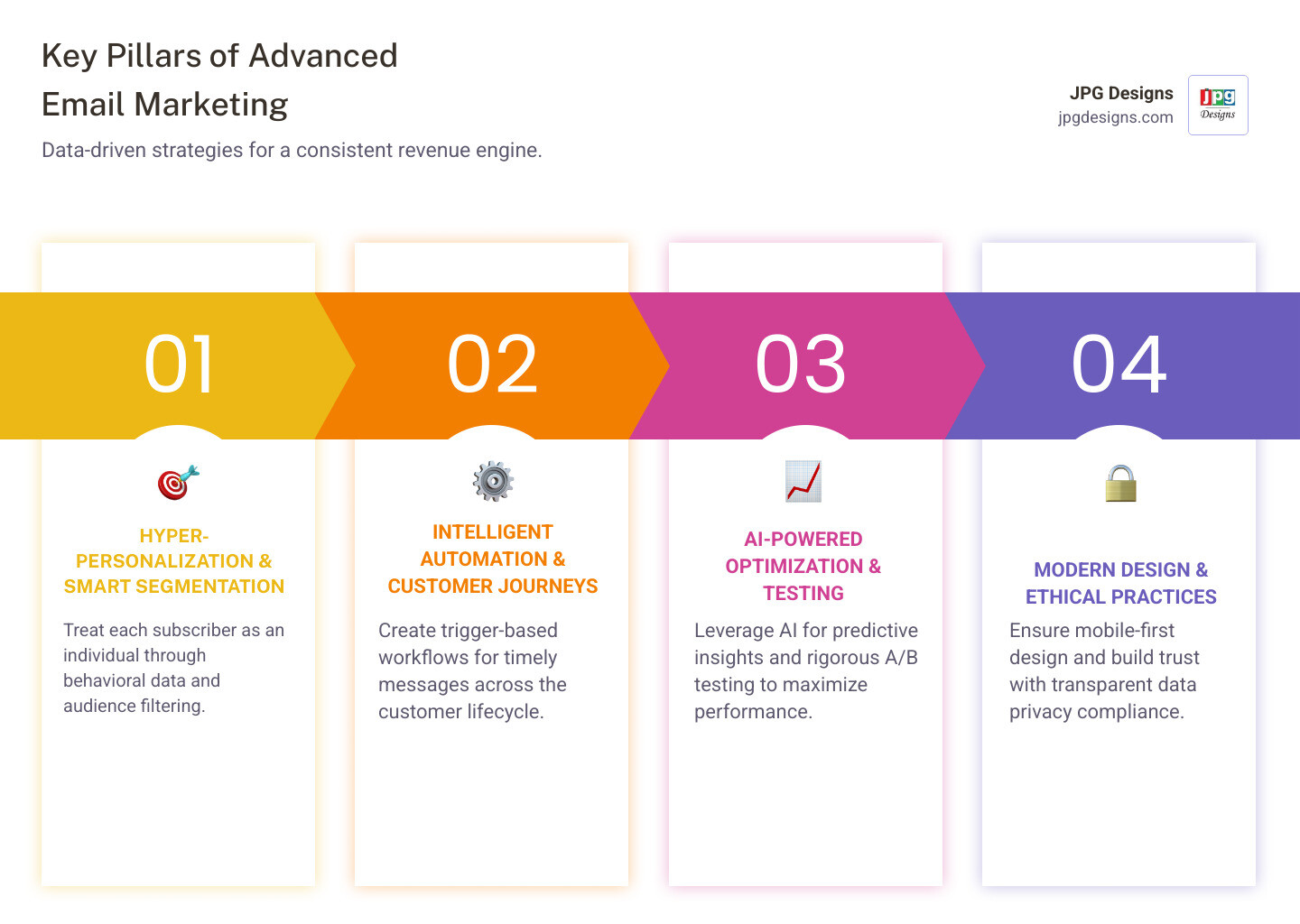
Pillar 1: Build a Foundation of Hyper-Personalization and Smart Segmentation
Pain point: Your generic emails are being ignored, leading to low engagement and lost sales.
Solution: Treat each subscriber as an individual by dividing your audience into meaningful groups and tailoring your message to their specific needs and behaviors.
Imagine a store where staff know your preferences and past purchases. That’s the power of email personalization. It’s a necessity, not a luxury, driving 6x more transactions by making subscribers feel valued. This means moving beyond just inserting a first name to understand what truly makes your audience tick.

Go Beyond First Names with Progressive Profiling
Basic name insertion is a start. Progressive profiling goes further by continuously collecting subscriber data over time. Instead of using long forms for new subscribers, you gather information at each interaction, building a richer profile.
This could include:
- Behavioral data: What pages do they visit? Which emails do they open and click? What products do they browse?
- Purchase history: What have they bought before? What categories interest them?
- Website activity: How long do they spend on certain pages? Do they read blog posts on specific topics?
To gather this data, we use tools like:
- Progressive profiling forms: Forms that adapt based on previously collected information.
- Quizzes and surveys: Engaging ways to collect explicit “zero-party data” directly from your audience. A “Color Family Quiz,” for example, could help a brand understand shopper preferences.
- Preference centers: Allowing subscribers to self-select their interests and how often they want to hear from you.
These methods build detailed customer profiles for precise, custom messaging. This deep understanding is key to a successful advanced email marketing strategy. To support this data collection, effective web design is foundational. More info about our web design services.
Master Advanced Segmentation Methods
With rich data, the magic happens through advanced segmentation. This means creating granular segments for hyper-targeted campaigns, not just dividing by “customers” and “prospects.” Marketers who segment lists see a 760% higher revenue, yet 90% don’t do it consistently.
Here are some advanced segmentation methods we employ:
- Demographic segmentation: Beyond age and gender, consider job title, industry, or company size for B2B.
- Psychographic segmentation: Grouping by lifestyle, values, and interests (e.g., “sustainability advocates”).
- Behavioral segmentation: The most powerful. This includes:
- Engagement level: Active vs. inactive subscribers.
- Website behavior: Visitors who viewed specific product categories.
- Purchase behavior: First-time buyers, repeat customers, high-value customers.
- Email behavior: Clicks on certain links or content downloads.
- RFM analysis (Recency, Frequency, Monetary): An e-commerce model that categorizes customers based on how recently, how often, and how much they spend.
- Predictive segmentation: Using AI to predict future actions, such as who is likely to churn or make a repeat purchase.
Combining these methods creates micro-segments for personalized communication. For example, you could invite SMBs within a 20-mile radius of your Rhode Island or Massachusetts location to a local event, instead of blasting your whole list. This precision drives higher engagement and conversions.
Pillar 2: Create Sophisticated Customer Journeys with Intelligent Automation
Pain point: You’re manually sending campaigns and missing crucial opportunities to engage customers at the right moment.
Solution: Use marketing automation to create trigger-based workflows that deliver timely, relevant messages throughout the customer lifecycle.
Manually sending emails for every customer action is time-consuming and prone to error. Intelligent automation changes your email marketing from a reactive task to a proactive, always-on growth engine. Automated email series (or email flows) such as abandoned cart or post-purchase emails create up to 30 times more revenue per recipient. This is about striking when interest is highest and providing immediate value.
Design High-Converting Automated Workflows
Automated workflows are email sequences triggered by user actions or predefined conditions. They guide subscribers through their customer journey, nurturing them into loyal customers. Trigger-based emails generate 5x higher open rates and 15x more clicks than standard newsletters because they’re directly relevant to recent behavior.
Here are some essential high-converting automated workflows:
- Welcome series: Your chance to make a great first impression. Welcome emails can deliver up to 336% higher transaction rates. A good series introduces your brand, sets expectations, and offers value.
- Abandoned cart recovery: A true revenue-saver! The average cart abandonment rate is over 77%. Automated sequences remind customers of items left behind, potentially offering a small incentive to complete the purchase.
- Post-purchase follow-up: Don’t let the conversation end after a sale. These emails can request reviews, offer related products (upselling/cross-selling), or provide helpful tips, building loyalty.
- Re-engagement/win-back campaigns: For inactive subscribers. These sequences aim to rekindle interest with a special offer. If they still don’t engage, it’s best to suppress them to maintain a healthy list.
- Birthday/anniversary emails: A simple, effective way to delight customers with a personalized message and a special offer.
These workflows operate in the background, ensuring every customer interaction is timely, relevant, and designed to drive a specific action, saving hours and generating consistent revenue.
The Difference Between Basic Blasts and Advanced Automation
To grasp the power of advanced email marketing, understand how it differs from the “basic email blast” approach. The table below highlights this shift:
| Feature | Basic Email Blasts | Advanced Automation |
|---|---|---|
| Communication | One-to-many (broadcast to entire list) | One-to-one at scale (custom messages to individuals/segments) |
| Content | Static, generic, same for everyone | Dynamic, personalized, adapts based on user data and behavior |
| Trigger | Manual send at a scheduled time | Behavior-triggered (e.g., sign-up, cart abandonment, page view, purchase) |
| Goal | Informational, broad promotion | Nurturing, conversion, retention, building relationships, specific actions |
| Integration | Often standalone | Multi-channel (integrated with SMS, CRM, website, ads) |
| ROI | Variable, often lower due to irrelevance | High, personalized and timely messages drive significant revenue |
The move from basic email blasts to advanced, multi-channel marketing automation is a leap from simple communication to strategic customer relationship management. It’s about building comprehensive platforms that leverage data to understand the whole customer experience.
Pillar 3: Accelerate Growth with AI, A/B Testing, and Paid Acquisition
Pain point: Your campaign results have plateaued and you’re struggling to grow your list with qualified leads.
Solution: Leverage technology and data-driven testing to continuously optimize performance and use paid channels to attract your ideal subscribers.
In today’s competitive landscape, intuition alone leads to stagnation. To accelerate growth, we use cutting-edge tools for data-backed insights and expanded reach. This means tapping into the power of Artificial Intelligence, rigorous testing, and strategic paid advertising.
How AI is Changing Advanced Email Marketing
Artificial Intelligence (AI) is a present-day game-changer for advanced email marketing. AI tools remove the guesswork, optimizing and speeding up campaign creation.
Here’s how AI transforms our strategies:
- AI-powered subject lines: AI suggests subject lines more likely to generate opens and clicks based on performance data.
- Predictive personalization: AI predicts individual subscriber preferences, enabling hyper-personalized content. Amazon’s approach, for example, drives 35% of their total product sales.
- Send-time optimization: AI analyzes each contact’s behavior to determine their individual ideal open time. Emails sent at optimized times see 33% higher transaction rates.
- Automated content generation: AI can assist in generating email copy, product descriptions, or even entire layouts, saving time.
- AI-driven segmentation: AI identifies subtle patterns in customer data to create dynamic segments that might be missed by manual analysis.
By integrating AI, we can build enterprise-grade email programs for our clients in Rhode Island and Massachusetts, even for smaller teams. We’ve seen how AI can provide things our clients actually want and need. See our success stories to learn more.
Optimize Everything with Rigorous A/B Testing
A great email strategy is built on insight, not intuition. A/B testing (or split testing) is our secret weapon for continuous improvement. It involves testing two or more versions of an email element with different audience segments to see which performs better. This data-driven approach helps refine messages for massive gains.
What elements should we rigorously test? Almost everything!
- Subject lines: Crucial for engagement. Nearly half of all opens are based on the subject line, and 69% of subscribers report spam just from reading it. Test different formats, lengths (under 40 characters for mobile), and personalization.
- Call-to-Action (CTA): The gateway to conversion. Test wording, button colors, placement, and size.
- Email copy and tone: Experiment with short vs. long copy, formal vs. informal tone, and different storytelling.
- Layout and design: Test single-column vs. multi-column layouts and image placement.
- Send times and frequency: While AI helps, A/B testing can confirm optimal send times for specific campaigns.
- Personalization elements: Does dynamic content outperform static content? Which types of personalization resonate most?
Real-world examples prove the power of A/B testing. Shop Home Med, for instance, increased revenue per recipient by 306% by testing their email campaigns. By making A/B testing a core part of our process, we constantly learn what truly drives results.
Use Paid Advertising to Build Your Email List
While organic list growth is vital, paid advertising offers a powerful way to accelerate the acquisition of qualified leads, especially when results have plateaued.
Here’s how we leverage paid channels:
- Facebook Lead Ads: These ads allow users to sign up directly within Facebook, reducing friction and boosting conversions. We recommend a specific welcome flow for these leads, often identified by a unique source value.
- Lookalike audiences: If you have at least 500 contacts, you can create “lookalike audiences” on platforms like Facebook and Google. These audiences share characteristics with your current subscribers, helping you reach new, interested customers.
- Gated content and lead magnets: Running paid ads to promote valuable content (e.g., e-books, webinars, quizzes) is an excellent way to attract highly engaged subscribers.
By strategically using paid advertising, we can efficiently grow a high-quality email list, feeding our advanced email marketing machine with eager prospects. Learn more about our digital marketing approach and how we integrate paid strategies for comprehensive growth.
Pillar 4: Polish Your Campaigns with Optimized Design and Ethical Practices
Pain point: Your emails look dated, don’t work on all devices, and may not comply with privacy regulations.
Solution: Focus on a seamless user experience with modern design principles and build trust by being transparent and ethical with customer data.
Even the best strategy fails if your emails look bad, are hard to read, or violate trust. With nearly half of emails opened on mobile and privacy concerns paramount, optimized design and ethical practices are non-negotiable pillars of advanced email marketing.
Design for Every Inbox: Mobile-First, Light & Dark Mode
“Nearly half of all marketing emails are opened on mobile – yet many are still designed with outdated, desktop-first principles. If your message doesn’t render well, load fast, and guide action on a small screen, it won’t perform. Period.” This insight from Cyberimpact highlights a critical area. Mobile-optimized emails generate 4x more revenue per click than those built for desktop. We accept a mobile-first approach, designing primarily for smaller screens.
Key design considerations include:
- Responsive design: Emails that automatically adjust their layout to fit any screen.
- Single-column layouts: Generally easier to read and steer on mobile devices.
- Thumb-friendly CTAs: Buttons should be large and spaced for easy tapping.
- Testing for dark mode rendering: It’s crucial to test how emails appear in both light and dark mode to ensure legibility and consistent branding.
- Image optimization: Using compressed images that load quickly on mobile data.
By prioritizing mobile-first design and ensuring compatibility with various display modes, we guarantee a smooth experience for every subscriber.
Craft Compelling Subject Lines and CTAs
Your subject line is the gatekeeper to your content, and your Call-to-Action (CTA) is the gateway to conversion. In advanced email marketing, these elements are carefully crafted and tested.
- Compelling Subject Lines:
- Urgency and scarcity: “Limited-time offer!” or “Ends tonight!”
- Curiosity and intrigue: “A secret we’ve been keeping.”
- Personalization: Use location (“Your Rhode Island exclusive deal!”) or behavioral cues. Nearly half of all opens are based on the subject line alone.
- Clarity and value: Clearly communicate what’s inside.
- Irresistible Calls-to-Action (CTAs):
- Action-oriented copy: Use strong verbs like “Shop Now,” “Download Your Guide.”
- Clear and concise: Subscribers should instantly know what to do.
- Prominent placement: CTAs should be easy to find and stand out.
- Benefit-driven: Emphasize what the user will gain by clicking.
Don’t send emails without a clear CTA. A well-crafted subject line gets the open, but a powerful CTA drives the action.
Steer Data Privacy and Ethical Considerations
With privacy regulations like GDPR and CCPA, and growing consumer awareness, ethical data collection is paramount. Building subscriber trust is essential for long-term success in advanced email marketing.
Our best practices include:
- Transparent data collection: Clearly inform subscribers what data you’re collecting and how you’ll use it.
- Easy unsubscribe process: Make it simple for users to opt-out. A frustrated subscriber might mark you as spam, harming your sender reputation.
- Setting clear expectations: When someone signs up, let them know what kind of emails they’ll receive and how often.
- GDPR and CCPA compliance: Ensure all data handling practices adhere to relevant privacy laws.
- Building subscriber trust: This is the foundation of a healthy email list. Respecting their inbox and protecting their data fosters loyalty.
By upholding these ethical standards, we not only comply with regulations but also cultivate a loyal audience that trusts our brand.
Frequently Asked Questions about Advanced Email Marketing
How can I effectively recover abandoned carts using email?
Recovering abandoned carts requires a timely, automated multi-email sequence:
- Immediate Reminder (1-3 hours): Send a simple, friendly reminder with a direct link back to the cart.
- Follow-Up (12-24 hours): Add a sense of urgency by highlighting the product’s popularity, limited stock, or a special offer.
- Incentive (24-48 hours): Offer a small incentive like free shipping or a discount to nudge hesitant buyers.
- Personalization: Always include images and descriptions of the actual cart items.
These automated series can create up to 30 times more revenue per recipient, turning potential losses into gains.
What are the core components of a modern advanced email marketing strategy?
A modern advanced email marketing strategy relies on several key pillars:
- Hyper-personalization: Using behavioral, psychographic, and predictive data for custom content.
- Intelligent automation: Implementing trigger-based workflows for the entire customer lifecycle.
- AI-powered optimization: Using AI for subject lines, send times, and content generation to maximize engagement.
- An omnichannel approach: Integrating email with SMS and other channels for a seamless brand experience.
- Data privacy and ethics: Building trust and ensuring compliance with regulations like GDPR and CCPA.
- Continuous A/B testing: Systematically testing all campaign elements to constantly improve performance.
How do I measure the ROI of my advanced email marketing efforts?
Measuring the ROI of advanced email marketing requires focusing on metrics that impact your bottom line, not just open rates:
- Conversion Rate: The percentage of recipients who complete a desired action (e.g., purchase, sign-up).
- Revenue Per Email (RPE): Total revenue from a campaign divided by the number of emails sent.
- Customer Lifetime Value (CLV): The total revenue a customer generates over their relationship with your business. Advanced strategies aim to increase CLV.
- Attribution Modeling: Using analytics and UTM parameters to attribute sales to specific email campaigns or automation flows.
While the average return is $36 for every $1 invested, advanced strategies can yield even higher returns. Tracking these key metrics allows us to determine financial impact and optimize for greater profitability.
Open up Your Revenue Potential with Advanced Email Marketing
We’ve explored how advanced email marketing transforms your approach from broadcasting messages to engaging in personalized, data-driven conversations. The power lies in combining hyper-personalization, intelligent automation, AI-powered optimization, and rigorous testing within an ethical, mobile-first framework. It’s about sending smarter emails that resonate, convert, and build lasting customer relationships.
At JPG Designs, we specialize in helping businesses in Rhode Island and Massachusetts leverage these data-driven strategies to turn their email program into a primary revenue driver. We understand the nuances of crafting effective web design and digital marketing strategies that support advanced email campaigns.
Don’t let your inbox potential go untapped. It’s time to move beyond the basics and open up the full power of your email marketing. Take the next step to transform your email program into a consistent, measurable, and highly profitable growth engine.
Contact us to discuss your digital marketing strategy today, and let’s work together to make your email marketing unstoppable.