Why Every Mission-Driven Organization Needs a Website That Actually Works
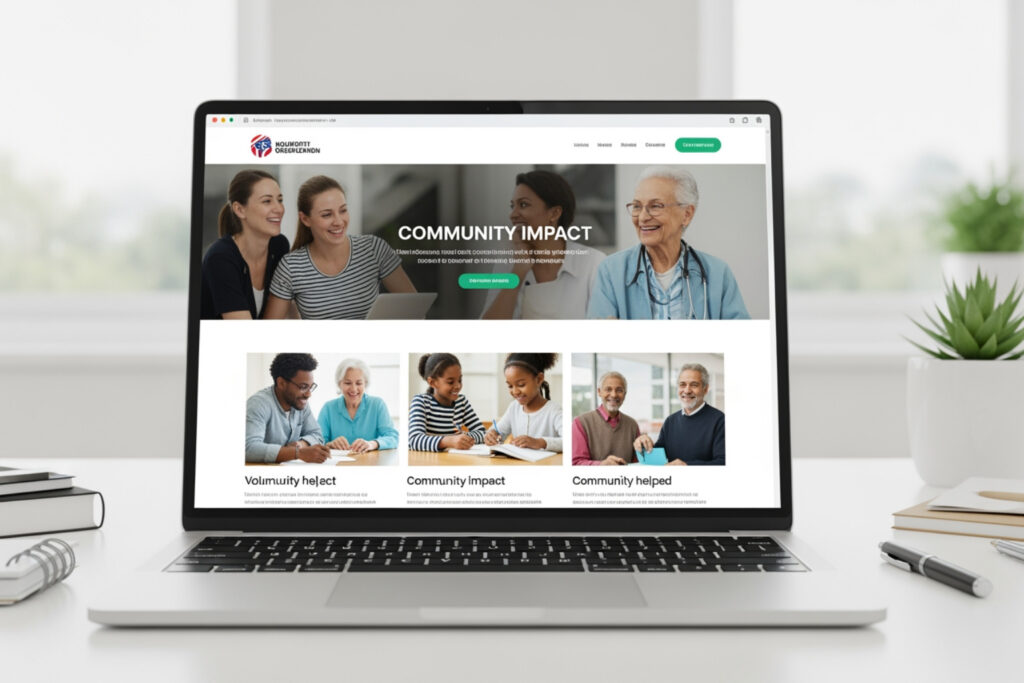
A mission driven website is more than an online brochure—it’s the digital headquarters where your organization’s purpose meets the people who care about it most. Here’s what defines one:
Key Elements of a Mission Driven Website:
- Clear mission statement prominently displayed on the homepage
- Compelling storytelling that shows impact, not just describes it
- Strategic CTAs that guide visitors toward meaningful action
- Accessible design following WCAG standards for all users
- Transparent impact metrics showing real-world results
- Seamless donation experience with simple forms and multiple giving options
- Mobile-responsive design that works perfectly on every device
The challenge? Most mission-driven organizations struggle with websites that don’t reflect the passion behind their work. Research shows nonprofit websites see bounce rates around 60%—significantly higher than the 40% average for other sites. When visitors leave quickly, that’s not just a lost click. It’s a missed connection with someone who might have become a donor, volunteer, or advocate.
Your website is doing work while you sleep. It’s answering questions, building trust, and making the case for support when you can’t be there in person. But if it’s slow, confusing, or fails to communicate why your mission matters, you’re losing people who genuinely want to help.
The good news: you don’t need a massive budget or a full-time web team. You need a strategic approach that combines smart design (the “head”) with emotional connection (the “heart”). When those two elements work together, your website becomes a powerful tool for growth—not just a digital placeholder.
What makes the difference? Organizations that treat their website as a strategic asset see measurable results. One parks conservancy reduced bounce rates by 31% through continuous improvements. A health foundation achieved perfect accessibility scores while increasing engagement. These aren’t accidents—they’re the result of intentional design choices.
For over a decade, I’ve worked with dozens of nonprofits, educational organizations, and community groups to build mission driven website experiences that convert visitors into supporters. At JPG Designs, we’ve seen how the right combination of accessibility, storytelling, and strategic CTAs transforms online presence into real-world impact.
The sections ahead break down exactly how to build a website that serves your mission—from core design principles to real-world examples of organizations getting it right.
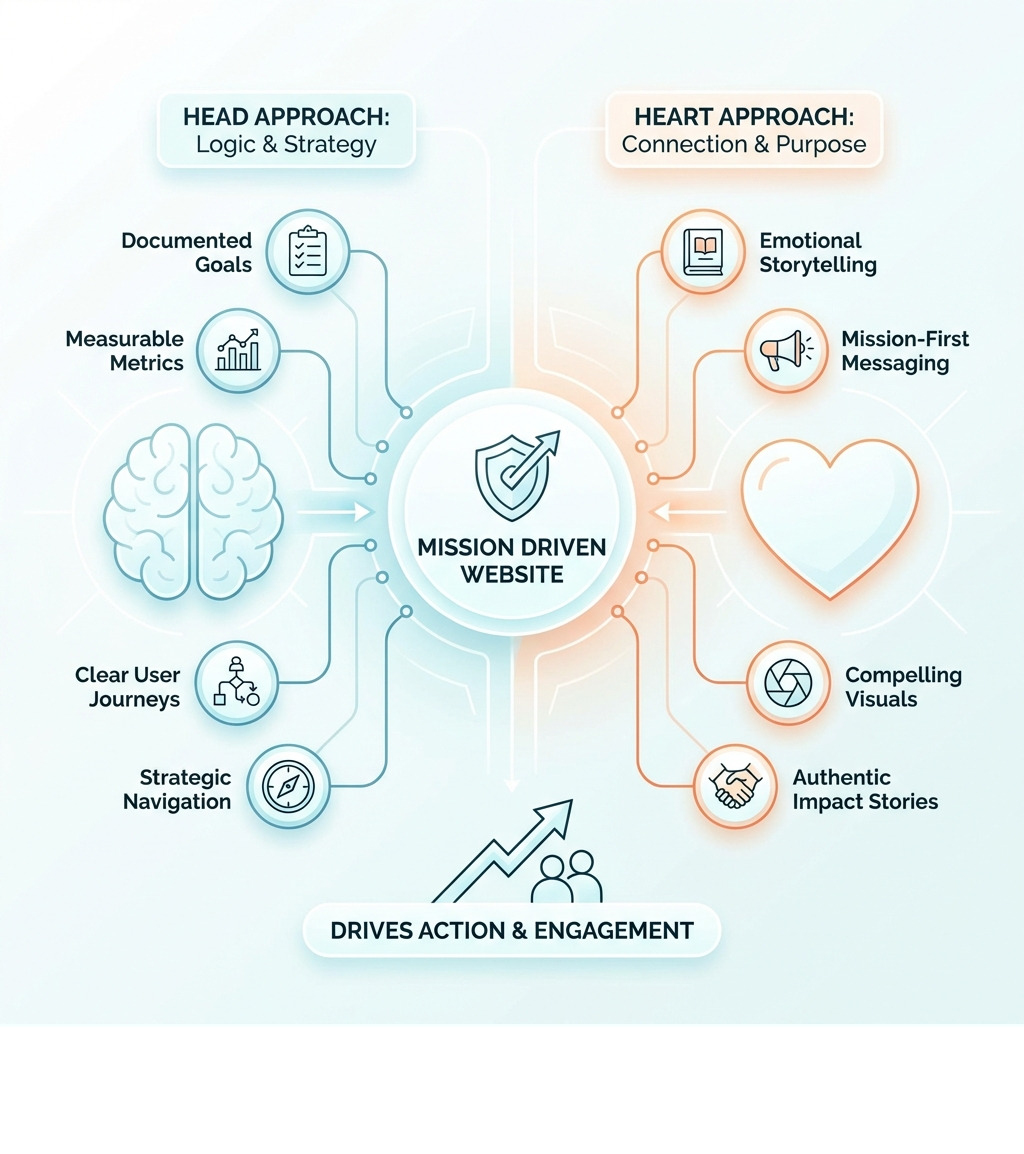
Mission driven website terminology:
Core Pillars of a High-Impact Mission Driven Website
Building a mission driven website requires more than just a pretty layout; it requires a foundation built on trust, usability, and purpose. When we talk about “high-impact,” we mean a site that doesn’t just sit there—it moves the needle for your cause. This starts with understanding that your website is your most valuable representative.
The first pillar is User Experience (UX). A common pain point for many organizations in Rhode Island and Massachusetts is a “cluttered” digital presence. If a donor has to hunt for the “Donate” button or a beneficiary can’t find how to access your services, the mission is effectively blocked. We focus on “cognitive ease,” ensuring that the path from landing on the site to taking action is frictionless.
The second pillar is Accessibility. For a mission-driven organization, inclusivity isn’t optional—it’s a reflection of your values. Following ADA Accessibility guidelines ensures that everyone, regardless of their physical or cognitive abilities, can engage with your content. This means adhering to the Web Content Accessibility Guidelines, which provide a roadmap for making the web accessible to people with disabilities.
Finally, there is Storytelling. Statistics are important (we’ll get to those!), but stories are what make people care. A high-impact site weaves your mission into its very DNA, leading with the “why” before asking for the “what.” By integrating a robust nonprofit digital strategy, you can ensure these pillars support every page of your site.
Designing for Inclusivity and a Mission Driven Website Experience
Inclusivity in web design means that your message reaches the widest possible audience. In the nonprofit sector, where missions often involve serving vulnerable or diverse populations, this is critical. We recommend aiming for WCAG Level AA standards. This includes technical details that make a massive difference:
- Color Contrast: Ensuring text is readable against its background for users with visual impairments.
- Alt Text: Providing descriptive text for images so screen readers can describe them to blind users.
- Logical Headings: Using H1, H2, and H3 tags correctly so the site’s structure is easy to navigate via keyboard.
One of the most significant shifts in the digital landscape is the move toward mobile. Research shows that 57% of nonprofit website traffic now comes from mobile devices. If your site isn’t mobile-responsive, you are essentially ignoring more than half of your potential supporters. At JPG Designs, we specialize in mobile-first indexing, which not only improves user experience but also boosts your visibility in search engines. Understanding the importance of a well-designed website for nonprofits means recognizing that accessibility and mobile-friendliness are two sides of the same coin.

Strategic Storytelling and the Mission Driven Website Funnel
To convert a casual browser into a committed donor, your website needs to lead with “heart.” This is where strategic storytelling comes into play. Your mission driven website should feature a “Hero Message”—a clear, concise statement at the top of your homepage that captures the essence of what you do.
But don’t stop at the “what.” Show the “so what.”
- Emotional Engagement: Use high-quality, authentic photos of the people (or animals, or landscapes) your organization helps. Avoid stock photos whenever possible; authenticity builds trust.
- Impact Metrics: People want to know their money is making a difference. Use “Impact-Tied Suggestions” on your donation pages. For example, instead of just asking for $25, say “A $25 gift provides 10 meals for local seniors.”
- Transparency: Share your success stories and your challenges. Transparency is a major driver of donor retention.
A convenient, inspirational donation page is the centerpiece of this funnel. It should be easy to find, fast to load, and simple to complete. When we design for non-profit-organizations, we ensure the donation process feels like a natural extension of the story they just read on the homepage.
Converting Visitors into Lifelong Supporters
The ultimate goal of a mission driven website is conversion. Whether that conversion is a donation, a volunteer sign-up, or a newsletter subscription, the “Call to Action” (CTA) must be unmistakable.
- Clear CTAs: Use high-contrast colors for your buttons and action-oriented language like “Join the Fight” or “Feed a Family” rather than a generic “Submit.”
- Recurring Gifts: Make it easy for donors to turn a one-time gift into a monthly commitment. This provides your organization with predictable, long-term funding.
- Social Proof: Include testimonials, partner logos, or “As Seen In” mentions to build immediate credibility.
- Matching Gifts: Encourage visitors to check if their employer will match their donation, effectively doubling their impact with no extra cost to them.
By implementing smart seo-for-nonprofits, you ensure that the people searching for ways to help find your organization first. SEO isn’t just about rankings; it’s about being visible to those who share your mission.
From Strategy to Success: Launching Your Online Presence
Launching or redesigning a website is a major undertaking, but it’s much less daunting with a clear roadmap. According to the Nonprofit Tech for Good report, 68% of nonprofits have recently redesigned their websites. If you haven’t, you may be falling behind modern user expectations.
The process starts with Goal Setting. What do you want your site to do? Be specific. Instead of “get more donations,” aim for “increase monthly recurring donors by 15% over the next six months.” Once your goals are documented, you can build Audience Personas. Who are you talking to? A 25-year-old volunteer has different needs and motivations than a 70-year-old major donor. Your site design and content should cater to both.
Wireframing is the next step. Think of this as the blueprint for your digital house. It allows you to plan the logical structure and navigation before you get distracted by colors and images. This is where you address the high bounce rates of about 60% often seen in the sector. By ensuring the most important information is easy to find, you keep visitors on the page longer.
Measuring Impact and Avoiding Common Pitfalls
Once your mission driven website is live, the work isn’t over. You need to measure its performance to see what’s working and what isn’t.
- Bounce Rate: If this is high, your landing pages might not be matching the user’s intent, or your site might be too slow.
- Conversion Tracking: Use tools like Google Analytics to see exactly where your donors are coming from and which pages are driving the most action.
- Regular Maintenance: Websites are not “set it and forget it” projects. They require security patches, plugin updates, and content refreshes to stay effective and secure.
Common pitfalls include “over-designing”—making the site so busy that the mission gets lost—and neglecting mobile users. Our design-for-nonprofits-complete-guide covers these technical and strategic aspects in detail to help you avoid these mistakes.
Real-World Examples of Mission-Centric Excellence
Looking at organizations that have mastered the mission driven website can provide excellent inspiration:
- Girls Who Code: Their site uses bold, vibrant colors and clear impact statistics (like serving 450,000 girls) to immediately convey their success and energy.
- charity: water: A masterclass in transparency and storytelling. They use GPS coordinates and photos to prove every single project they fund, building immense trust with donors.
- The Nature Conservancy: They excel at setting lofty, measurable goals (like conserving 10 billion acres of ocean) that inspire visitors to be part of something big.
These organizations don’t just have websites; they have digital experiences that reinforce their mission at every turn. They utilize professional web-design-services-for-non-profit-organizations to ensure their message is never lost in translation.
Partnering for Long-Term Growth
For many organizations in Massachusetts and Rhode Island, the biggest hurdle to a great website is a lack of internal technical resources. Small teams are often stretched thin, focusing on operations rather than digital marketing. This is where partnering with an expert agency like JPG Designs makes the difference.
We specialize in mobile-first indexing, ensuring your site is built for the way people browse today. We don’t just build a site and walk away; we help you develop a long-term strategy for growth, visibility, and impact.
| Feature | DIY Website Builders | Professional Agency (JPG Designs) |
|---|---|---|
| Customization | Limited templates | Fully custom to your mission |
| SEO Strategy | Basic/Generic | Advanced Mobile-First Indexing |
| Accessibility | Often manual/difficult | Built-in WCAG compliance |
| Maintenance | User’s responsibility | Managed updates and security |
| ROI | Low initial cost, low impact | Strategic investment for long-term growth |
If you are ready to move beyond the statement and build a digital presence that truly reflects your passion, we are here to help. Your mission is too important to be hidden behind an outdated, inaccessible website. Let’s build something that works as hard as you do.