

Why Schema Markup is Essential for Modern SEO
How schema markup helps is simple: it translates your website content into a language that search engines and AI systems can clearly understand. Instead of guessing what your content means, search engines get explicit signals about your business, products, services, and expertise.
Here’s how schema markup helps your website:
- Boosts click-through rates – Websites with schema markup see up to 82% higher CTR compared to sites without it
- Enables rich results – Your listings can show star ratings, prices, images, event dates, and other eye-catching details
- Improves AI visibility – AI-powered search tools like Google’s AI Overviews rely on structured data to understand and cite content
- Clarifies your content – Schema tells search engines exactly what your content represents (a product, a service, an event, a local business)
- Strengthens local SEO – LocalBusiness schema helps you appear in map packs and local search features
- Future-proofs your site – Voice search and AI assistants depend on structured data to deliver accurate answers
Think of schema markup as structured data – code you add to your website that provides explicit context about your content. It’s the difference between a search engine guessing what “Apple” means on your page versus knowing whether you’re talking about the tech company or the fruit.
Schema markup uses a standardized vocabulary (primarily from Schema.org) that all major search engines understand. You implement it by adding a snippet of code (typically in JSON-LD format) to your website’s HTML. This code describes the entities on your page – whether that’s your business name and address, a product with its price and availability, or an article with its author and publication date.
The results speak for themselves. Companies like Rakuten saw 2.7x more traffic from search after implementing Recipe schema. Jobrapido experienced a 182% boost in organic traffic. Eventbrite reported a 100% year-over-year increase in traffic to event listings. These aren’t isolated cases – they demonstrate what happens when you speak the language search engines understand.
I’m Jeff Pratt, owner of JPG Designs, and over 15 years I’ve helped hundreds of businesses improve their search visibility through strategic implementation of schema markup and advanced SEO techniques. Understanding how schema markup helps has become essential for any business that wants to compete in today’s AI-driven search landscape, and I’ve made it a core part of every website we build.
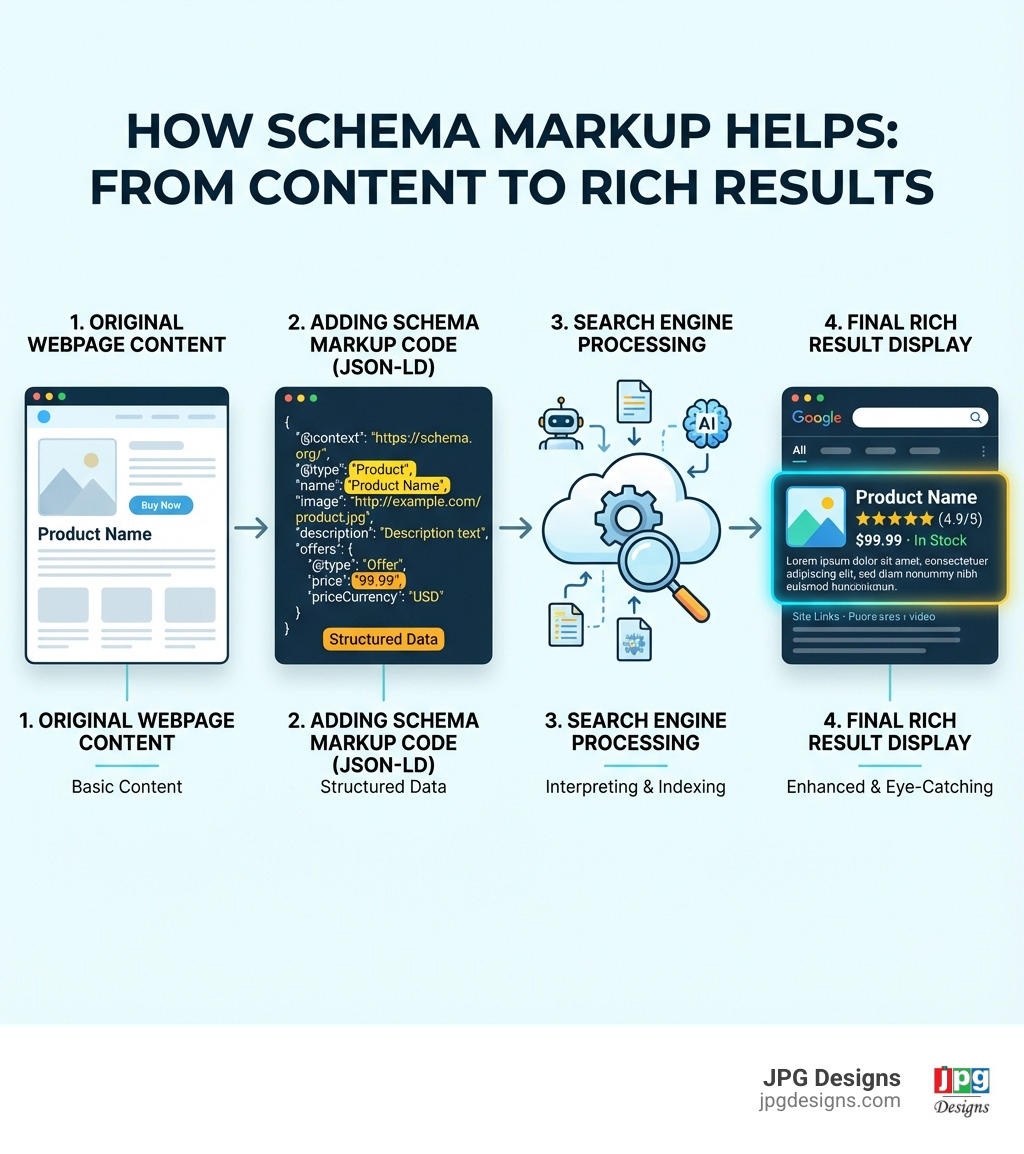
Basic how schema markup helps? terms:
Why Your Website is Invisible and How Schema Markup Helps?
Imagine your website as a beautifully written book. Without schema markup, search engines are like librarians who can see the cover and read the title, but struggle to understand the specific plot points, characters, or key takeaways inside. Your valuable content might be there, but it’s getting lost in the vast digital library because search engines can’t fully grasp its context. This is a common pain point for many businesses – investing time and resources into a website only to find it invisible to potential customers.
How schema markup helps is by acting as a universal translator, providing explicit signals about your content. It’s a form of structured data that helps search engines and AI systems understand the content of your website. By embedding schema code in your site’s HTML, you provide additional context about your content, such as its subject, featured entities, and data types. This structured data makes your content machine-readable, which is becoming increasingly critical in an AI-driven world.
Consider the word “Apple.” To a human, context usually clarifies if you mean the fruit or the tech giant. But for a machine, it’s ambiguous. Schema markup eliminates this ambiguity by labeling the entity explicitly. If your page is about the company, you can use Organization schema to tell search engines precisely that. This level of clarity is vital for your website to be truly “AI-ready.”

The rise of AI in search means that clarity isn’t just a bonus; it’s a necessity. AI searches are up a whopping 357% year over year, highlighting the urgent need for websites to communicate effectively with these advanced systems. Without schema markup, your content risks being overlooked or misunderstood by the very systems that are increasingly shaping how users find information.
For more insights into how we optimize websites for digital visibility, explore our digital marketing services.
The Direct Impact on Search Engine and AI Comprehension
Schema markup provides content context and semantic understanding, which are foundational for how modern search engines and AI interpret information. While Large Language Models (LLMs) can attempt to understand content without schema, having it properly configured significantly improves their comprehension. This is because machine learning and structured data go hand in hand, allowing algorithms to present users with content that better aligns with their search intent.
Google’s Knowledge Graph, which powers many of its advanced search features, relies heavily on structured data. As AI Overviews become more prevalent, the ability of AI agents like Bard and ChatGPT to accurately summarize and cite your content hinges on how well your website provides explicit, structured information. Schema markup provides the clarity and precision these AI systems need to interpret and act on web content, ensuring your site is considered for inclusion and citation in AI-generated answers.
From Blue Links to Rich Results: Enhancing Your SERP Appearance
Perhaps one of the most immediate and visible benefits of schema markup is its ability to transform your search engine results page (SERP) appearance. Gone are the days when a simple blue link was enough to grab attention. Today, rich results derived from schema markup offer a visual feast of information, making your listing significantly more appealing.
Rich results include additional information that is valuable to potential consumers, such as ratings, prices, operating hours, event dates, and images. This visual improvement helps your listing stand out from competitors, building user trust and encouraging clicks. For instance, a product listing might show star ratings and pricing directly in the search result, or a recipe might display cook time and ingredients. This pre-qualifies users, as they can see key information at a glance, increasing the likelihood that those who click are genuinely interested.
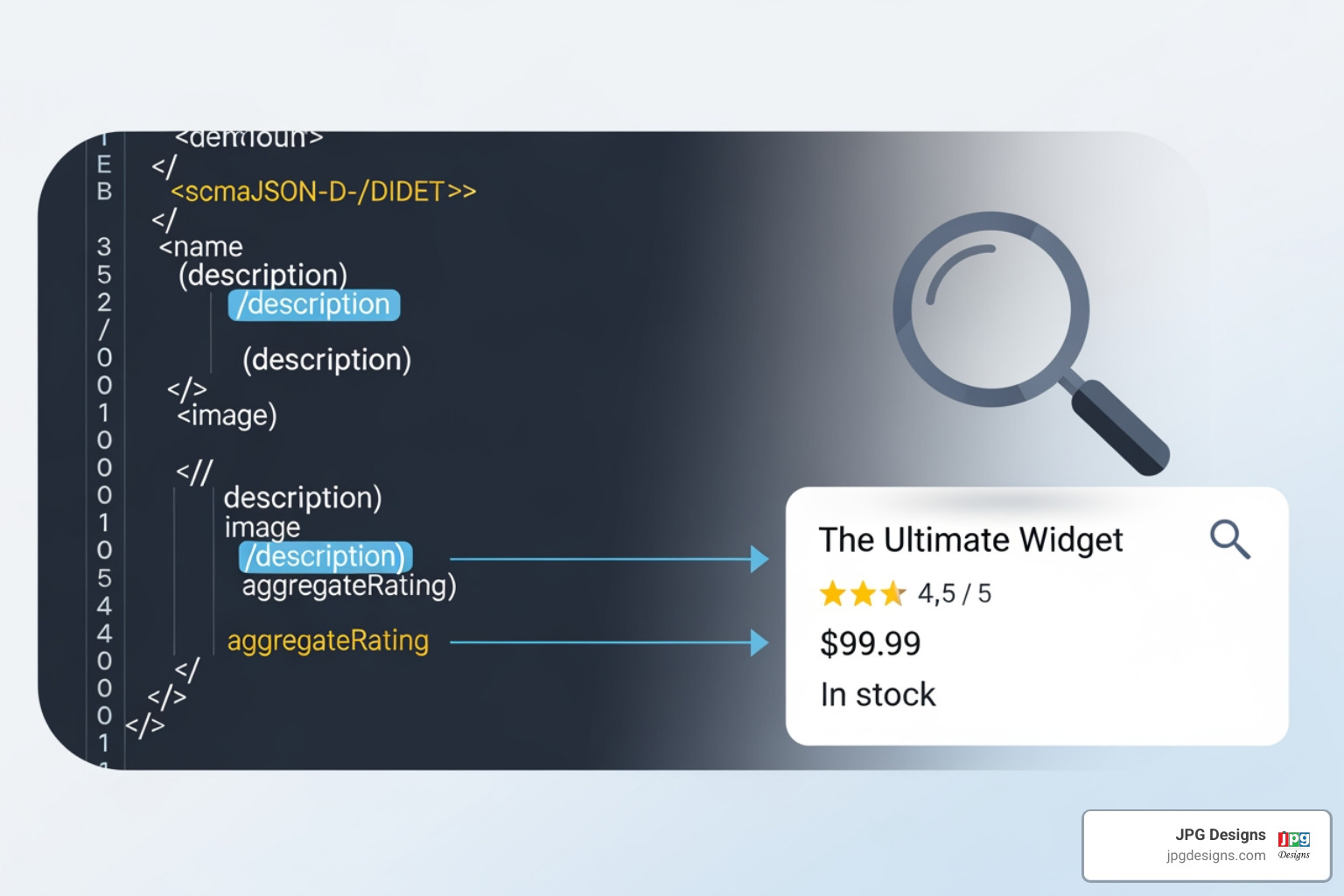
The statistics are compelling: rich results derived from schema markup receive 58% of user clicks compared to just 41% for non-rich results. This significant difference underscores the power of improved SERP appearance in driving traffic to your site.
Boost Your SEO: The Tangible Benefits of Schema Markup
The ultimate goal of SEO is to increase visibility and drive qualified traffic to your website. How schema markup helps achieve this is through a combination of direct and indirect benefits that significantly impact your bottom line.
One of the most tangible benefits is the increased Click-Through Rate (CTR). Websites with schema have been shown to have, in some cases, an 82% higher click-through rate compared to websites that don’t use schema markup. BlueTone Media reported that websites using schema markup have encountered a 40% boost in CTR. This isn’t just about vanity metrics; higher CTR signals to search engines that your result is highly relevant, potentially leading to improved rankings over time.
Schema markup also contributes to improved search visibility. By providing clear context, search engines are better equipped to match your content with relevant user queries, including complex or long-tail searches. This means your website is more likely to appear for a wider range of searches, putting your business in front of more potential customers.
For businesses in Rhode Island and Massachusetts, schema markup offers a crucial local SEO boost. Appearing in the top spots of Google’s Local Pack or map listings can make or break a local business. Implementing LocalBusiness schema, for example, helps search engines display your name, address, phone number, business hours, and customer reviews directly in local search results, making it easier for nearby customers to find and choose you. This is particularly important given that 92% of searchers pick businesses on the first page of local search results.
Schema markup provides a significant competitive advantage. When your competitors’ listings are plain blue links and yours is a vibrant rich snippet showcasing ratings, prices, or event details, you immediately stand out. This can lead to more clicks, more traffic, and ultimately, more conversions.
We’ve seen real-world examples of businesses benefiting immensely:
- Rakuten recipe pages saw 2.7x more traffic from search engines, while average session duration was 1.5x longer after implementing recipe schema.
- Jobrapido saw increases in several metrics, including a 182% boost in organic traffic. The firm also saw a 395% increase in new user registrations from organic traffic, and a lower bounce rate from Google visitors to job pages.
- Eventbrite believes that it has seen a 100% increase in year-over-year growth of traffic from Google Search to event listing pages after using Event schema.
These success stories are not outliers; they demonstrate the powerful impact structured data can have. We’ve helped many of our clients in Rhode Island and Massachusetts achieve similar growth by leveraging schema markup effectively. Read more about our client achievements in our success stories.
Getting Started: Key Schema Types and How to Implement Them
With over 800 types of schema markup available on Schema.org, it might seem overwhelming to know where to start. However, a few essential types are particularly impactful for most businesses:
- Organization Schema: This is foundational for any business, providing structured data for key details such as your company’s name, logo, official URL, and contact information. It helps search engines understand the primary entity behind your website.
- LocalBusiness Schema: Crucial for local businesses in Rhode Island and Massachusetts, this type (a subtype of
OrganizationandPlace) provides details like address, phone number, operating hours, payment methods, and geographic coordinates. It’s vital for appearing in local search results and map listings. - Product Schema: For e-commerce sites, this schema marks up details about products, including name, image, description, price, availability, and customer reviews. It makes your products eligible for rich results like product carousels.
- Article/BlogPosting Schema: Ideal for informational content, this schema describes articles, blog posts, and news pieces with properties like headline, author, publication date, and image. It helps your content appear in “Top stories” or news carousels.
- FAQ Schema: If your website has a Frequently Asked Questions page, this schema allows you to mark up questions and their answers, making them eligible to appear directly in search results as expandable snippets.
- Review/AggregateRating Schema: This schema allows you to display star ratings and review counts for products, services, or local businesses directly in search results, significantly boosting credibility and CTR.
- Event Schema: For businesses hosting events, this schema marks up event details such as name, date, time, location, and ticket information, making your events findable in event listings.
- Recipe Schema: For food-related websites, this schema provides details like ingredients, cooking instructions, preparation time, and nutritional information, allowing recipes to appear in specialized rich results.
How schema markup helps different business models:
- For local service businesses (e.g., plumbers, landscapers in Rhode Island or Massachusetts),
LocalBusinessschema is paramount. It ensures your operational details are clear, driving local traffic and calls.Reviewschema also builds trust. - For e-commerce businesses,
ProductandOfferschema are essential. They display prices, availability, and reviews, directly impacting purchasing decisions.FAQschema can also address common customer queries upfront. - For content-driven websites (blogs, news sites),
ArticleandFAQschema boost visibility and engagement. They help your content stand out and provide direct answers to user questions.
A 5-Step Guide to Implementing Schema Markup
Implementing schema markup might sound technical, but with the right approach, it’s a straightforward process. Here’s our 5-step guide:
- Identify Content and Choose Schema Types from Schema.org: The first step is to review your webpages and identify what schemas you will need to implement. Look through Schema.org to decide what types of schemas apply to your content. For instance, if you have a product page, you’ll need
Productschema. If you have an “About Us” page, considerOrganizationorLocalBusiness. - Generate the Markup (JSON-LD): While there are older formats like Microdata and RDFa, JSON-LD is the format recommended by Google due to its ease of implementation and readability. You can generate JSON-LD code manually, using helper tools, or with plugins.
- Add the Code to Your Website: JSON-LD schema markup is implemented directly in the page source code, typically within