Inspiring Designs: How to Build a Powerful Website for Your Charity
Why Your Charity’s Website Matters More Than Ever
Website design for charities is about more than aesthetics–it’s about creating a digital platform that solves real problems your nonprofit faces every day: low supporter engagement, high bounce rates, confusing donation flows, and limited visibility for your mission.
Many organizations come to JPG Designs because:
- Visitors land on their site and leave within seconds
- Supporters say they “meant to donate” but got lost or frustrated
- Their mission and impact are buried under cluttered content
- The site looks dated or breaks on mobile devices
A strategic, modern website directly addresses these pain points by building trust, telling your story clearly, and converting visitors into supporters. Here are the core elements every effective nonprofit website needs:
- Clear Mission Statement: Immediately communicate your purpose and impact
- Strategic Calls-to-Action: Guide visitors toward donating, volunteering, or engaging
- Compelling Storytelling: Share authentic stories that connect emotionally with supporters
- Accessible Design: Ensure everyone can access and steer your site (WCAG Level AA compliance)
- Simple Donation Process: Remove friction with streamlined forms and multiple payment options
- Trust Signals: Display financial transparency, partner logos, and impact metrics
- Mobile-First Design: Optimize for over half of users browsing on phones
If you’re considering a website redesign, you’re not alone. Recent industry reports show that a majority of nonprofits (around 68%) have redesigned their websites in recent years, according to the most recent Nonprofit Tech for Good report. There’s a reason for this urgency: nonprofit websites currently face higher bounce rates (around 60%) compared to general websites (around 40%), meaning visitors leave quickly if they don’t immediately connect with what they see.
The stakes are high. Your website is often the first–and sometimes only–impression potential donors, volunteers, and beneficiaries have of your organization. A poorly designed site doesn’t just cost you traffic; it costs you donations, volunteer hours, and the opportunity to expand your mission’s reach.
The good news? You don’t need a massive budget to create an impactful website. You need strategy, clarity, and an understanding of what makes charity websites work. The best nonprofit sites share common traits: they make visitors feel something, they make taking action easy, and they prove their impact is real.
I’m Jeff Pratt, owner of JPG Designs, and I’ve spent over 16 years helping nonprofits, educational organizations, and community groups build websites that drive real results through strategic website design for charities. My team and I understand that your website isn’t just a digital brochure–it’s a fundraising tool, a volunteer recruitment platform, and the heart of your online presence.
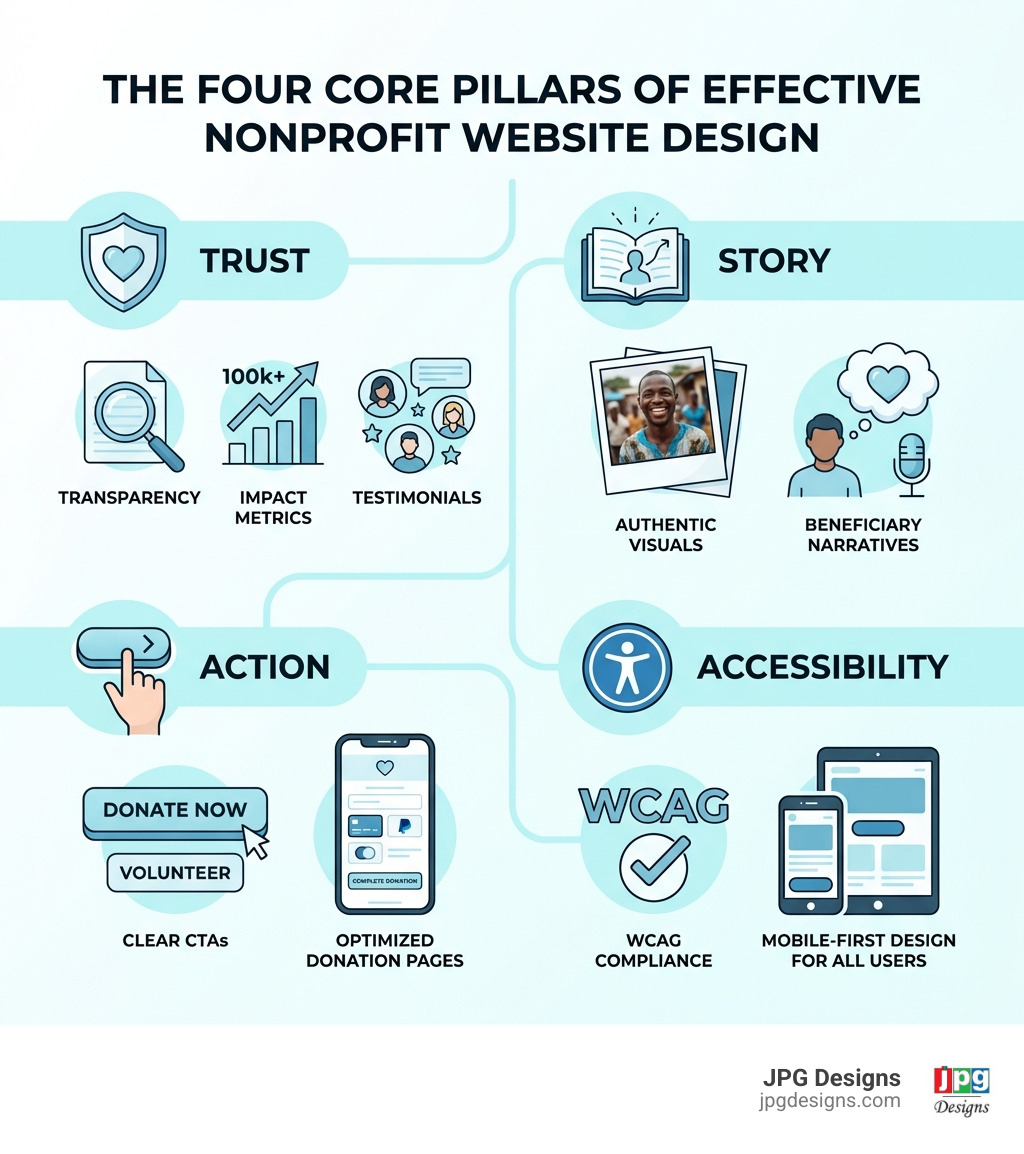
At JPG Designs, we build charity websites around four core pillars: Trust, Story, Action, and Accessibility. When these elements work together, your site becomes a powerful engine for donations, advocacy, and long-term supporter relationships.
The Foundation: Essential Elements of an Impactful Charity Website
An impactful nonprofit website serves as your organization’s digital headquarters, a place where your mission comes to life and your supporters find clear next steps. Many charities in Rhode Island, Massachusetts, and beyond struggle with the same foundational issues: vague messaging, inconsistent branding, and buried impact stories. These problems confuse visitors and weaken trust.
For our team at JPG Designs, the essential elements of an impactful nonprofit website begin with a crystal-clear mission statement that immediately communicates your purpose. Think of it as your digital elevator pitch that answers your visitor’s core question: “What do you do, and why does it matter?”
Beyond that, consistent branding across every page builds recognition and trust. We want visitors to connect emotionally with your cause, and that happens through powerful storytelling and genuine trust signals that directly address donor concerns about transparency and impact. Showing your impact through transparent reporting isn’t just good practice; it’s essential for building credibility and overcoming skepticism.
When we design for nonprofits, we focus on weaving these elements together to create a cohesive and compelling online experience that removes friction for donors and volunteers. You can explore more about our approach to impactful design in our Design for Nonprofits: Complete Guide.
For instance, the Equal Opportunity Community Initiative (EOCI) uses a seamless branded donation page and engaging photos of their work to connect with supporters. The California Wellness Foundation exemplifies powerful branding and a clear mission statement, setting a standard for how nonprofits can present their offerings to the community. These organizations demonstrate that a strong brand identity, coupled with a clear purpose, forms the bedrock of an effective website design for charities.
Crafting Your Narrative: Storytelling in website design for charities
How can a nonprofit website effectively tell its story and connect with supporters? The answer lies in authentic, human-centered storytelling that speaks directly to what your donors and beneficiaries care about. People are moved by people, not just statistics. We encourage using authentic visuals, such as high-quality photos of beneficiaries, volunteers, and the communities you serve, rather than stock imagery. These visuals, combined with compelling beneficiary stories and success stories, create an emotional connection that resonates deeply with visitors.
Consider Habitat for Humanity, which powerfully engages site visitors with an uplifting story of building strength, stability, and self-reliance through shelter. This isn’t just about building houses; it’s about changing lives and solving the concrete problem of unsafe or unstable housing. Similarly, the Michael J. Fox Foundation tells a hopeful story, inviting users to “Celebrate Science” from their homepage hero, inspiring action through optimism.
We also advocate for donor-centric language that highlights the supporter’s role in creating change. Instead of “we helped,” try “your support helped.” This simple shift answers a key donor question: “What difference does my gift make?” Video testimonials can be incredibly powerful, putting a face and voice to your mission’s impact. The Gakino’amaage: Teach for Canada website, for example, brings teacher and community stories to life through engaging videos, testimonials, and a blog, painting a clear picture of their work.
Your website should be a living testament to your mission, continuously updated with fresh, mission-driven content that reassures visitors their support is still needed and still effective. For more inspiration on impactful storytelling, take a look at Habitat for Humanity’s storytelling approach.
Building Trust and Showcasing Your Impact
Building trust is paramount for any charity. Potential donors and volunteers want to know their contributions are making a real difference and not being wasted. This is why financial transparency is non-negotiable. Clearly displaying annual reports, audited financials, and how funds are allocated builds confidence and reduces hesitation to give.
For example, charity: water famously states that 100% of public donations directly fund clean water projects, with operational expenses covered by a separate group of philanthropists, and they even provide GPS coordinates and photos to prove every project. This level of transparency is inspiring.
Beyond financials, showcasing your impact is critical. This can be done through real-time impact statistics, before-and-after stories, and testimonials from those whose lives have been touched by your work. Partner logos, indicating collaborations with reputable organizations, also serve as strong trust signals. The END Fund, dedicated to addressing neglected tropical diseases, places a major focus on its impact, with plenty of statistics related to its cause and programs, effectively building trust through demonstrated results.
We believe that by prominently featuring your achievements and being open about your operations, your charity website can effectively showcase its impact and build trust with potential donors and volunteers. This is central to how JPG Designs approaches website design for charities. Explore how organizations like The END Fund focus on accountability.
Driving Action: Best Practices for Engagement and Donations
Your charity’s website isn’t just an information hub; it’s a powerful tool for inspiring action and solving key growth challenges like flat donations, low volunteer sign-ups, and underused programs. The ultimate goal for many nonprofits is to convert visitors into active supporters, whether through donations, volunteering, or advocacy. This requires a strategic approach to calls-to-action (CTAs), an optimized donation page, and clear user journeys that remove confusion and unnecessary steps.
We ensure that every element of your website design for charities guides visitors smoothly towards engagement.
Consider the user journey. The Boys & Girls Clubs of America provides a clear starting point right from their homepage, with a drop-down menu catering to parents, teens, supporters, and educators. Similarly, Feeding America offers straightforward user journeys for donors, volunteers, and advocates. This thoughtful segmentation ensures that different audience segments can quickly find the information most relevant to them, leading to higher engagement and fewer abandoned visits.
Mobile optimization is also crucial here, as over half of all website traffic comes from mobile devices. A seamless experience on smartphones and tablets means more completed donations and sign-ups and fewer frustrated visitors bouncing away. For a deeper dive into optimizing your donation process, refer to a guide to inspirational donation pages.
Designing High-Converting Calls-to-Action (CTAs)
What are the best practices for calls-to-action (CTAs) on nonprofit websites? Effective CTAs are clear, compelling, and strategically placed so visitors never have to wonder, “What should I do next?” They use action-oriented language like “Donate Now,” “Volunteer Today,” or “Join Our Cause.” We recommend using contrasting colors to make CTAs stand out against the rest of your website’s design, ensuring they catch the visitor’s eye.
Strategic placement is key–CTAs should be visible above the fold on your homepage, within relevant content sections, and prominently featured on your navigation bar. Mercy Corps, a global humanitarian organization, effectively uses multiple CTAs, including a compelling matching gift page that encourages visitors to double their impact. This not only drives donations but also provides a clear pathway for supporters to maximize their contribution.
A/B testing different CTA texts, colors, and placements can help you find what resonates most with your audience. Sometimes, adding a touch of urgency (“Donate Before [Date]”) can also boost conversion rates, but use this sparingly and authentically. The key is to make it easy and obvious for supporters to take the next step and to align every CTA with a specific supporter need or intent.
Creating a Seamless and Compelling Donation Experience
A convenient and compelling donation page is arguably the most critical component of your charity’s website. It’s where your mission translates into tangible support, and it’s also where many nonprofits lose potential donors because of long forms, confusing layouts, or limited payment options.
We focus on designing simple forms with minimal steps to reduce friction. The fewer clicks and fields required, the higher the completion rate. Clear progress indicators and friendly error messages also help prevent frustration.
Offering options to turn one-time gifts into recurring donations (e.g., monthly giving) is a powerful strategy for sustained support. Glacier Conservancy’s website, for example, features a variety of ways to give, from direct donations to purchasing items in an online store, making it easy for supporters to contribute in a way that suits them.
We also integrate suggested donation amounts tied to specific impacts (e.g., “$50 provides a week of meals for a family”). This helps donors visualize how their contribution makes a difference and answers the common question, “Is my gift big enough to matter?” Multiple payment options (credit card, PayPal, Apple Pay, etc.) and prominent security badges reassure donors that their information is safe.
As mentioned earlier, charity: water’s 100% model, where all public donations go directly to projects, sets a high bar for transparency, fostering deep trust and encouraging generosity. They even highlight that “703 million people lack basic access to clean and safe drinking water,” powerfully framing the scale of the need and the life-saving impact of access to clean water.
Inclusive & Accessible: Critical Considerations for Website Design for Charities
Many nonprofits unintentionally exclude potential supporters and beneficiaries because their websites are hard to read, difficult to steer with assistive technology, or unusable on mobile devices. Why is website accessibility crucial for nonprofits, and how can it be achieved? Beyond being a moral imperative, website accessibility is often a legal requirement.
In the United States, regulations like the Americans with Disabilities Act (ADA) require websites to be accessible to all visitors, regardless of their abilities. Failing to meet these standards can lead to legal challenges, but more importantly, it means excluding potential supporters and beneficiaries who want to engage with your mission but cannot.
We ensure our website design for charities adheres to the Web Content Accessibility Guidelines (WCAG) Level AA standards. This means focusing on elements like alternative text for all images and multimedia, ensuring sufficient color contrast for readability, and making forms fully accessible with descriptive labels. St. Jude Children’s Research Hospital, for instance, offers website translation into Spanish with just one click, making their site accessible to a broader audience.
Mobile-first design is also an integral part of accessibility, ensuring your site functions flawlessly on smartphones and tablets, which many users rely on. Our approach to website design for charities prioritizes inclusivity from the ground up so that no interested supporter is turned away by technical barriers.
Why Website Accessibility is Crucial for Nonprofits
Accessibility isn’t just a checkbox; it’s a reflection of your organization’s values and a direct response to the diverse needs of your community. Nonprofits serve diverse populations, and their websites should embody that inclusivity. An accessible website ensures that everyone, including individuals with visual, auditory, cognitive, or motor impairments, can access your information, understand your mission, and engage with your calls to action.
The California Wellness Foundation’s website is a prime example of high accessibility, conforming to Level AA standards of the WCAG. Features like alternative text for images, sufficient color contrast, and logical headings create a user-friendly experience for all. By embracing accessibility, your nonprofit not only complies with legal mandates like the Americans with Disabilities Act (ADA) compliance but also broadens its reach, strengthens its reputation, and truly lives its mission of serving all.
The Boys & Girls Clubs of America, with their audience-specific navigation for parents, teens, supporters, and educators, also demonstrates how considering diverse user needs improves overall accessibility and helps visitors find what they need without frustration.
Catering to Different Audiences on Your Website
Nonprofits often have multiple audience segments: donors, volunteers, beneficiaries, corporate partners, media, and even job seekers. A truly effective charity website anticipates the needs of each group and provides clear, intuitive pathways for them to find relevant information, reducing confusion and support requests.
This involves thoughtful audience segmentation in your website’s structure and content. For example, the Boys & Girls Clubs of America effectively uses a drop-down menu on their homepage to guide different user types–parents, teens, supporters, and educators–to their specific content. Feeding America similarly provides straightforward user journeys for donors, volunteers, and advocates.
We recommend developing user personas for each key audience segment to understand their motivations, questions, and desired actions. This allows us to tailor content and navigation, ensuring that a potential donor isn’t sifting through volunteer handbooks and vice-versa. Our web design services for non-profit organizations focus on creating these clear and effective user experiences so that every visitor quickly finds a path that fits their needs.
Strategy & Growth: Measuring Success and Overcoming Challenges
Developing a robust nonprofit web design strategy is fundamental to your organization’s long-term digital success. Many nonprofits face common challenges, such as budget constraints, limited in-house resources, outdated technology, and a lack of clarity around what to measure. However, with careful planning and a clear vision, these problems can be overcome.
We work with our clients in Rhode Island and Massachusetts to establish clear goals from the outset, whether it’s increasing online donations, recruiting more volunteers, or raising awareness for a specific campaign. By aligning your website with concrete goals, you can prioritize features and content that deliver the greatest impact for your budget.
Measuring the success of your website design and digital marketing efforts is crucial for demonstrating return on investment (ROI) and informing future strategies. Without clear metrics, you’re essentially flying blind and may continue investing in pages or campaigns that are not working.
We help our clients identify key performance indicators (KPIs) and set up tracking to monitor progress.
Boosting Visibility: SEO in website design for charities
How can nonprofit websites be optimized for search engines (SEO) to increase visibility? SEO for nonprofits is about ensuring your website appears prominently when people search for causes, services, or ways to get involved that relate to your mission. This helps solve a common challenge: “People in our community don’t know we exist.”
This starts with thorough keyword research to identify the terms your target audiences are using. On-page SEO involves optimizing your website’s content, titles, and meta descriptions with these keywords. Local SEO is particularly important for community-based charities, helping people in Rhode Island and Massachusetts find your local services and events.
Developing a strong content strategy, regularly publishing valuable and relevant articles or stories, also plays a significant role. For instance, Glacier Conservancy strategically uses Google Ads, leveraging the Google Ad Grant program to drive traffic to their site by targeting keywords related to their cause. This is a powerful way for nonprofits to increase their visibility without a large paid advertising budget.
Learn more about how to improve your online presence with our comprehensive guide to SEO for Nonprofits.
Measuring Your Website’s Success
To truly understand if your website design for charities is effective, you need to measure its performance. We rely on tools like Google Analytics to track crucial metrics and reveal where visitors may be dropping off or getting stuck.
This includes monitoring your website’s bounce rate (the percentage of visitors who leave after viewing only one page)–remembering that nonprofit websites currently face a higher average bounce rate of 60% compared to general websites at 40%. A lower bounce rate often indicates a more engaging user experience.
We also track conversion rates for key actions, such as completed donations, volunteer sign-ups, and newsletter subscriptions. For example, we’ve helped nonprofit clients increase page views per session by 37%, indicating greater engagement.
Other important metrics include time on page (how long visitors spend on specific content), donation form abandonment rate (how many start but don’t finish a donation), and tracking the success of specific campaigns. Using heatmaps can also reveal where users click and scroll, providing valuable insights into their behavior and identifying areas for improvement.
Regular analysis of these metrics allows us to continuously refine your website for optimal performance and to make data-driven decisions about design updates, campaigns, and content priorities.
Conclusion
The digital landscape is constantly evolving, but the core principles of effective website design for charities remain steadfast: trust, compelling storytelling, clear calls to action, and unwavering accessibility. When these elements are missing, nonprofits feel the effects through low donations, poor engagement, and confusion about their mission.
Your website is more than just a digital brochure; it’s a dynamic tool that can inspire action, build a vibrant community, and ultimately help you fulfill your vital mission. A strategic site reduces friction for donors and volunteers, highlights your real-world impact, and makes it easy for supporters to stay connected over time.
We understand the unique challenges and incredible opportunities that nonprofits face in the digital field. Our expertise in mobile-first design and improving Google rankings, custom for organizations in Rhode Island and Massachusetts, ensures that your message reaches the right people at the right time. Our clients trust us because we dig deep into understanding their audiences and consistently deliver healthy, high-performing websites.
Don’t let an outdated or ineffective website hinder your noble work. Partnering with a professional web design agency like JPG Designs can provide the strategic vision, technical expertise, and ongoing support needed to create an online presence that truly makes a difference.
Let us help you address common pain points–from high bounce rates to underperforming donation pages–and transform them into strengths. Explore how we can help you with our Non-Profit Organization services.