

Why Advanced Social Media Marketing Is the Growth Engine Your Business Is Missing
Advanced social media marketing goes far beyond posting content and hoping for likes. It’s a data-driven, AI-powered system that turns social platforms into real revenue channels.
Here’s a quick snapshot of what separates advanced strategies from basic ones:
| Basic Social Media | Advanced Social Media Marketing |
|---|---|
| Post and hope | SMART goals tied to business outcomes |
| One-size-fits-all content | AI-powered micro-segmentation |
| Manual scheduling | Predictive posting with dynamic timing |
| Vanity metrics (likes, followers) | ROI, lead attribution, conversion tracking |
| Single platform focus | Cross-platform content orchestration |
| Reactive to trends | Sentiment analysis and crisis response |
The numbers tell a clear story. Organic reach has dropped nearly 62% in just three years. Meanwhile, businesses with a documented strategy are 414% more likely to report success. Yet only 29% of marketers have one written down.
The gap between businesses that show up on social media and those that grow because of it has never been wider. If your engagement is flat, your reach is shrinking, or you’re not sure what’s actually working — this guide is built for you.
I’m Jeff Pratt, owner of JPG Designs, a Rhode Island-based digital agency with over 15 years of experience helping businesses build revenue-producing digital systems — including advanced social media marketing strategies that connect directly to leads and sales. In the sections ahead, I’ll walk you through the exact frameworks, tools, and tactics we use to help clients stop guessing and start growing.
Similar topics to advanced social media marketing:
Mastering Advanced Social Media Marketing Frameworks
To succeed in the current landscape, we have to move past “winging it.” The foundation of any high-performing campaign is a documented strategy. Research shows that businesses that set measurable goals are 377% more likely to report success. At JPG Designs, we emphasize the SMART framework—Specific, Measurable, Achievable, Relevant, and Time-bound—to ensure every post serves a purpose.
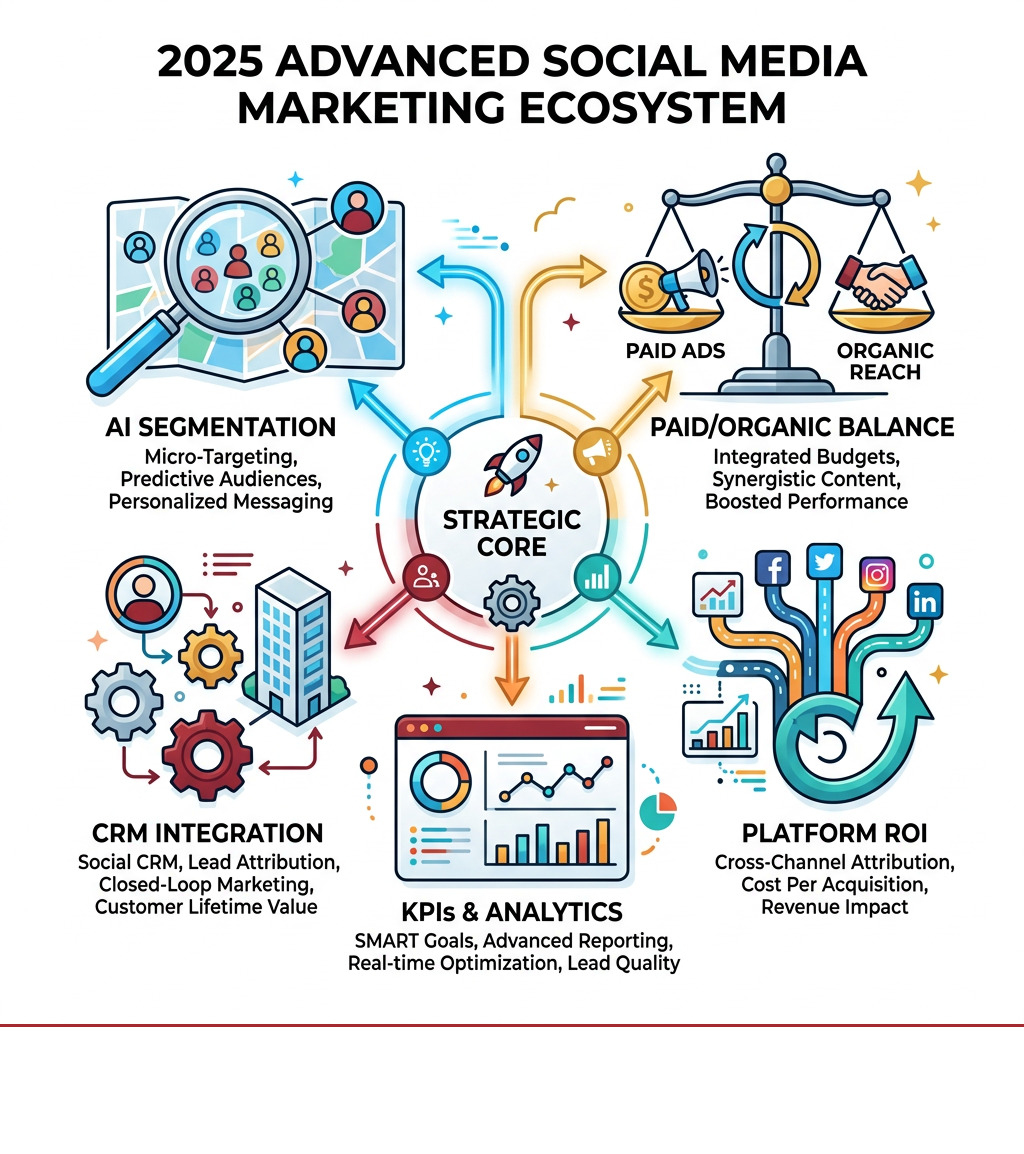
A critical component of modern strategy is the 70/20/10 budget rule. We recommend allocating 70% of your resources to proven tactics that drive consistent results, 20% to emerging trends or new platforms, and 10% to “moonshot” experimental ideas. This balance keeps your brand stable while ensuring you don’t get left behind as algorithms evolve. For those looking to dive deeper into the academic side of these methodologies, you can explore scientific research on advanced social media strategies to see how data-backed models outperform intuition every time.
Predictive AI and Advanced Social Media Marketing Orchestration
The most significant shift we’ve seen recently is the 180% year-over-year increase in AI adoption among marketers. We aren’t just talking about using ChatGPT to write a caption; advanced social media marketing now leverages predictive AI for “content orchestration.”
Instead of broad targeting, AI allows for micro-segmentation. While a human might identify three target personas, an AI model can identify 47 distinct micro-segments based on behavioral patterns. For instance, one segment might engage with video testimonials between 6 PM and 8 PM, while another prefers case studies during their morning commute.
By implementing these AI-driven workflows, businesses often see a 60-70% reduction in content production time. More importantly, tools now offer real-time sentiment analysis. This means we can detect a shift in public mood or a potential customer service crisis within minutes rather than hours, allowing for immediate engagement optimization.
Balancing Organic Engagement with Paid Advertising Precision
With organic reach in a tailspin, a “pay-to-play” element is now mandatory. However, advanced marketers don’t just throw money at the “Boost Post” button. We use Bayesian optimization and custom lookalike models to ensure every dollar works harder.
By feeding your first-party data into social platforms, we can create lookalike audiences that are 30-40% more likely to convert. The secret lies in the balance. Organic social is for community building and retention, while paid social is your engine for scale and acquisition.
We often see brands make the mistake of choosing one over the other. In reality, they are two sides of the same coin. You can read more info about organic and paid social media advertising to understand how to synchronize these two forces for maximum efficiency.
Scaling B2B and B2C ROI Through Platform-Specific Tactics
Not all platforms are created equal. In the current landscape, the ROI has shifted significantly depending on your business model. For our B2B clients in Rhode Island and Massachusetts, LinkedIn remains the undisputed heavyweight, accounting for roughly 80% of B2B social leads. Interestingly, employee-shared content on LinkedIn gets 8x more engagement than posts from a brand’s company page.
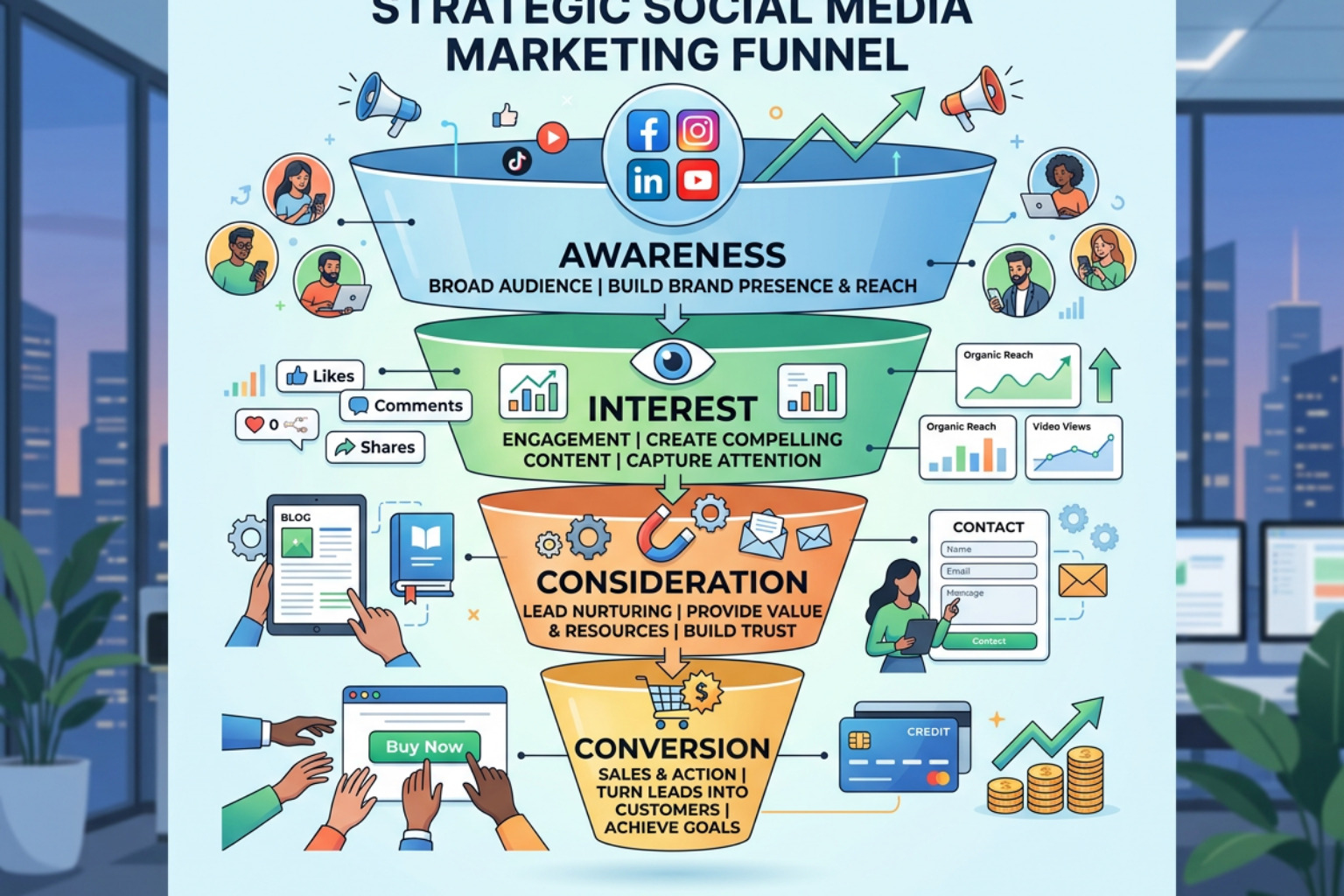
On the B2C side, TikTok continues to lead the pack with an average engagement rate of 3.70%. The power of video cannot be overstated: video content generates 1,200% more shares than text and image content combined. However, 85% of social videos are watched without sound, making captions a non-negotiable requirement.
| Platform | Primary Audience | Best Use Case | Average Engagement |
|---|---|---|---|
| Professionals/Decision Makers | B2B Lead Gen & Thought Leadership | 1.5% – 2% | |
| TikTok | Gen Z & Millennials | Brand Awareness & Viral Trends | 3.7% |
| Lifestyle/Visual Shoppers | Social Commerce & Community | 2% – 3% | |
| Broad Demographics | Local Services & Community Groups | 1% – 1.5% |
Integrating Social Ecosystems and Avoiding Expert Pitfalls
A common mistake in advanced social media marketing is treating social platforms as silos. To truly level up, your social strategy must be integrated with your broader marketing ecosystem, specifically your CRM and SEO efforts.
Advanced Social Media Marketing Integration with SEO and CRM
At JPG Designs, our USP is leveraging mobile-first indexing to improve Google rankings. Social media plays a massive role here. When your social content drives high-quality traffic to your site, it signals relevance to search engines. Furthermore, as “social search” becomes more prevalent, your profiles often rank on the first page of Google for your brand name.
By integrating social data with your CRM, you move from “vanity metrics” to “revenue metrics.” This allows for:
- Lead Attribution: Knowing exactly which LinkedIn post led to a $10,000 contract.
- Zero-Party Data: Using polls and quizzes on Instagram to gather customer preferences that go directly into your email marketing segments.
- Conversion Tracking: Using UTM parameters to see the exact path a customer took from a TikTok video to a website purchase.
You can find more info about brand engagement with social media management to see how we bridge the gap between social interactions and long-term customer loyalty.
Leveraging Micro-Influencers and Employee Advocacy for Scale
You don’t need a celebrity to go viral. In fact, nano-influencers (those with fewer than 10,000 followers) often see up to 10% more engagement than their mega-influencer counterparts. Why? Trust.
Currently, 62% of consumers emphasize that their purchases should reflect their personal values and identity. They want to buy from brands that stand for something, and they trust real people more than polished advertisements. This is why we advocate for employee advocacy programs. When your team shares your company’s story, it feels authentic and carries 8x the weight of a corporate post.
To scale this, define your content pillars—the 3 to 5 core topics your brand owns. This ensures consistency, which research shows can increase revenue by up to 23%. Whether you are a contractor in Warwick or a professional service firm in Boston, staying consistent with your pillars prevents your audience from getting “brand confusion.”
Conclusion: Future-Proofing Your Digital Presence with JPG Designs
The world of advanced social media marketing is moving fast. Between AI-powered orchestration, declining organic reach, and the necessity of mobile-first strategies, it’s easy for small to medium-sized businesses to feel overwhelmed.
That is where we come in. At JPG Designs, we don’t just build beautiful, mobile-first websites; we build digital growth engines. We understand the nuances of the Rhode Island and Massachusetts markets, and we know how to integrate social media with SEO to ensure you aren’t just getting “likes,” but you’re actually improving your Google rankings and bottom line.
If you are ready to stop “posting and praying” and start implementing a documented, high-ROI strategy, we are here to help. Level up your brand engagement with social media management by reaching out to our team today. Let’s turn your social presence into your most powerful sales tool.