
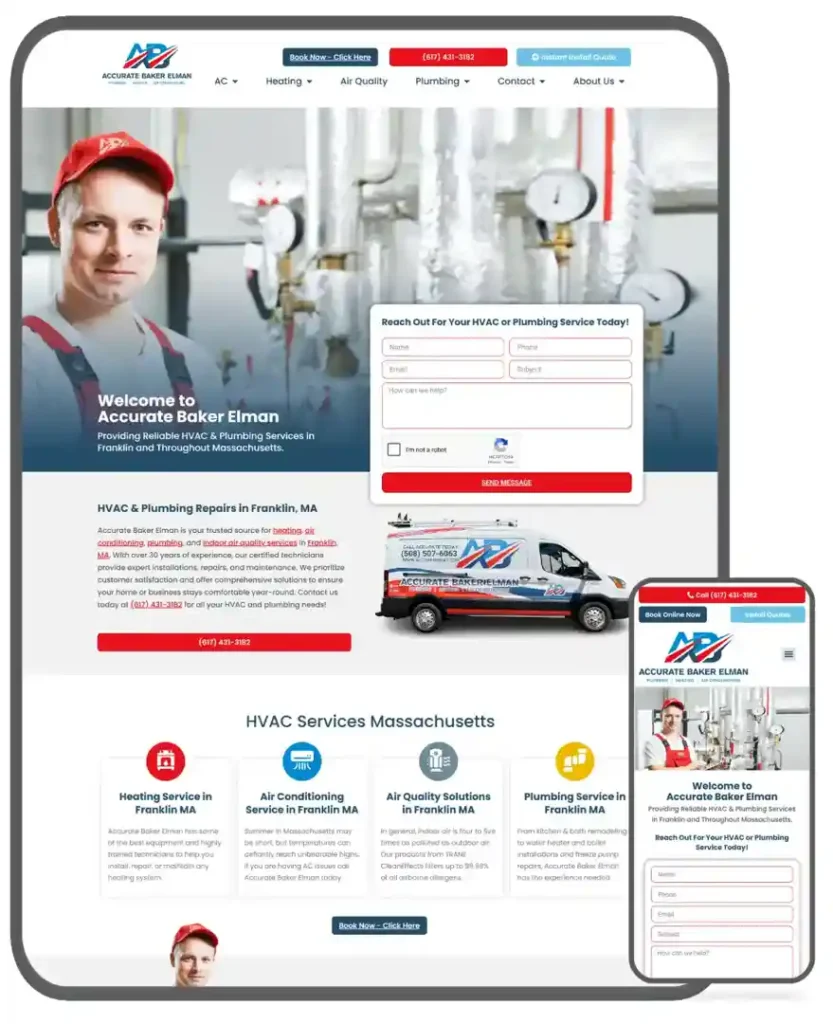
Why Your Plumbing Business Needs a Lead-Generating Website
Web design for plumbers is the foundation of a digital marketing system that turns online searches into booked jobs. If you’re evaluating companies to build or redesign your plumbing website, here’s what to prioritize:
What to Look for in a Plumber Website Design Company:
- Mobile-first responsive design – Over half of web traffic comes from mobile devices, especially during plumbing emergencies
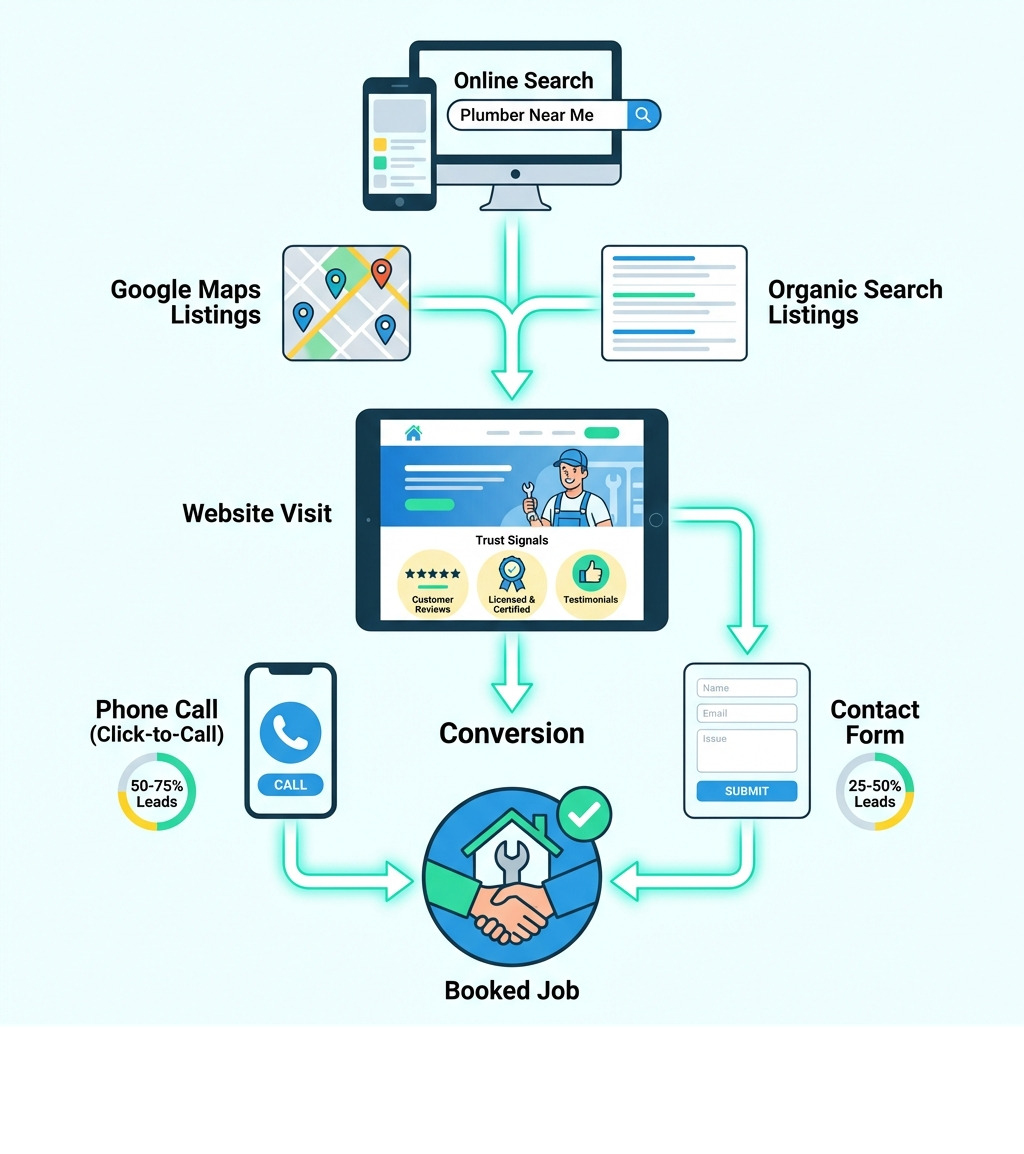
- Clear calls-to-action (CTAs) – Click-to-call buttons and contact forms that capture 50-75% of leads via phone and 25-50% via web forms
- Local SEO optimization – Service area pages, Google Business Profile integration, and keyword-rich content for “plumber near me” searches
- Fast loading speeds – Sites that load in under 3 seconds to prevent bounce rates from killing conversions
- Social proof integration – Reviews, testimonials, and before-after galleries (97% of consumers read reviews before choosing a service provider)
- Ongoing support and optimization – Monthly maintenance, security updates, and performance tracking
When a pipe bursts at 2 AM, homeowners don’t flip through the Yellow Pages anymore. They grab their phone and search “emergency plumber near me.” Your website isn’t just a digital brochure—it’s your 24/7 virtual sales representative. Research shows that 63% of consumers primarily use a company’s website to find and engage with businesses, while 30% won’t even consider a business without one.
The plumbing industry is unique. No single company owns more than 1% of the market, which means there’s massive opportunity for plumbers with a strong online presence. Companies that invest in professional web design have experienced up to 204% lead-generation growth, 70% improvement in client retention, and nearly 208% increase in total online conversion rate.
But here’s the challenge: most plumbing websites fail to convert visitors into paying customers. They’re either built on outdated templates, buried on page three of Google, or missing the trust signals that make homeowners comfortable inviting a stranger into their home during a crisis.
The good news? The right web design partner understands how plumbing businesses operate—from emergency service demands to local service area targeting to the balance between phone calls and online booking preferences (44% of people now prefer booking services online rather than over the phone).
I’m Jeff Pratt, owner of JPG Designs, and I’ve spent nearly two decades building high-converting websites for service-based businesses, with specialized expertise in web design for plumbers and home-service contractors who need lead-generation systems—not just pretty websites. This guide will show you exactly what separates a working plumbing website from one that’s just taking up digital space.
Web design for plumbers terminology:
Essential Features of High-Converting web design for plumbers
Creating a website that actually generates revenue requires more than just a list of services and a logo. In the plumbing industry, your website must act as a bridge between a high-stress problem and a reliable solution. To do this, it needs a conversion-driven layout that guides the user toward taking action immediately.
For plumbers in Rhode Island and Massachusetts, your competition is fierce. If a potential customer lands on your page and can’t find a phone number within two seconds, they’re going back to Google. High-converting web design for plumbers prioritizes “above the fold” information—this means your phone number, emergency availability, and a “Book Now” button should be visible without the user having to scroll.
User experience (UX) is the silent salesman. A clean, uncluttered design with professional typography and high-quality images of your actual team (not just stock photos of generic wrenches) builds immediate rapport. Furthermore, scientific research on consumer bounce rates indicates that as page load time goes from 1 second to 10 seconds, the probability of a mobile site visitor bouncing increases by 123%. In plumbing, a bounce isn’t just a lost click; it’s a lost service call.
Mobile-First Optimization and Fast Loading Speeds in web design for plumbers
We cannot overstate this: your website must be built for the phone first. According to scientific research on mobile-first indexing, Google now predominantly uses the mobile version of a site’s content for indexing and ranking. If your site looks great on a desktop but is a jumbled mess on an iPhone, Google will bury you.
The “3-second rule” is the gold standard for web design for plumbers. If your site takes longer than three seconds to load, you’ve likely lost the customer. This is especially true for emergency calls. A homeowner with a flooded basement doesn’t have the patience for heavy video backgrounds or unoptimized images to load.
Key mobile features include:
- Click-to-Call Buttons: Large, thumb-friendly buttons that initiate a call instantly.
- Sticky Navigation: A menu or “Call Now” bar that stays at the top of the screen as the user scrolls.
- Simplified Forms: Minimal fields to make it easy to request a quote on a small screen.
For a deeper dive into these technical requirements, check out our more info about plumbing website design.
Building Trust Through Social Proof and Local SEO
Plumbing is a trust-based business. You are entering people’s private homes, often when they are at their most vulnerable. Your website must communicate “You can trust us” through every pixel. This is where social proof comes in.
Essential trust signals for your website include:
- Google Review Snippets: Real-time reviews with star ratings.
- Industry Certifications: Logos for Master Plumber licenses, BBB accreditation, or local trade associations.
- Before-and-After Photos: Visual proof of your craftsmanship, such as a beautifully installed water heater or a cleared sewer line.
- Real Team Photos: Showing your branded vans and uniformed technicians humanizes your brand.
Beyond trust, you need visibility. Scientific research on local pack rankings shows that Google’s “Local Pack” (the map results) is the most valuable real estate on the internet for plumbers. To win here, your web design for plumbers must include dedicated service area pages. If you serve Providence, Warwick, and Cranston, you need specific landing pages for each city to signal to Google that you are the local authority. Explore our more info about SEO for plumbers to learn how we dominate local search.
Strategic Navigation and Lead Capture Tools
How should a plumbing website be structured? It should be intuitive. A visitor should never wonder where to find your drain cleaning service or your contact page. We recommend a “Service-First” navigation style where your main offerings are categorized clearly.
When it comes to capturing leads, you need a multi-pronged approach. While phone calls are king, digital preferences are shifting.
| Lead Type | Percentage of Leads | Best Use Case |
|---|---|---|
| Phone Calls | 50% – 75% | Emergency repairs, immediate questions, elderly clientele. |
| Web Forms | 25% – 50% | Non-urgent quotes, scheduling maintenance, after-hours inquiries. |
Scientific research on online booking preferences highlights that 44% of consumers actually prefer to book a technician online. Integrating a live booking tool or a simple “Request a Quote” form can capture the segment of the market that doesn’t want to spend time on the phone. For more strategy on this, see our more info about plumber marketing plans.
Selecting the Right Partner for Your Plumbing Business Growth
Choosing a web design agency is a lot like a homeowner choosing a plumber. You want someone who knows the “piping” of the internet, offers transparent pricing, and doesn’t leave a mess behind. A professional layout vs. a cluttered, DIY template can be the difference between a $500 water heater repair and a $15,000 whole-home repipe.
Your brand identity should be consistent. Whether you’re a one-man shop or a multi-van operation in Massachusetts, your website should reflect your professionalism. This includes using a cohesive color scheme (blues and greens are popular for their association with water and cleanliness) and professional logos.
Technical sophistication also matters. Scientific research on structured data explains that adding specific code (schema markup) to your site helps search engines understand your business hours, service area, and reviews, which can lead to “rich snippets” in search results that make your listing stand out.
Avoiding Common Pitfalls in web design for plumbers
Many plumbers fall into the trap of “set it and forget it.” A website is a living asset, not a one-time expense. Avoid these common mistakes:
- Overusing Stock Photos: Customers can tell when a photo isn’t yours. Use real photos of your work in Rhode Island to build genuine trust.
- Hidden Pricing or Fees: While you can’t always give an exact quote online, being transparent about your dispatch fees or offering “starting at” prices can reduce friction.
- Ignoring Data Security: With scientific research on data breaches making headlines, customers are wary. Ensure your site has an SSL certificate (HTTPS) to protect their contact information.
- Slow Response Times: If you have a contact form but don’t check your email, you’re killing your ROI.
For a breakdown of what you should expect to invest, read our more info about plumber website costs.
Measuring Success and Lead Generation ROI
If you can’t measure it, you can’t improve it. Every plumbing website we build is integrated with Google Analytics and conversion tracking. You need to know:
- Where are your visitors coming from? (Google Search, Facebook, or direct?)
- What is your bounce rate? (Are people leaving immediately?)
- What is your conversion rate? (How many visitors turn into callers?)
Optimization is an ongoing process. By tracking which pages perform best, we can tweak your CTAs and content to drive more leads. This data-driven approach is also vital for more info about plumber email marketing, allowing you to remarket to existing customers for annual maintenance checks.
Why Specialized Expertise Matters for Long-Term Growth
At JPG Designs, we don’t just build “pretty” websites. We build lead-generation machines specifically for the plumbing and HVAC industries. Our unique selling proposition is our deep expertise in mobile-first indexing. We understand that for a plumber in the Northeast, your website needs to work perfectly in the dead of winter when pipes are freezing and customers are frantic.
We focus on the metrics that matter to your bottom line: higher Google rankings, more phone calls, and a professional image that allows you to charge what you’re worth. Don’t settle for a generalist designer who doesn’t know the difference between a P-trap and a ball valve. Choose a partner that understands your trade.
Ready to dominate your local market? Explore our more info about professional web design services and let’s get your phone ringing.
FAQ: Web Design for Plumbers
Q: How much does a professional plumber website cost? A: Costs vary based on the number of pages and features (like online booking). However, a professional site is an investment that typically pays for itself through increased lead generation within the first few months. You can find a detailed breakdown here: plumber-website-design-costs.
Q: Do I really need a blog for my plumbing site? A: Yes! A blog allows you to answer common customer questions (like “how to shut off a main water valve”), which builds authority and improves your SEO by targeting “long-tail” keywords.
Q: How long does it take to build a new website? A: Most professional plumbing websites take between 4 to 8 weeks from the initial discovery phase to launch, depending on the complexity and content requirements.
Q: Can I keep my existing domain name? A: Absolutely. We can migrate your existing domain to a new, high-performing site without losing your current SEO standing.
Q: What is the most important page on my site? A: While the homepage is your “front door,” your individual Service Pages (e.g., Water Heater Repair, Drain Cleaning) are often where the actual conversion happens. Each should be optimized for both the user and search engines.
For more information on building your digital presence, check out our plumbing-website-design-guide or our plumber-website-design-complete-guide.