

The SEO Shortcut That’s Actually Costing You Rankings
What are SEO best practices today? Here’s the quick answer:
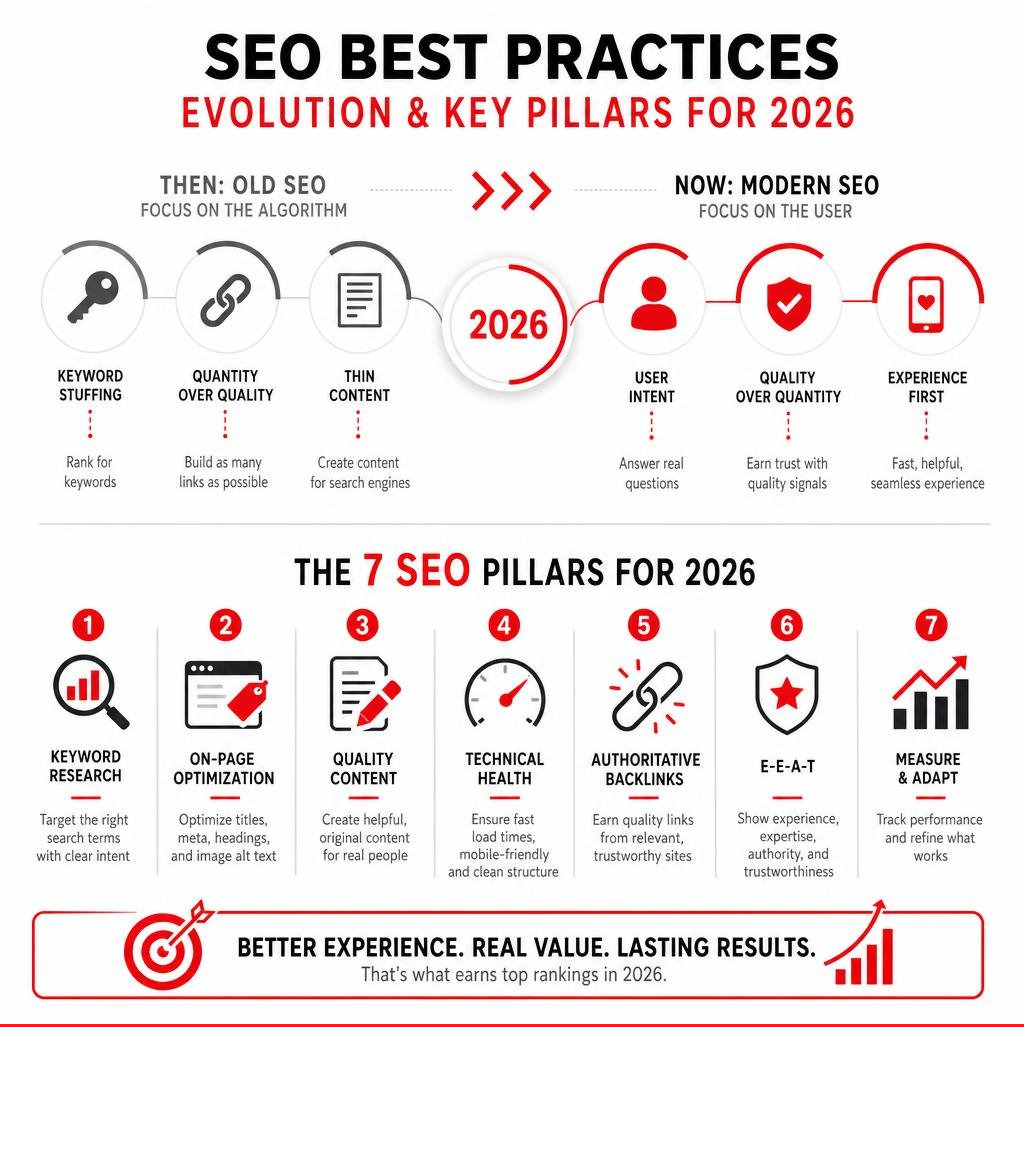
- Do keyword research – Target the right search terms with clear intent
- Optimize on-page elements – Title tags, meta descriptions, headings, and image alt text
- Create high-quality content – Helpful, original, and written for real people
- Build technical health – Fast load times, mobile-friendly design, and clean site structure
- Earn authoritative backlinks – Quality links from relevant, trustworthy sources
- Demonstrate E-E-A-T – Show experience, expertise, authority, and trustworthiness
- Measure and adapt – Use Google Search Console and Analytics to track what works
Remember when ranking on Google felt simple? Stuff your page with keywords, build a few links, and watch the traffic roll in. That era is long gone.
Today, Google is far smarter. Its algorithm evaluates content quality, page speed, mobile experience, user intent, and dozens of other signals. On top of that, AI Overviews now appear on roughly 30% of informational searches — pushing traditional organic results further down the page and cutting click-through rates by as much as 30–60% for positions 4 through 10.
For small and mid-sized business owners, this is genuinely overwhelming. You’re already running a business. Keeping up with a constantly shifting search landscape isn’t exactly in the job description.
But here’s the good news: the fundamentals haven’t changed as much as the headlines suggest. What changed is the standard. Google now rewards content that’s genuinely useful, technically sound, and built with real expertise. Shortcuts don’t just stop working — they actively hurt you.
I’m Jeff Pratt, owner of JPG Designs, a Rhode Island-based digital agency where I’ve spent over 15 years helping businesses grow through SEO, high-converting websites, and targeted digital marketing. Understanding what are SEO best practices — and applying them consistently — is at the core of everything we do for our clients. This guide walks you through exactly what works right now, so you can stop guessing and start ranking.
Easy what are SEO best practices? word list:
What Are SEO Best Practices and Why Do They Matter Today?
At its core, search engine optimization is the art and science of making your website easy for both search engines and human readers to understand. But why should you care? Because organic search remains the most sustainable way to drive consistent, targeted traffic to your business. Even in a landscape increasingly defined by AI-powered search, the principles of solid optimization ensure your brand gets noticed.
To understand why this matters, we must first look at What Does SEO Stand For? and how it functions. When search engines crawl the web, they look for signals that a page is authoritative, relevant, and user-friendly. By following official documentation like Google Search Central’s SEO Starter Guide, we can align our websites with what algorithms actually reward.
Today, optimization is a dual-purpose game. You are no longer just optimizing for the traditional “ten blue links.” You are also optimizing for generative AI engines (like ChatGPT, Perplexity, and Google’s AI Mode) that extract web content to answer user queries directly.
| Feature | Traditional Search Optimization | AI-Driven Search Optimization (AEO) |
|---|---|---|
| Primary Goal | Rank in the top organic search results | Get cited as a trusted source in AI answers |
| Key Metric | Click-Through Rate (CTR) and positions | Mention frequency and citation tracking |
| Content Format | Keyword-optimized headings and paragraphs | Answer-first structures and clear definitions |
| Authority Signal | Backlink profiles and domain rating | Verified E-E-A-T and schema markup |
Whether you are targeting local customers in Connecticut using SEO-Best-Practices – CT.gov guidelines, or looking to build a digital presence in Maine by studying Search Engine Optimization (SEO) Basics, the ultimate goal is search visibility. Let’s look at the actual elements you need to optimize to get there.
Core On-Page Elements: What Are SEO Best Practices for Content?
On-page SEO is entirely within your control. It refers to the optimization of both the content and the HTML source code of a page. To get started, we recommend following a clear structure like Similarweb’s On-Page SEO Checklist alongside our own 7 Tips to Get the Best On-Page SEO Results.
First, write unique, descriptive title tags (under 60 characters) and front-load your primary keyword. Your meta descriptions (145–155 characters) should act as compelling ad copy that encourages clicks.
Second, establish a logical heading hierarchy. Use exactly one H1 tag per page that matches the topic of your title, followed by H2 and H3 tags to organize subtopics. To win featured snippets and AI citations, write “answer-first” headings: state the question as an H2, and provide a direct 1-to-2 sentence answer immediately below it.
Third, never copy content. Since Content is King: Creating High-Quality SEO Optimized Content, focus on original insights. Creating standout content takes effort; in fact, the average blogger now spends over 3 hours on a single post, representing a 44% increase compared to a decade ago. Write naturally, keep your paragraphs short (around three sentences), and place your primary keyword within the first 10% of your text.
Finally, optimize your media. Name your images with descriptive filenames (e.g., modern-web-design-providence.jpg) instead of generic codes, and always write descriptive image alt text to improve accessibility and image search rankings.
Technical Foundations: What Are SEO Best Practices for Site Speed and Mobile?
A beautiful website is useless if it takes forever to load or breaks on a smartphone. Google primarily uses mobile-first indexing, meaning it evaluates the mobile version of your site for ranking, even for desktop searches.
We specialize in creating mobile-responsive designs that align with SEO Elements: Website Design and Optimization. To ensure your site is built to succeed, you must focus on Core Web Vitals, which measure real-world user experience:
- Largest Contentful Paint (LCP): Measures loading speed (target: under 2.5 seconds).
- Interaction to Next Paint (INP): Measures page responsiveness (target: under 200 milliseconds).
- Cumulative Layout Shift (CLS): Measures visual stability (target: under 0.1).

To Optimize Your Website for Google, start by compressing your images into modern formats like WebP or AVIF. Implementing lazy loading is another massive win — lazy loading images can boost a site’s loading speed by 50% or more.
Additionally, ensure your site uses HTTPS security, submit a clean XML sitemap to Google Search Console, and use canonical tags to prevent duplicate content from draining your crawl budget.
Strategic Keyword Research and Search Intent Alignment
Keyword research is no longer about finding high-volume words and sprinkling them everywhere. Modern search engines use semantic systems to understand the context behind a user’s query.
When you learn How to SEO Optimize, you must start by classifying search intent into four main buckets:
- Informational: The user wants to learn something (e.g., “what are SEO best practices?”).
- Commercial: The user is researching options (e.g., “best digital marketing agencies in New England”).
- Transactional: The user wants to buy (e.g., “hire JPG Designs for web design”).
- Navigational: The user is looking for a specific website.
Targeting long-tail keywords (phrases of 3 to 5 words) is highly effective for small businesses. They have lower search volume but attract highly qualified traffic with a much higher conversion rate. If you are operating in New England, localized research is key. For instance, businesses targeting Massachusetts audiences can gain a significant competitive edge by tailoring their content to regional search behavior and local search intent.
Demonstrating E-E-A-T and Building Topical Authority
Google rewards websites that demonstrate E-E-A-T: Experience, Expertise, Authoritativeness, and Trustworthiness. This is especially critical for “Your Money or Your Life” (YMYL) topics like finance, legal advice, and healthcare.
To showcase E-E-A-T, we recommend using detailed author bios with verifiable credentials, linking to reputable primary sources (like .gov or .edu sites), and regularly updating older content with fresh statistics.
Building topical authority requires you to think in terms of content clusters rather than isolated blog posts. Create a comprehensive “pillar” page that covers a broad topic, and link it to narrower “spoke” articles that dive deep into subtopics. This hub-and-spoke model is a cornerstone of The SEO Playbook: Simple Strategies to Improve Your Search Visibility.
High-Quality Link Building and Off-Page Authority
While on-page optimization tells search engines what your site is about, off-page authority tells them that your site is trustworthy. Backlinks — links from other websites to yours — act as digital votes of confidence.
However, quality always beats quantity. A single backlink from an authoritative, relevant local site provides far more value than dozens of low-quality directory links. For small brands, focusing on local PR and community partnerships is one of the most effective SEO Tips for Small Businesses.
To attract links naturally, focus on creating “linkable assets.” An analysis of over 900 million blog posts found that what and why posts, along with infographics, earn significantly more links than other content formats. Additionally, creating a single high-quality post with multiple unique hooks can pay off massively; one such study earned an incredible 23.4k backlinks.
If you are looking to build authority in New Hampshire, collaborating with an experienced regional agency like JPG Designs can help you secure high-quality local citations and regional backlinks.
Measuring Success and Adapting to AI Search Overviews
You cannot optimize what you do not measure. To track your success, you must monitor key performance indicators (KPIs) using Google Search Console (GSC) and Google Analytics 4 (GA4).
More than 60% of Office of Critical Minerals and Energy Innovation (CMEI) web traffic comes from search engine referrals, illustrating just how powerful search visibility is for driving traffic. In GSC, monitor your organic clicks, impressions, and average keyword positions.
As AI Overviews continue to shape search behavior, keeping up with resources like Ranki’s SEO Guide will help you adapt your strategy. One of the most underrated ways to stand out in both traditional search and AI engine summaries is structured data. You can significantly Boost Your SEO with Schema Markup. By implementing Article, Product, or FAQ schema, you give search engines explicit clues about your content’s meaning. If you are new to this technical step, read The A-Z of Schema Markup: A Beginner’s Handbook to get started.
Conclusion: Building Your Long-Term Search Strategy
At the end of the day, SEO is not a one-time project or a collection of quick tricks. It is a long-term business system. The companies that succeed today and in the future are those that commit to delivering fast, mobile-friendly web experiences paired with genuinely helpful, expert-written content.
At JPG Designs, we specialize in building mobile-first websites and implementing custom search strategies that help businesses across Rhode Island, Massachusetts, Connecticut, Maine, and New Hampshire stand out online. Whether you need high-performance web design services or result-driven digital marketing services, we are here to help you navigate the changing search landscape.
Ready to stop stuffing keywords and start building sustainable organic growth? Contact us today, and let’s build a strategy that gets your business noticed.