What Is HVAC Customer Acquisition Cost? (And Why It’s Eating Your Profits)
HVAC customer acquisition cost? is one of the most important numbers your business needs to know — and most contractors don’t track it.
Here’s the quick answer:
| Metric | Benchmark |
|---|---|
| Average HVAC CAC (industry standard) | $296 – $350 |
| CAC range depending on channel | $75 – $350 |
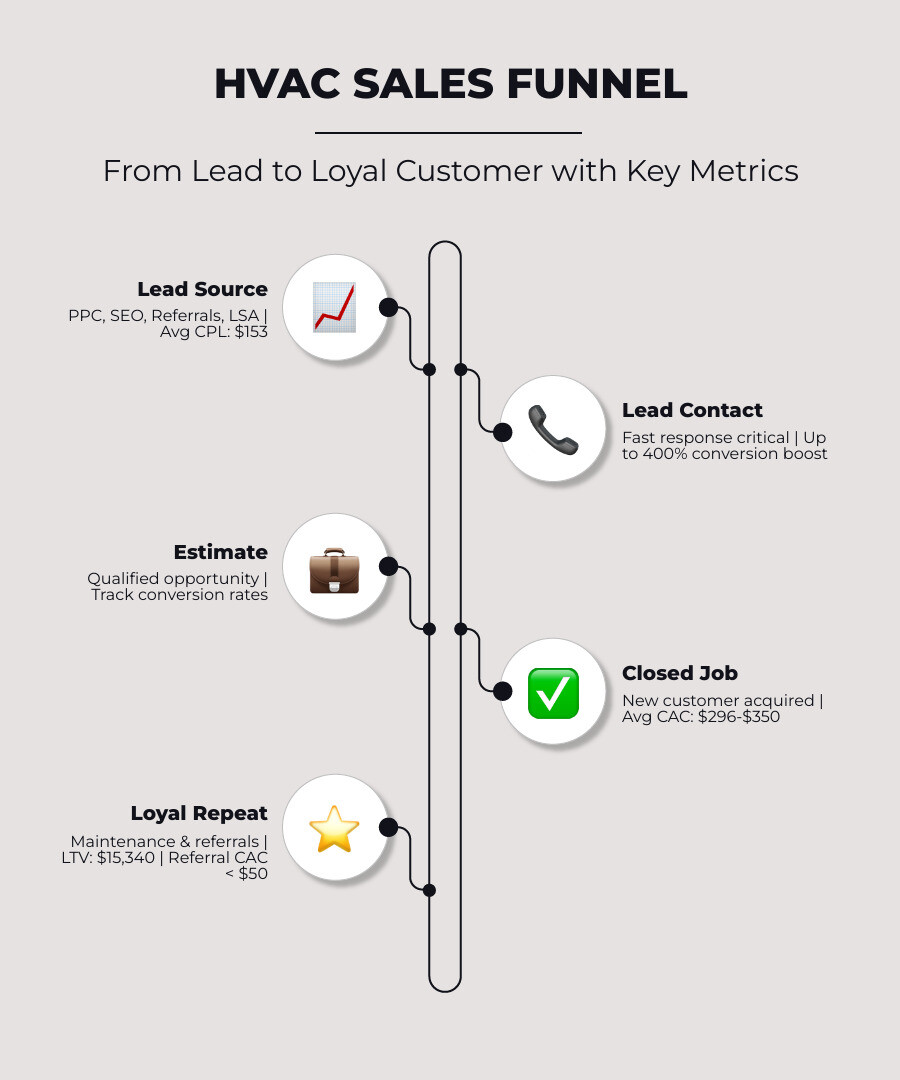
| Average cost per lead (CPL) | $153 |
| CAC via referrals and loyalty strategies | Under $50 |
| Recent PPC CAC increase | +40% year-over-year |
Customer Acquisition Cost (CAC) = Total sales and marketing spend ÷ Number of new customers acquired
Every time your truck rolls out to a new customer’s home, that customer cost you money to win. According to a Decision Analyst study, the average residential HVAC company spends around $350 to acquire a single new customer. In competitive markets, paid ads alone can push that number even higher — and with PPC costs rising significantly in recent years, the pressure on margins is real.
The problem isn’t just that acquisition is expensive. It’s that most HVAC business owners are spending money without knowing what it’s actually costing them per customer. That’s a leak in your business — and it compounds fast when you’re running thin margins in a competitive market.
I’m Jeff Pratt, owner of JPG Designs, a Rhode Island-based digital agency with over 15 years of experience helping HVAC contractors and home service businesses build marketing systems that reduce HVAC customer acquisition cost while driving consistent, qualified lead flow. This guide walks you through exactly how to calculate, benchmark, and lower your CAC so every marketing dollar works harder.
HVAC customer acquisition cost? terms to know:
How to Calculate and Benchmark Your HVAC Customer Acquisition Cost?
Calculating your HVAC customer acquisition cost? isn’t just about looking at your Google Ads bill. To get a true “all-in” number, you need to account for every dollar spent to move the needle.
The CAC Formula
The standard formula is: Total Marketing + Sales Expenses ÷ Number of New Customers Acquired.
For example, if you spend $3,500 in a month on marketing (including ad spend, agency fees, and sales commissions) and you sign up 10 brand-new customers, your CAC is $350.

Benchmarking Against the Industry
According to a Decision Analyst study, the benchmark for a new residential HVAC customer is $350. However, this varies wildly based on how you generate those leads. If you are blindly spending on HVAC or plumbing sales budgeting without tracking which channels are closing, you’re likely overpaying.
| Marketing Channel | Estimated Cost Per Lead (CPL) | Estimated CAC |
|---|---|---|
| Local Services Ads (LSA) | $25 – $80 | $85 – $150 |
| Search Engine Optimization (SEO) | $40 – $100 | $150 – $250 |
| Pay-Per-Click (PPC/Google Ads) | $50 – $200 | $250 – $450 |
| Referrals / Word of Mouth | $0 – $20 | Under $50 |
In markets like Rhode Island and Massachusetts, competition for “emergency AC repair” keywords can drive PPC costs to the high end of these ranges. This is why understanding the difference between CPL (how much a phone call costs) and CAC (how much a signed contract costs) is vital.
Why Tracking Your HVAC Customer Acquisition Cost? Is Essential for Profitability
The average net profit margin in the HVAC industry is roughly 8%. When you consider that a typical service call might only bring in $400 in revenue, a $350 CAC means you essentially broke even (or lost money) on that first visit after paying for labor, parts, and fuel.
This is where customer lifetime value (LTV) becomes your best friend. A single customer might cost $350 to get through the door, but if they sign a maintenance agreement and eventually buy a $12,000 system replacement, their LTV could exceed $15,000.
Tracking your CAC allows you to:
- Stop Budget Leaks: Identify which ads are “vanity” clicks and which are “revenue” clicks.
- Scale with Confidence: If you know every $350 spent brings in $1,500 in profit over two years, you can aggressively outspend competitors who are afraid of the upfront cost.
- Optimize Your Digital Presence: A high CAC often points to a leaky website. Our HVAC Website Design Guide explains how a better user experience can double your conversion rate, effectively cutting your CAC in half without spending an extra dime on ads.
Realistic Benchmarks for HVAC Customer Acquisition Cost? by Service Type
Not all leads are created equal. An emergency “no heat” call in the middle of a Massachusetts winter has a much higher intent (and lower CAC) than someone browsing for “energy-efficient heat pump rebates.”
- Emergency Repairs: These leads have the highest CPL because everyone is bidding on them, but they have a high close rate (60-70%), often resulting in a CAC between $150 and $250.
- System Installations: These are the “big fish.” While the CAC can range from $300 to $500+, the high ticket price makes it the most sought-after lead.
- Maintenance Agreements: Smart contractors use HVAC and plumbing extended warranty programs for contractors to lock in customers. The initial acquisition might be $100, but the recurring revenue and “first call” advantage for future repairs are priceless.
Factors Influencing Your Total Acquisition Spend
Several external factors can inflate your HVAC customer acquisition cost? overnight:
- Seasonality: In the “shoulder seasons” (Spring and Fall), demand drops, and contractors often get into bidding wars, driving up PPC costs. In recent years, PPC CAC has seen significant increases, sometimes rising over 30-40% year-over-year.
- Market Competition: In densely populated areas of New England, you aren’t just competing with the guy down the street; you’re competing with national franchises with million-dollar budgets.
- Google’s Quality Score: Google rewards relevant ads. If your ad says “AC Repair” but your landing page is a generic home page, your Google’s Quality Score will drop, and Google will charge you more per click than your competitors.
- Website Performance: If your site isn’t mobile-friendly, you are throwing money away. Our HVAC Contractor Web Design Services focus on mobile-first indexing to ensure that when a homeowner in Rhode Island clicks your ad, they actually call you.
Strategies to Reduce Costs and Maximize Lifetime Value
Lowering your CAC doesn’t always mean spending less; it often means spending smarter.
Optimizing Ad Spend and Quality Score
The fastest way to burn through cash is bidding on broad keywords like “HVAC.” Instead, focus on high-intent, long-tail keywords and use aggressive negative keyword lists (e.g., exclude “DIY,” “jobs,” “parts”) to save 20-30% of your budget instantly.
- Speed to Lead: Did you know that responding to a lead within 5 minutes can increase conversion by up to 400%? If you pay $100 for a lead but don’t call them back for two hours, your CAC just doubled because they already called the next guy.
- Track Everything: Use tools like CallRail tracking to see exactly which keywords resulted in a booked job, not just a phone call.
- Refine Your Targeting: Much like our strategies for Google Ads for Electricians, HVAC ads should be geo-fenced to the specific ZIP codes where you actually want to work.
Leveraging Retention and Referrals to Offset Costs
The most profitable HVAC companies keep their effective CAC under $50 by turning one-time customers into lifelong fans.
- SMS Marketing: Text messages have an open rate exceeding 99%. Sending a quick automated reminder for a seasonal tune-up is significantly cheaper than winning a new customer via Google.
- The Power of Referrals: A referred customer is 3x more likely to convert and has a 37% higher retention rate. Building a formal referral program can generate leads that cost you almost nothing.
- Conversion-Centric Design: Your website is your 24/7 salesperson. Check out our HVAC Web Design Tips to see how small changes to your contact forms and “click-to-call” buttons can slash your acquisition costs. A best HVAC website isn’t just pretty; it’s a lead-conversion machine.
The Current Transition: A New Opportunity
With the current EPA refrigerant phasedown and the ban on R-410A manufacturing, homeowners are confused. This is a massive opportunity for contractors to position themselves as experts. By educating your customers on the shift to A2L refrigerants (like R-32), you build trust that lowers the “barrier to entry” for new clients, effectively reducing the friction in your sales process.
Conclusion: Building a Sustainable Growth Engine
Understanding your HVAC customer acquisition cost? is the difference between a business that struggles to make payroll and one that scales predictably. In today’s market, you cannot afford to “guess” at your marketing ROI. With equipment prices rising significantly in recent years and a critical shortage of 110,000 technicians, your marketing must be efficient.
At JPG Designs, we specialize in helping New England HVAC contractors dominate their local markets. By focusing on mobile-first indexing, high-converting HVAC-Plumber Website Design, and data-driven SEO, we help you lower your CAC and increase your profit per truck.
Don’t let rising ad costs eat your margins. Let’s build a system that turns clicks into customers and customers into loyal advocates.
Ready to lower your CAC? Contact us today for a free audit of your current digital presence.