
Why Search Visibility Is the Growth Lever Most Small Businesses Are Missing
Learning how to do seo is one of the highest-leverage investments you can make for your business — and this guide walks you through exactly how to do it, step by step.
Quick answer: How to do SEO in 7 steps:
- Check that Google can find and index your site (use
site:yourdomain.comin Google search) - Fix technical issues — speed, mobile-friendliness, and Core Web Vitals
- Research keywords your customers are actually searching for
- Create helpful, well-structured content that matches what users want
- Optimize on-page elements — title tags, meta descriptions, headings, and image alt text
- Build internal links between related pages and earn backlinks from other sites
- Track your results in Google Search Console and improve over time
Organic search drives 53% of all website traffic — more than any other channel. Google alone processes over 8.5 billion searches every day. If your business isn’t showing up in those results, you’re leaving real customers on the table.
The frustrating part? Most SEO advice is either too vague to act on or written for large teams with big budgets. Small and mid-sized business owners end up overwhelmed — unsure where to start, what actually moves the needle, and why their traffic isn’t growing.
That’s exactly what this guide fixes.
I’m Jeff Pratt, owner of JPG Designs, a Rhode Island-based digital agency where I’ve spent over 15 years helping businesses grow through SEO, high-converting websites, and targeted digital marketing — including teaching clients how to do seo in a way that produces real, measurable results. Let’s walk through the full playbook, from the ground up.
Basic how to do seo terms:
- what does seo stand for
- what is seo and how it works for small businesses
- seo tips for small businesses
Master the Fundamentals: How to Do SEO for Sustainable Growth
When we talk about how to do seo, we aren’t talking about “tricking” a computer program. We are talking about becoming the best possible answer for a user’s question. At JPG Designs, we focus on a “beat the leader” strategy. This means we analyze the top-ranked websites in Rhode Island and Massachusetts for your specific niche and aim to make your site the “least imperfect” version among them.
To do this effectively, we lean heavily on the E-E-A-T framework.
E-E-A-T stands for Experience, Expertise, Authoritativeness, and Trustworthiness. While it isn’t a direct “ranking factor” in the way a keyword is, it is the lens through which Google evaluates the quality of your site. We believe that optimizing your website for Google starts with demonstrating real-world experience. For example, if you’re a contractor in Massachusetts, showing photos of your actual local projects builds more trust than using stock imagery.
We only use “white-hat” methods—strategies that follow search engine guidelines. Manipulative tactics like keyword stuffing or buying low-quality links might provide a temporary spike, but they eventually lead to penalties. Instead, we focus on building and engaging your audience through most effective and lasting ways like word-of-mouth and high-quality information.
Understanding Search: Crawling, Indexing, and Ranking
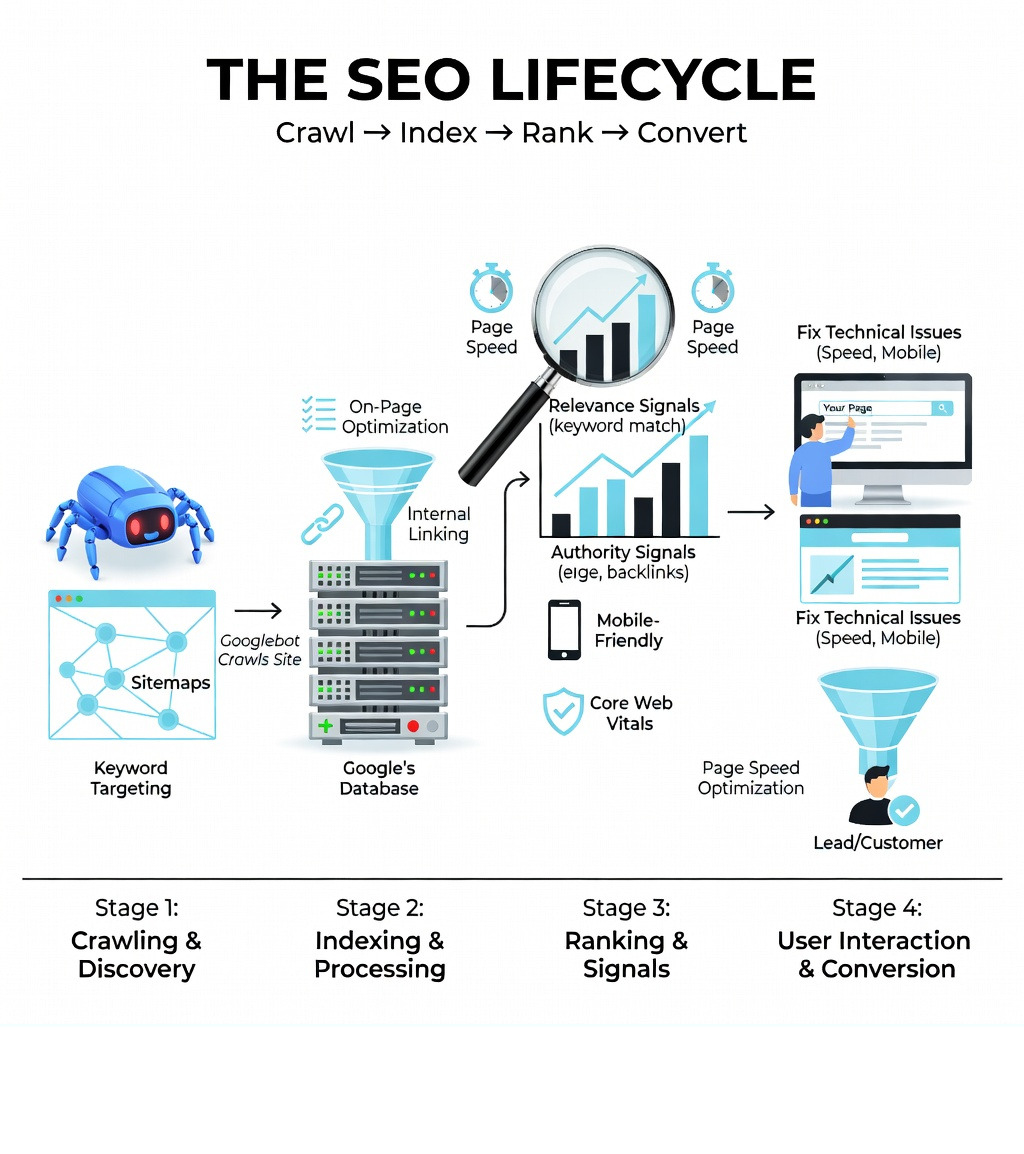
Before you can rank, Google has to know you exist. Think of the internet as a massive library without a central filing system. Google uses “spiders” or “crawlers” (specifically Googlebot) to follow links from one page to another.
The process happens in three main steps:
- Crawling: Googlebot visits your pages to see what’s on them.
- Indexing: Google stores your pages in a massive database.
- Ranking: When someone types a query, Google pulls the best pages from its index to show the user.
You can check if your site is currently indexed by typing site:yourdomain.com into Google. If these results show your pages, you’re in the index! If not, you may need to submit a sitemap through Google Search Console. To see exactly how Googlebot views a specific page, use the URL Inspection Tool in Search Console. This helps you identify if JavaScript or CSS issues are preventing Google from seeing your content correctly.
Technical Foundations and Mobile-First Optimization
Technical SEO is the engine under the hood of your website. If the engine is broken, it doesn’t matter how pretty the car is; it won’t go anywhere. At JPG Designs, our USP is our expertise in mobile-first indexing. Since Google now primarily uses the mobile version of your site for ranking, your mobile experience is your SEO experience.
One of the most critical parts of technical SEO is site speed. Research shows that technical optimization can make a website load 2x to 5x faster. Slow sites frustrate users and lead to higher bounce rates, which tells Google your site isn’t a good result.
We focus on Core Web Vitals, which are specific metrics Google uses to measure user experience:
- LCP (Largest Contentful Paint): How fast the main content loads (aim for under 2.5 seconds).
- FID (First Input Delay): How fast the site responds to a user’s first click (aim for under 100ms).
- CLS (Cumulative Layout Shift): How much the page elements “jump around” while loading (aim for less than 0.1).
You can test your own site using Google’s Lighthouse testing tool. Beyond speed, ensure your SEO elements and website design include a secure SSL certificate (HTTPS), a clean URL structure, and a sitemap.
Keyword Research: The First Step in How to Do SEO
Keyword research is the process of discovering the actual phrases your customers use. Without it, you are essentially guessing. We recommend starting with a competitor analysis. Tools like Semrush allow you to see exactly which keywords your top competitors in Rhode Island are ranking for.
When performing research, don’t just look for high volume. Look for Search Intent.
- Informational: The user wants to learn (e.g., “how to do seo”).
- Navigational: The user wants a specific site (e.g., “JPG Designs login”).
- Transactional: The user is ready to buy (e.g., “hire SEO agency Rhode Island”).
For small businesses, targeting “long-tail keywords”—longer, more specific phrases—is often the best strategy. They have lower search volume but much higher conversion rates because the user knows exactly what they want. Once you have your list, organize them into Topic Clusters. Create one main “pillar” page about a broad topic and link it to several smaller, detailed “cluster” posts. This structure helps search engines understand your topical authority. For more ideas, check out our SEO tips for small businesses.
Creating People-First Content That Ranks
Google’s recent updates have one clear message: write for humans, not for robots. “People-first” content is helpful, easy to read, and provides a satisfying answer to the user’s query.
A good rule of thumb is to look at the top-ranking results for your keyword and aim to create content that is 1.5x to 2x more comprehensive. This doesn’t mean adding “fluff”—it means providing more value, better examples, and clearer explanations.
Here are the essential on-page elements to optimize:
- Title Tags: Keep these under 60 characters and include your primary keyword.
- Meta Descriptions: These are your “ad copy” in the search results. Keep them between 50-160 characters to encourage clicks.
- Headings (H1, H2, H3): Use these to structure your page so both users and Google can skim it easily.
- Image Alt Text: Always describe your images. This helps with accessibility and allows your images to show up in Google Image Search.
- Descriptive URLs: Use
jpgdesigns.com/how-to-do-seoinstead ofjpgdesigns.com/p=123.
content is king, but only if it’s high-quality and SEO-optimized. Avoid keyword stuffing, which makes your writing feel unnatural and can actually hurt your rankings.
Building Authority Through Strategic Internal and External Links
Links are like votes of confidence. There are two types you need to care about: internal and external.
Internal Linking is when you link from one page on your site to another. This helps Google find new pages and passes “link equity” (ranking power) throughout your site. One case study showed that a company improved its organic traffic by 40% solely through better interlinking! We recommend a bi-annual audit to ensure your most important pages are well-linked.
External Links (Backlinks) are links from other websites to yours. These are harder to get but incredibly powerful. In competitive niches, top-ranking pages often have hundreds or even thousands of links. While some agencies spend $20,000 a month on link building, small businesses can see great results through:
- Guest Posting: Writing helpful articles for reputable local sites.
- Broken Link Building: Finding broken links on other sites and suggesting your content as a replacement.
- Local Directories: Ensuring your business is listed on sites like Yelp, Yellow Pages, and local Chambers of Commerce.
If you are a local service provider, such as an electrician or plumber, local backlinks are even more vital. Check out our Local SEO Electricians Ultimate Guide for specific tactics on dominating your local service area.
Measuring Success: Tracking Your How to Do SEO Progress
SEO is not a “set it and forget it” task. It takes time—usually 4 to 6 months—to see significant results. To know if your efforts are working, you must track your data.
The most important tool for this is Google Search Console. It tells you which keywords are driving traffic, how many people are seeing your site (impressions), and how many are clicking through (clicks).
One metric we watch closely is Click-Through Rate (CTR). Your position on the page drastically affects how many people click.
If you are ranking in the top 3 but your CTR is low, it’s a sign that your title tag or meta description isn’t enticing enough. Use Bing Webmaster Tools and Moz as secondary resources to get a full picture of your search health.
Conclusion: Scaling Your Search Visibility Long-Term
Learning how to do seo is a journey, not a destination. Search engines are constantly evolving, especially with the rise of AI-powered search features like Google’s AI Overview and ChatGPT. However, the core principles remain the same: build a fast, mobile-friendly site, provide the best possible answers to your customers’ questions, and earn the trust of your industry.
At JPG Designs, we specialize in helping businesses in Rhode Island and Massachusetts navigate these digital tides. Whether you’re a local contractor or a growing e-commerce brand, our mobile-first expertise ensures you’re ready for the way people search today.
Ready to take the next step in your SEO journey? Explore our Digital Marketing Services or contact us today to see how we can help you build sustainable, long-term search visibility.
Stay Connected & Keep Learning:
- Follow Google Search Central on LinkedIn or X (Twitter).
- Join the Google Search Central Help Forum to ask questions.
- Watch expert tutorials on the Google Search Central YouTube Channel.