
Navigating Your Business with a Clear Compass
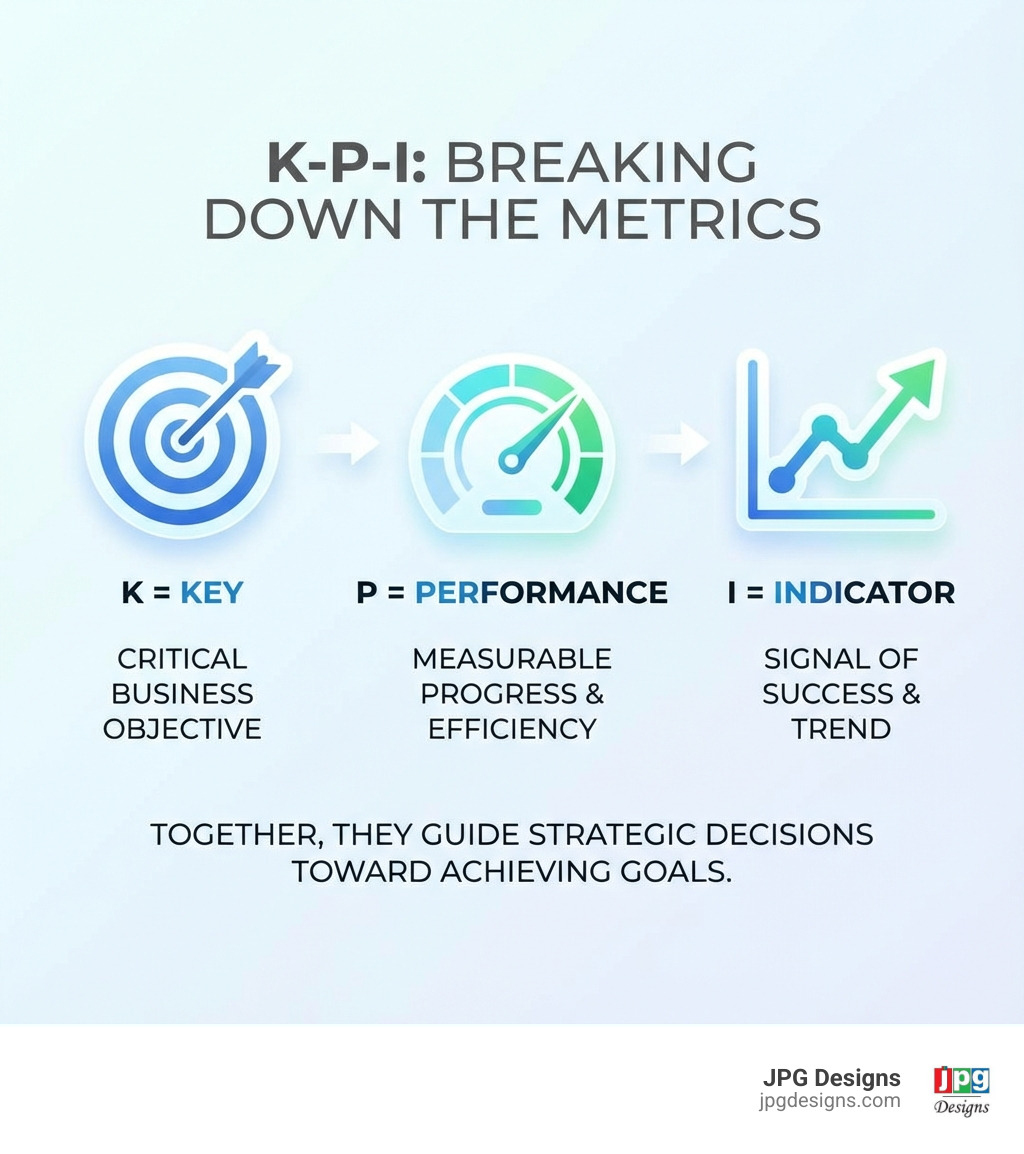
What are KPIs? KPIs, or Key Performance Indicators, are measurable values that show how effectively your business is achieving its most important objectives. They’re specific metrics that help you track progress toward your strategic goals, providing a clear picture of what’s working and what needs improvement.
Quick Answer:
- Definition: Quantifiable measurements that evaluate success in reaching key business objectives
- Purpose: Track progress, inform decisions, and align teams toward common goals
- Key Characteristic: Not just any metric—they’re “key” because they directly impact your business success
- Use: Applied at company-wide, department, or project levels to measure what matters most
If you’ve ever felt like you’re steering your business in the dark—unsure whether your marketing is working, if your sales are on track, or whether you’re spending money in the right places—you’re alone. Many business owners struggle to cut through the noise of endless data and metrics to find what truly matters.
The problem isn’t a lack of information. It’s knowing which numbers actually tell you if you’re moving in the right direction.
That’s where KPIs come in. They act as your business compass, cutting through the clutter to show you exactly where you stand against your most important goals. Instead of drowning in spreadsheets, you get a clear snapshot of performance that helps you make confident, data-driven decisions.
As Jeff Pratt, owner of JPG Designs, I’ve spent well over a decade helping businesses identify and track the metrics that drive real growth, including clarifying what are KPIs and how to use them effectively. Through working with everyone from contractors to manufacturers to nonprofits, I’ve seen how the right KPIs transform vague business anxiety into actionable strategy.
What are KPIs? The Core Definition and Its Importance for Business Growth
At JPG Designs, we believe understanding what are KPIs is the first step toward opening up your business’s full potential. They aren’t just fancy acronyms; they’re the heartbeat of your strategic planning. Key Performance Indicators are defined measurements used to assess a company’s performance and track progress on key business objectives.
Imagine trying to drive from Rhode Island to Massachusetts without a speedometer or fuel gauge. You might eventually get there, but it would be a stressful, inefficient, and potentially disastrous journey. KPIs provide that essential dashboard for your business, allowing you to steer with precision and confidence.
For us, the core of any successful digital strategy, from web design to boosting Google rankings, hinges on clearly defined KPIs. They help us ensure that every dollar invested, every design element chosen, and every SEO tweak made is pushing your business toward measurable success. This is why we view marketing as a growth opportunity, not just an expense, because when we tie our efforts to clear KPIs, we can demonstrate tangible returns. You can learn more in our article on Why Marketing Should Be Viewed as a Growth Opportunity and Not an Expense.
Many businesses feel stuck making critical decisions without reliable data. We often see clients frustrated by stagnant growth or ineffective marketing because they haven’t identified what to measure. KPIs solve this by providing objective evidence for informed choices, fostering a data-driven culture and team accountability.
So, what are KPIs in simple terms?
In the simplest terms, a KPI is a measurable value that shows how effectively you’re achieving a business objective. It’s not just any metric; it’s a key metric. The “Key” in KPI signifies its strategic importance – these are the metrics that directly impact your business success and help you reach your most important goals.
Think of it this way: your doctor measures your blood pressure and cholesterol levels as key indicators of your health. Similarly, in business, we use KPIs to gauge the health and performance of your organization. As Microsoft explains, “Key performance indicators (KPIs) are targets that help you measure progress against your most strategic objectives.” For a deeper dive, you can explore resources like Key performance indicators (KPIs): What they are and how to use them.
Why are KPIs essential for your business?
KPIs are essential because they transform abstract goals into concrete, actionable insights. Without them, your business objectives can feel like distant dreams. With them, you have a clear roadmap and a way to measure every step of the journey.
- Aligning Teams: KPIs ensure everyone, from the CEO to the newest hire, understands the company’s priorities and how their work contributes to the larger vision.
- Measuring Progress: They provide a quantifiable way to track whether you’re on pace to hit your targets.
- Improving Performance: By highlighting areas of strength and weakness, KPIs enable targeted improvements.
- Fostering Accountability: When specific KPIs are assigned to individuals or teams, it creates a sense of ownership and responsibility.
- Informed Decision-Making: KPIs provide the data needed to make strategic decisions, rather than relying on gut feelings.
- Identifying Problems Early: A dip in a critical KPI can signal an issue before it becomes a major crisis.
At JPG Designs, we leverage KPIs to ensure our digital marketing strategies, from mobile-first web design to SEO, deliver measurable value. We believe that a cutting-edge marketing agency doesn’t just create; it measures, analyzes, and optimizes. This commitment to data-driven results is a core part of The Role of a Cutting-Edge Marketing Agency.
The Anatomy of a Powerful KPI: Types and Characteristics
Choosing the right metrics solves the common pain point of data overload. Not all metrics are equal, and understanding KPI types is crucial for effective performance management. Avoid “vanity metrics”—numbers that look good but don’t reveal anything useful about strategic goals. A powerful KPI is strategically aligned with your objectives, providing clear, actionable insights.

Key Types of KPIs to Understand
KPIs can be categorized in several ways to give a comprehensive view of performance:
- Leading Indicators: These predict future performance. They are proactive and tell us what might happen. For example, the number of qualified leads generated for a sales team is a leading indicator for future sales revenue.
- Lagging Indicators: These measure past performance and tell us what has happened. They are reactive and confirm trends. Sales revenue itself is a lagging indicator, as it reflects past efforts.
- Quantitative Indicators: Objective, numerical measurements such as monthly sales revenue or customer acquisition cost.
- Qualitative Indicators: Subjective data, vital for understanding things like brand reputation or customer satisfaction (e.g., through customer feedback surveys).
- Strategic KPIs: High-level indicators used by executives to track progress toward overall organizational goals.
- Operational KPIs: Focused on day-to-day performance within a tighter timeframe, often used by management staff.
- Financial KPIs: Related to your business’s financial health and performance.
- Customer KPIs: Focused on customer satisfaction, retention, and acquisition.
Here are some of the main KPI categories we often consider:
- Financial Perspective KPIs: Revenue growth rate, Net profit margin, Return on Investment (ROI), Operating cost as % of revenue.
- Customer/Stakeholder Perspective KPIs: Customer satisfaction score (CSAT), Net Promoter Score (NPS), Customer retention rate, Churn rate, Market share.
- Internal Process Perspective KPIs: % of on-time deliveries, Cycle time per unit, Defect rate, First call resolution rate.
- Organizational Capacity (Learning & Growth) Perspective KPIs: % of employees trained, Employee satisfaction score, Voluntary turnover rate, IT system uptime.
What Makes a Good KPI? The SMART Framework
A good KPI isn’t just a number; it’s a strategic tool. We use the SMART framework to ensure that every KPI we help our clients define is truly effective:
- S – Specific: Clearly define what is being measured. Instead of “increase sales,” use “increase online sales of product X by 10%.”
- M – Measurable: You must be able to quantify the KPI with reliable data sources and a clear method for calculation.
- A – Attainable: While ambitious, the target for your KPI should be realistic and achievable.
- R – Relevant: The KPI must be directly related to your overarching business objectives.
- T – Time-bound: Every KPI needs a deadline, such as “by the end of Q4.”
Beyond SMART, a good KPI should also be:
- Actionable: It should provide insights that allow you to take specific steps to improve performance.
- Easy to Understand: Everyone who interacts with the KPI should grasp its meaning and importance without a detailed explanation.
- Aligned with Goals: It must directly support your strategic objectives so that efforts to improve the KPI contribute to broader business success.
From Theory to Action: Setting and Using KPIs Effectively
Putting KPIs into practice is where the real value emerges. Many businesses struggle with the operational side: setting them up, collecting data, and using them to drive decisions. This is a common pain point we address at JPG Designs. Our solution is a clear, step-by-step process that turns KPIs into dynamic tools for growth.

When setting KPIs, we consider several key elements: a clear measure, a specific target, a reliable data source, a defined reporting frequency, and an assigned owner. These elements ensure clarity and accountability.
How to Set Effective KPIs in 4 Steps
Setting effective KPIs doesn’t have to be complicated. We recommend a straightforward, four-step process:
- Define Business Objectives: Before you can measure performance, you need to know what you’re trying to achieve. Are you aiming to increase market share, improve customer retention, or boost profitability? If your objective is to grow your online presence, your KPIs will naturally revolve around digital metrics.
- Identify Critical Metrics: Once objectives are clear, identify the 3–5 key metrics that will most effectively measure progress toward each goal. Focus on a mix of leading and lagging indicators. If your objective is to increase the ROI of your website, we’ll look at metrics like conversion rates and customer acquisition costs. For more, see: Do You Know the ROI of Your Website?.
- Set Up a Tracking System: Decide how you will collect, store, and visualize your KPI data. This might be through analytics platforms, CRM systems, or dedicated KPI dashboards.
- Track and Share Progress: Regularly monitor your KPIs and share the results with relevant stakeholders. This consistent review allows for timely adjustments and keeps everyone engaged.
Using KPIs at Different Organizational Levels
One of the strengths of KPIs is their versatility. They can be applied at multiple levels within an organization, ensuring that everyone’s efforts are aligned toward common goals.
- Company-Wide KPIs: High-level indicators that reflect the overall strategic health and performance of the entire business, such as Net Profit Margin or Customer Lifetime Value.
- Department-Level KPIs: Each department has its own KPIs that align with the company’s overall goals but focus on their specific contributions, like website traffic for marketing or average deal size for sales.
- Project-Specific KPIs: For individual projects, such as a new website launch or a targeted digital marketing campaign, specific KPIs track the success of that initiative.
- Individual KPIs: In some roles, KPIs can be used to track individual performance, especially where output is highly measurable.
This cascading effect helps businesses in Rhode Island and Massachusetts see their daily work translate into tangible business outcomes. Our Success Stories often highlight how a clear focus on KPIs led to significant achievements for our clients.
KPIs in Practice: Examples and Common Frameworks
Understanding what are KPIs conceptually is a strong start, but seeing them in action truly brings their value to life. Let’s look at some real-world applications and common frameworks that help businesses, especially those leveraging digital strategies, achieve their goals.
What are KPIs in marketing and how do they drive results?
For businesses focused on online growth, marketing KPIs are critical. They help measure the effectiveness of digital campaigns and ensure every marketing dollar generates a positive return. At JPG Designs, our SEO and Google Ads expertise means we live by these metrics, translating them into improved Google rankings and online visibility for our clients.
Here are some essential marketing KPIs:
- Website Traffic: The total number of visitors to your website. On its own this can be a vanity metric, but when segmented (e.g., organic traffic, referral traffic) and combined with other metrics, it indicates reach and brand awareness.
- Conversion Rate: The percentage of website visitors who complete a desired action, such as filling out a form, making a purchase, or downloading a resource.
- Cost per Lead (CPL): The average cost incurred to acquire a new lead through marketing efforts.
- Customer Acquisition Cost (CAC): The total cost of sales and marketing efforts required to acquire a new customer.
- Return on Investment (ROI): The financial return generated from your marketing investments. For example, if a marketing campaign spends $1,000 and generates $5,000 in sales, that’s a strong ROI. Learn more in Maximizing Your ROI with SEO & Google Ads.
For businesses in Rhode Island and Massachusetts looking to dominate local search results, specific SEO KPIs related to local rankings, Google Business Profile performance, and localized organic traffic are paramount. Our Best SEO Services for Small Business are built around these indicators.
Common KPI Examples by Department
KPIs are customized to each department’s functions and objectives. Here are some examples across different business areas:
- Sales Department: Revenue Growth, Customer Lifetime Value (CLV), Lead-to-Customer Conversion Rate, Average Deal Size.
- Finance Department: Net Profit Margin, Operating Cash Flow, Return on Assets (ROA), Budget Variance.
- Customer Service Department: Net Promoter Score (NPS), Customer Retention Rate, Average Resolution Time, First Contact Resolution (FCR).
- Operations Department: Cycle Time, Defect Rate, On-Time Delivery Rate, Inventory Turnover.
For more comprehensive examples across various industries, Investopedia provides a detailed overview in KPIs: What Are Key Performance Indicators? Types and Examples.
KPIs vs. OKRs: What’s the Difference?
KPIs and OKRs (Objectives and Key Results) are often used together but serve different purposes.
- KPIs (Key Performance Indicators): Performance metrics that track the health of a business process or outcome. KPIs are about “how we are doing” against a predefined target.
- OKRs (Objectives and Key Results): A goal-setting framework. Objectives define what you want to achieve and Key Results define how you’ll measure success.
Here’s a table comparing the two:
| Feature | Key Performance Indicators (KPIs) | Objectives and Key Results (OKRs) |
|---|---|---|
| Purpose | Monitor health and track performance against targets | Set ambitious goals and measure progress towards them |
| Format | A single metric with a target | An Objective + 3–5 measurable Key Results |
| Nature | Performance metric, often continuous | Goal-setting framework, typically time-bound (e.g., quarterly) |
| Focus | “How are we doing on this important metric?” | “What do we want to achieve, and how will we know if we did it?” |
| Typical Use | Operational reporting, dashboards, performance reviews | Strategic planning, team alignment, driving significant change |
You might use KPIs within your OKRs as Key Results. For example, an Objective could be “Delight our customers,” with a Key Result being “Increase NPS (a KPI) from 60 to 70.”
Learning how to align goals and OKRs across teams can be transformative, as it helps teams understand how their work contributes to overall organizational goals. We encourage you to explore resources like the Asana webinar on How to align goals and OKRs across teams for more insights.
Frequently Asked Questions about Key Performance Indicators
We often hear similar questions from businesses in Rhode Island and Massachusetts when they start exploring what are KPIs and how to implement them. Here are some of the most common ones we encounter:
How many KPIs should a business track?
The answer is usually “fewer than you think.” Tracking every possible metric often leads to “metric overload”—drowning in data but starved for insights.
For most objectives, we recommend selecting three to five KPIs that will be most effective in measuring progress. The focus should always be on quality over quantity. These 3–5 KPIs should provide a balanced view, ideally including a mix of leading and lagging indicators.
How often should you review KPIs?
The frequency of KPI review depends largely on the nature of the metric and the pace of the project or department.
- Fast-Moving Projects or Campaigns: For digital marketing campaigns or specific website changes, certain KPIs (like website traffic or conversion rates) might be reviewed weekly, or even daily.
- Operational KPIs: For day-to-day operational metrics, a weekly or bi-weekly review might be appropriate for managers.
- Strategic KPIs: For high-level, company-wide goals, a monthly or quarterly review is typically sufficient for leadership teams.
Regular review is key. KPIs are not “set it and forget it” tools. Consistent monitoring allows for timely interventions and keeps your business agile.
What is the biggest mistake companies make with KPIs?
The biggest mistake we see is a lack of strategic alignment and follow-through. Many companies fall into traps such as:
- Tracking Vanity Metrics: Focusing on numbers that look good but don’t contribute to strategic objectives.
- Misalignment with Strategy: KPIs that don’t tie back to clear business goals create busywork without driving value.
- Setting Unrealistic Targets: Goals that are impossible to achieve can demotivate teams.
- Poor Communication: If teams don’t understand the KPIs or why they’re important, the system breaks down.
- “Set It and Forget It” Mentality: KPIs are dynamic tools that require continuous monitoring and adjustment.
- Lack of Action Based on Results: The purpose of KPIs is to drive decision-making and improve performance. If you track KPIs but don’t act on the insights, you lose their value.
Avoiding these pitfalls ensures that your KPIs serve as powerful tools for business growth and strategic direction.
Conclusion: Turn Your Data into a Roadmap for Success
Understanding what are KPIs and how to effectively implement them is no longer optional; it’s a necessity for any business looking to thrive in today’s competitive landscape. From our experience working with businesses across Rhode Island and Massachusetts, we’ve seen how a clear, data-driven approach transforms uncertainty into strategic advantage.
KPIs provide the clarity you need to:
- Measure what truly matters.
- Align your entire team toward common goals.
- Make informed, data-driven decisions.
- Identify opportunities and address challenges proactively.
- Drive continuous improvement and sustainable growth.
At JPG Designs, we specialize in helping businesses not only define their most impactful KPIs but also implement the digital strategies—from mobile-first web design to advanced SEO and Google Ads—that directly influence those key performance indicators. We turn your data into a clear roadmap, guiding you every step of the way.
Ready to stop guessing and start growing? Open up your business potential with our expert Digital Marketing Services.