
From Invisible to Unmissable: Why Small Businesses Need SEO
What is SEO and how it works for small businesses is simple: SEO (Search Engine Optimization) is the process of improving your website to appear higher in search results when customers look for what you offer. It makes your site easy for search engines like Google to find, understand, and recommend—without you paying for ads.
Here’s the quick answer:
- What SEO is: A strategy to increase your website’s visibility in organic (unpaid) search results.
- How it works: Search engines crawl, index, and rank your content based on relevance and quality.
- Why it matters: Over half of all website traffic comes from organic search, and the top result gets the most clicks.
- For small businesses: SEO levels the playing field, allowing you to compete with larger companies by targeting local keywords.
If you feel invisible online while competitors dominate Google, you’re not alone. The good news is that SEO is one of the most cost-effective ways to attract customers actively searching for your services.
Unlike paid ads that stop when you stop paying, SEO builds lasting visibility. It connects you with high-intent customers at the exact moment they need you. With 76% of local mobile searches leading to a store visit within a day, local SEO can directly drive foot traffic to your door.
I’m Jeff Pratt, owner of JPG Designs. For over 15 years, I’ve helped small businesses understand what is SEO and how it works for small businesses to generate real leads and revenue. My team knows how the right SEO strategy transforms a website into a customer-generating asset.
Why Your Small Business Can’t Afford to Ignore SEO
If potential customers can’t find your website when they search online, you might as well not exist. What is SEO and how it works for small businesses comes down to this: it’s the process of making your website visible to people who are already looking for exactly what you offer. When someone in your area searches for your services, SEO determines whether they find you or your competitor.
The numbers tell a compelling story. According to research from BrightEdge, organic search accounts for 53% of all website traffic. And since only 0.63% of searchers click to the second page of Google, if you’re not on page one, you’re essentially invisible.
For small businesses in competitive markets like Providence, RI, or Warwick, RI, this matters even more. You’re competing for customers who might drive right past your location to visit a competitor they found online first.
Organic search also builds genuine trust and credibility. Appearing at the top of search results positions you as an authority. Unlike paid ads that vanish when you stop paying, SEO creates lasting value. It requires an upfront investment, but once your site ranks, you attract high-intent customers without paying for each click. This is how small businesses level the playing field against larger competitors. To see how this translates into real growth, check out how Google ranking can help your business.
The Main Benefits of SEO for a Small Business
- Higher conversion rates: People finding you through search are actively looking for a solution and are often ready to buy.
- Long-term results: While it can take 4-12 months to see significant movement, good rankings are durable and provide lasting value.
- Better user experience: Optimizing your site for SEO (e.g., mobile-friendliness, speed) also makes it better for human visitors.
- Increased brand awareness: Consistent visibility in search results builds familiarity and trust with potential customers.
- Cost-effective customer acquisition: Once you rank, you attract customers without paying per click, offering a higher ROI over time.
The real value: How SEO works for small businesses to drive growth
When someone’s sink bursts in East Greenwich, RI, or a family wants dinner recommendations in Providence, they grab their phone and search. This is where SEO becomes beautifully practical. Almost half of all Google searches have local intent, meaning users are ready to visit, buy, or hire.
Google’s research on mobile search shows that 76% of people who search for something nearby on a smartphone visit a business within 24 hours, and 28% of those searches result in a purchase. For businesses in Warwick, Cranston, or Pawtucket, RI, these numbers represent real foot traffic and revenue.
Local SEO drives sustainable growth by connecting you with your community at the exact moment they need you. It’s not about competing globally; it’s about dominating your local market and ensuring that when a neighbor needs what you offer, your business is the obvious choice.
What is SEO and How It Works for Small Businesses: The Core Mechanics
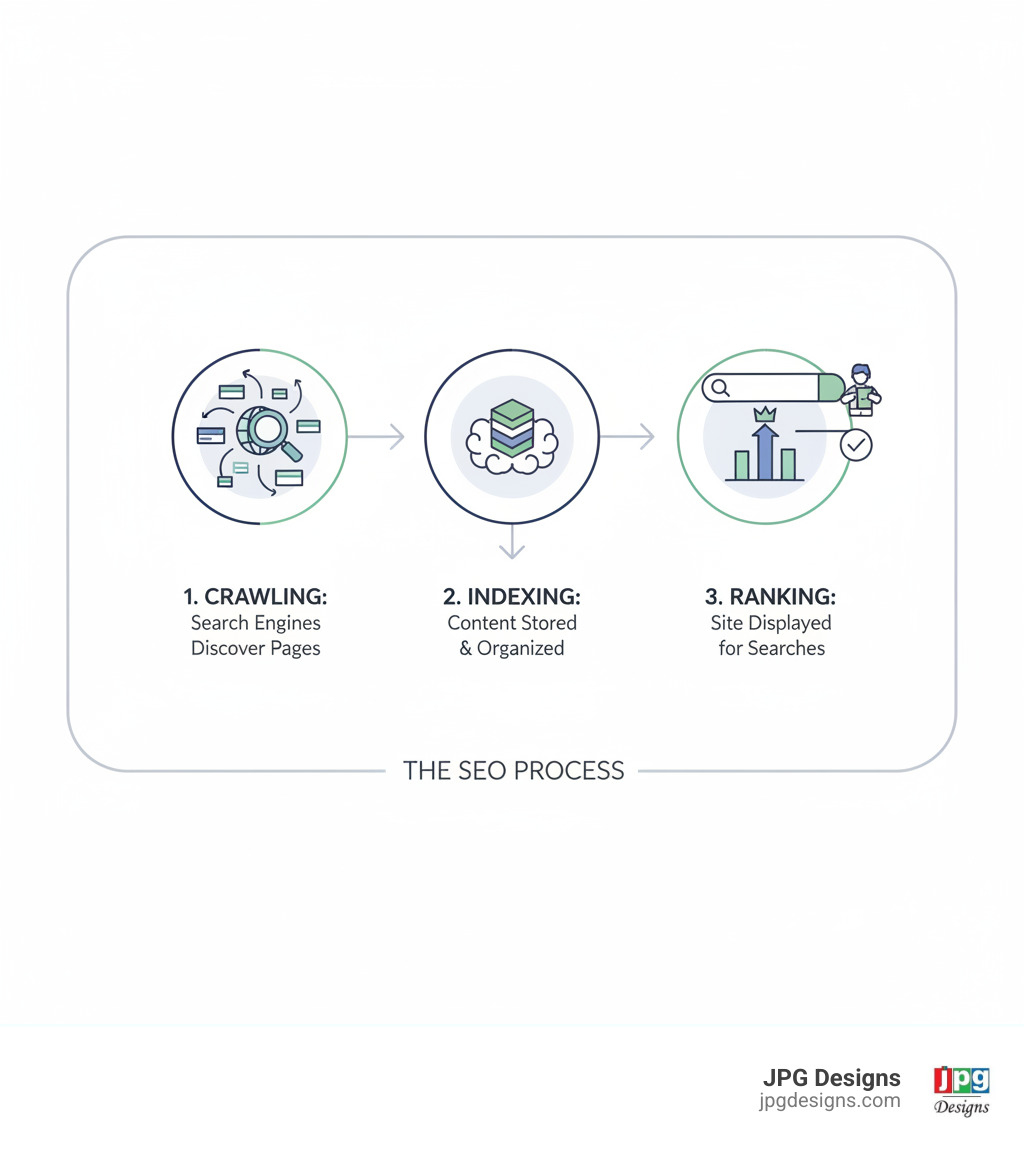
Let’s pull back the curtain on how search engines work. Think of Google as a librarian for the internet. What is SEO and how it works for small businesses is about making your website the book that librarian confidently recommends. This happens in three steps:
- Crawling: Google’s bots (“spiders”) follow links to find new and updated pages across the web.
- Indexing: Google analyzes and stores the content from those pages in a massive database. If your page isn’t indexed, it’s invisible to searchers.
- Ranking: When someone searches, Google’s algorithms sift through the index to find and display the most relevant, helpful results. These algorithms consider hundreds of factors, from keywords and content quality to site speed and mobile-friendliness.
Google’s goal is to understand user intent—what people actually want when they search. Your job is to match that intent. A key concept here is E-E-A-T: Experience, Expertise, Authoritativeness, and Trustworthiness. This is Google’s philosophy for what makes content valuable. By demonstrating you’re a reliable, knowledgeable source, you build E-E-A-T and improve your standing.
SEO rests on three main pillars:

On-Page SEO: Optimizing What’s on Your Site
On-page SEO is everything you control directly on your website to show search engines and users that your content is relevant.
- Content Optimization: Create genuinely helpful, informative content that answers your customers’ questions.
- Keyword Usage: Include target keywords naturally in titles, headings, and text. Write for humans, not algorithms.
- Title Tag: The clickable headline in search results. Make it unique and descriptive (under 60 characters).
- Meta Description: The summary under your title. It doesn’t directly impact rank but affects click-through rates (under 155 characters).
- Header Tags (H1, H2): Structure your content like an outline to improve readability and help search engines understand its hierarchy.
- Image Alt Text: Descriptive text that tells search engines and visually impaired users what your images show.
- Internal Linking: Connect related pages on your site to guide users and help search engines understand your site structure.
For a deeper dive, see our 7 tips to get the best on-page SEO results.
Off-Page SEO: Building Authority Beyond Your Website
Off-page SEO involves actions taken outside your website to build its reputation and authority.
- Link Building: Earning backlinks (links from other sites to yours) acts as a vote of confidence. Quality over quantity is key.
- Brand Mentions: Even unlinked mentions of your business across the web signal relevance to search engines.
- Social Media Signals: While not a direct ranking factor, a strong social presence drives traffic and amplifies your content. Learn how social media improves your SEO.
- Online Reviews: Positive reviews on Google, Yelp, and other platforms build trust and heavily influence local search rankings.
Technical SEO: Ensuring Your Site is Search-Engine Friendly
Technical SEO ensures search engines can easily crawl, index, and understand your site.
- Site Speed: Slow sites lose visitors and rank lower. Aim for a load time under 3 seconds.
- Mobile-Friendliness: With Google’s mobile-first approach, your site must work flawlessly on all devices. Learn about what is Mobile-First Indexing.
- XML Sitemap: A roadmap of your site that helps search engines find all your important pages.
- Site Architecture: A logical, intuitive structure helps both users and search engines steer your site.
- SSL Certificate (HTTPS): Encrypts data to secure your site, which is a trust signal for both users and Google.
- Structured Data (Schema): Code that helps search engines understand your content’s context, potentially earning you eye-catching “rich snippets” in search results.
General SEO vs. Local SEO: What’s the Difference?
General SEO targets a broad audience, optimizing for keywords like “web design services.” Local SEO focuses on customers in a specific area, like Providence, RI, targeting terms like “web design Woonsocket RI” or “plumber near me.” The goal of local SEO is to drive foot traffic and local inquiries, often by appearing in the Google Map Pack.
For most small businesses, local SEO is where you’ll see the fastest, most tangible results. It connects you with the huge volume of “near me” searches from people ready to buy.
| Feature | General SEO | Local SEO |
|---|---|---|
| Target Audience | Broad, geographically dispersed customers | Customers in specific areas (Newport RI, Cumberland RI, North Providence RI) |
| Keyword Focus | Broader terms (“web design services”) | Location-specific (“web design Woonsocket RI,” “plumber in Warwick, RI”) |
| Primary Goal | Increase overall traffic and brand visibility | Drive local foot traffic, calls, and “near me” search visibility |
| Key Tools | Website optimization, content marketing, backlinks, technical SEO | Google Business Profile, local citations, reviews, location pages, plus standard SEO |
| Search Results | Standard organic results | Google Map Pack, localized results, directory listings |

To understand its full potential, find out why your business can benefit greatly from Local SEO.
Your Actionable SEO Blueprint: From Zero to Found on Google
What is SEO and how it works for small businesses becomes clear when you break it down into manageable steps. You don’t need to do everything at once. Consistency is the key to the DIY approach, as small, regular efforts compound over time.

Step 1: Master Keyword Research to Understand Your Customers
Before you do anything else, you must understand what your customers are searching for. Put yourself in their shoes: what would someone in Pawtucket, RI, type into Google to find you? They likely use simple terms, not industry jargon.
Focus on long-tail keywords—longer, more specific phrases like “affordable web design for small businesses in Providence RI.” These searches have lower volume but much higher intent, leading to better conversion rates.
Free tools like Google Keyword Planner and Google Trends are perfect for getting started. They help you find search volumes and identify popular terms in specific locations. Also, analyze your competitors’ keywords to find opportunities you may have missed. For a full walkthrough, see this Beginner’s Guide to Keyword Research.
Step 2: Create High-Quality, Relevant Content
Once you know what people are searching for, give them the answers. The golden rule is to write for humans first, search engines second. Google is smart enough to recognize genuinely helpful content.
Your goal is to create valuable, informative, and engaging content that solves your customers’ problems. Answer their questions directly through:
- Blog posts that share your expertise.
- Service pages that detail what you offer.
- How-to guides that solve common problems.
- Video content that demonstrates your products.
Avoid “keyword stuffing”—cramming keywords unnaturally into your text. It hurts readability and your rankings. Focus on demonstrating real expertise to build trust and authority. Learn more in our guide: Content is King: Creating High-Quality, SEO-Optimized Content.
Step 3: A practical look at what is SEO and how it works for small businesses
Here are concrete actions you can take today:
- Optimize on-page elements: Review your site’s title tags, meta descriptions, headers, and image alt text to ensure they are descriptive and relevant.
- Create and optimize your Google Business Profile: This free tool is non-negotiable for local businesses in areas like Woonsocket, RI. It puts you on Google Maps and boosts visibility in “near me” searches. Our guide on how to setup and optimize your GMB walks you through it.
- Build local citations: Ensure your business Name, Address, and Phone number (NAP) are identical across all online directories (Yelp, Facebook, etc.). Consistency is crucial for trust.
- Encourage customer reviews: Ask happy customers to leave reviews on your Google Business Profile. Positive reviews build credibility and are a powerful local ranking signal.
For a comprehensive foundation, reference Google’s SEO Starter Guide. It’s the official playbook.
Measuring Success and Navigating the Future of SEO
Understanding what is SEO and how it works for small businesses is one thing—tracking if it’s working is another. You don’t need expensive software to measure success. Google provides powerful free tools to show you what’s working.
Tracking Your Progress with Free Tools
Google Search Console is your direct line to Google. This free tool shows which keywords people use to find you, how often your site appears (impressions), your click-through rate, and any technical issues. It’s essential for understanding how Google sees your site. Get started at Welcome to Google Search Console.
Google Analytics shows what happens after someone clicks to your site. You can see where visitors come from, which pages they visit, and how long they stay. This helps you understand if your site is meeting user needs.
Focus on metrics that matter to your business:
- Organic Traffic: Visitors from search engines (not paid ads).
- Keyword Rankings: Your position in search results for key terms.
- Click-Through Rate (CTR): The percentage of people who see your listing and click it.
- Conversions: The number of visitors who complete a desired action (e.g., contact form submission, phone call).
The SEO Timeline and the Impact of AI
Set realistic expectations: SEO is not instant. Google states that seeing meaningful benefits from improvements typically takes 4 to 12 months. It’s a long-term investment that builds sustainable growth.
The search landscape is also evolving with Artificial Intelligence, which now provides AI-generated summaries in search results. This has led to new approaches like Generative Engine Optimization (GEO), but the fundamentals of quality remain.
This is where E-E-A-T (Experience, Expertise, Authoritativeness, Trustworthiness) becomes even more critical. AI prioritizes content from credible, expert sources with real human experience. A generic article can’t outrank a guide written by an actual expert.
To adapt, focus on creating original, expert-level content that offers unique insights. Structure your content with clear headings and concise answers to common questions. Double down on local SEO, as AI struggles with the nuanced local context that makes your business the perfect choice for customers in Providence, RI, or Cranston, RI. The core principle remains: provide genuine value to real people. Learn more about Maximizing your ROI with SEO & Google Ads.
Frequently Asked Questions about Small Business SEO
How much does SEO cost for a small business?
The cost depends on your approach. What is SEO and how it works for small businesses can be learned, but it takes time.
- DIY: Your main investment is time. Free tools like Google Search Console and Analytics are available, but learning and implementation require a significant time commitment.
- Hiring a freelancer: Typically costs between $75 and $100 per hour, often with a recommended minimum engagement of three months.
- Working with an agency: Expect to invest $3,500 per month or more, usually with a six-month commitment to allow for comprehensive strategy implementation and results.
View SEO as an investment, not an expense. Unlike paid ads, SEO builds lasting value and delivers a strong long-term ROI.
Can I do SEO myself for my business?
Yes, absolutely. Foundational SEO is achievable for any business owner willing to put in consistent effort. Focus on the basics:
- Ensure your site is fast, mobile-friendly, and provides value.
- Conduct basic keyword research with free tools.
- Optimize page titles, meta descriptions, and content.
- Set up and optimize your Google Business Profile—this is crucial for local visibility in areas like Warwick, RI, and Cranston, RI.
- Use Google’s free tools to track your progress.
However, know when to ask for help. If you’ve been working on SEO for months with no results, or if you simply lack the time, consulting with professionals can save you frustration and accelerate your growth.
How long does it take to get to the first page of Google?
There’s no single answer, as it depends on factors like competition, your industry, and your website’s current authority. Anyone promising instant first-page rankings is not being honest.
Generally, expect it to take six months to a year to rank on the first page for competitive search terms. This might sound long, but you’re building a sustainable asset. Google itself states it takes four months to a year to see benefits from SEO improvements.
You can often see faster results for long-tail keywords (e.g., “emergency plumber in Pawtucket RI”) or highly localized searches. The key is patience and persistent effort. It’s a marathon, not a sprint, and the businesses that stick with it are the ones that win in the long run.
Conclusion: Your Journey to Sustainable Growth Starts Now
You now know what is SEO and how it works for small businesses—from the core mechanics to the actionable steps you can take today. We’ve covered on-page, off-page, and technical SEO, and the vital importance of a local strategy.
Here’s the bottom line: SEO is essential for your small business. It’s how customers find you, how you compete with larger brands, and how you build a lasting online presence that works for you 24/7.
SEO is a marathon, not a sprint. You won’t be on page one tomorrow, but by starting now, you lay a foundation that compounds over time, bringing more visibility and more customers.
If you’re feeling overwhelmed, that’s normal. For over 15 years, we’ve helped small businesses across Rhode Island—from Providence to Warwick—transform their online presence. Our expertise in mobile-first web design and SEO means we build websites that don’t just look good; they get found and generate results.
Your competitors are already investing in their visibility. Your future customers are searching for you right now. Let’s make sure they find you.
Ready to turn your website into a customer-generating asset? Explore our digital marketing services and find out how we can help your business grow.