Why Understanding Fair Pricing Matters for Your Business
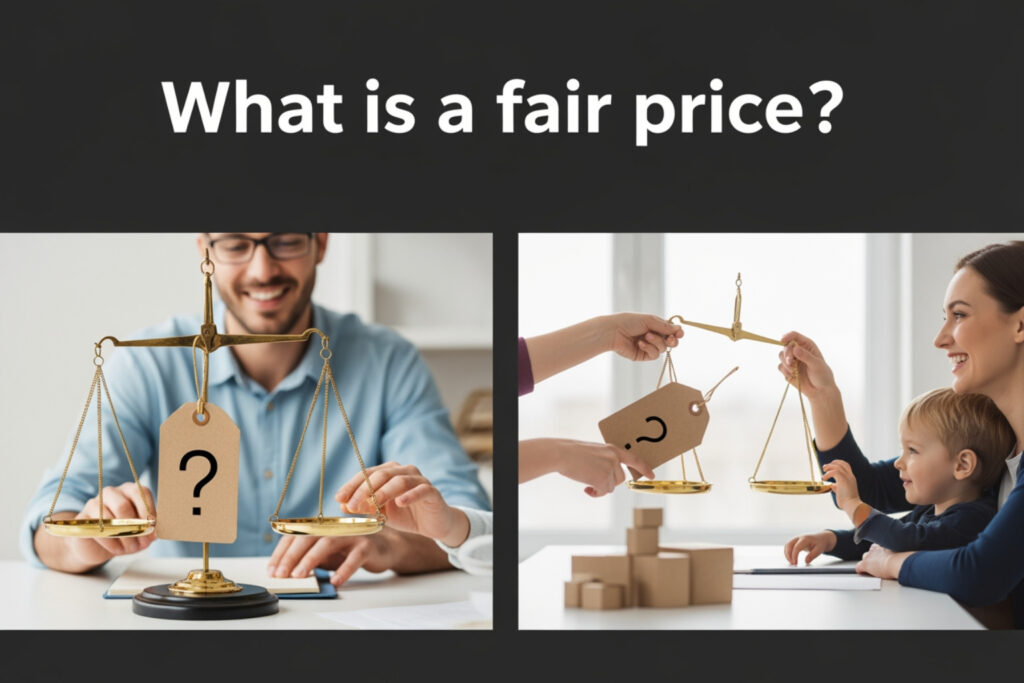
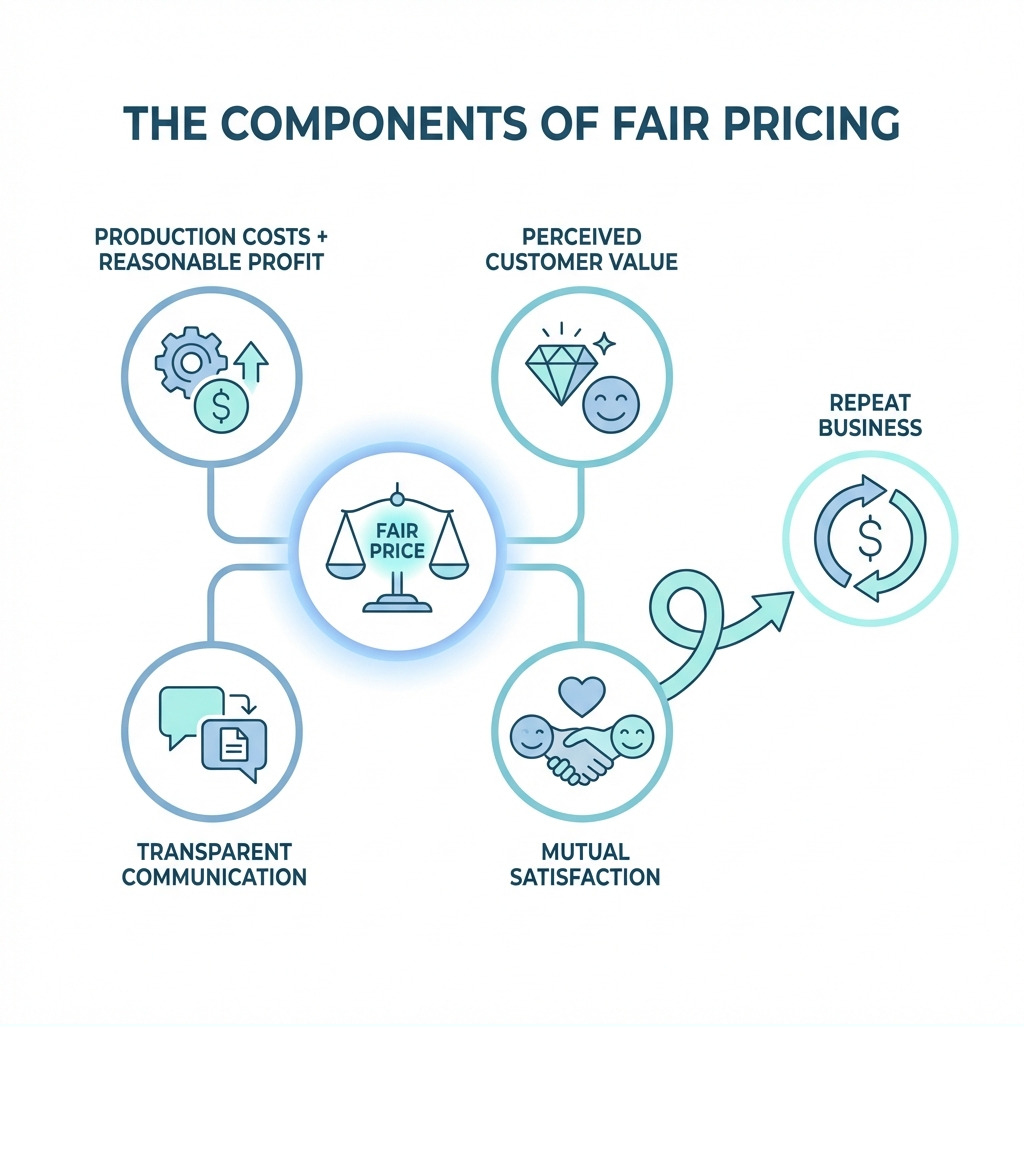
What is a fair price? A fair price is the equilibrium point where both buyer and seller agree on a mutually acceptable cost, ensuring neither party feels exploited. It’s not simply about being “low” or “cheap”—it’s about creating a transaction where both sides would gladly do business again. Fair pricing balances:
- Production costs and market conditions — covering legitimate business expenses while remaining competitive
- Perceived value and quality — reflecting the actual benefit delivered to the customer
- Ethical considerations — incorporating fair wages, sustainable practices, and transparent dealings
- Mutual satisfaction — achieving what experts call the “double thank-you” moment, where both parties genuinely feel good about the exchange
This definition challenges the purely economic view that any price someone pays is automatically “fair.” Research from Wharton and behavioral economists shows that fairness is deeply tied to feelings about a transaction, not just economic rationality. When a customer resents paying—even if they willingly agreed—the price wasn’t truly fair. When a service provider feels pressured to undervalue their expertise, that’s not fair either.
For small business owners navigating web design, SEO services, or digital marketing, this distinction is critical. You’ve likely encountered wildly different price quotes for similar services and wondered: What’s actually fair here? The answer isn’t found in the lowest bid or industry averages alone. It’s in understanding the objective factors (time, expertise, tools, results) and subjective elements (trust, communication, long-term value) that together create genuine fairness.
Without this understanding, businesses risk two painful outcomes: overpaying for substandard work, or underpaying and receiving work from providers who “don’t want to be there”—neither of which builds the foundation for growth. Fair pricing creates sustainable relationships where quality work gets properly compensated and clients receive genuine value.
I’m Jeff Pratt, owner of JPG Designs, and for over 15 years I’ve helped hundreds of businesses navigate the question of what is a fair price for web design, SEO, and digital marketing services. My approach focuses on transparent communication about costs, scope, and expected outcomes—ensuring both our team and our clients achieve that “double thank-you” moment.
Simple What is a fair price? glossary:
What is a fair price? Understanding the Psychology of Value
When we ask, “What is a fair price?” we aren’t just asking for a number. We are asking for a feeling. In digital services, a business owner might receive three different quotes for a website: one for $500, one for $5,000, and one for $50,000. Economically, all three could be “rational” depending on the scope, but the perception of fairness varies wildly based on what the buyer expects to receive.

Subjective Feelings vs. Economic Rationality
Traditional economists often argue that if a transaction occurs, the price was fair because both parties agreed to it. However, behavioral science tells a different story. In a scientific research on perceptions of fair prices, researchers found that consumers rely on “reference prices”—what they’ve paid in the past or what they think the seller’s costs are—to determine fairness.
If a customer feels a company is raising prices just to exploit a shortage (like surge pricing during a storm), they perceive it as unfair, even if they pay it. Conversely, if a service provider delivers immense value in a short time, the price can still feel fair. For example, a consulting engagement priced at $3,500 that takes only 20 minutes can result in an effective hourly rate of over $10,000. Yet, if the client’s problem is solved perfectly, both parties often leave happy. This is because the true value of a website for small business isn’t measured in the hours spent coding, but in the revenue it generates.
The Dual Entitlement Principle
The “Dual Entitlement” principle suggests that consumers believe they are entitled to a reasonable price, while firms are entitled to a reasonable profit. Perceptions of unfairness arise when one party tries to infringe on the other’s entitlement. If a firm raises prices simply because they can, it’s seen as a violation. But if they raise prices because their own costs (like labor or materials in Rhode Island or Massachusetts) have gone up, consumers are much more likely to accept it as fair.
The Difference Between Market Value and a Fair Price
It is easy to confuse “market value” with a “fair price,” but in the eyes of the law and accounting, they are distinct concepts.
- Market Value: This is the price an asset would fetch in the open market under current supply and demand conditions. It can be volatile and driven by trends.
- Fair Price (or Fair Market Value): This assumes a more stable environment. According to Fair Market Value (FMV): Definition and How to Calculate It, FMV requires that both the buyer and seller are knowledgeable, acting in their own best interest, and—crucially—not under any pressure to transact.
In our industry, pricing for web services often settles into a “fair” range when both parties understand the complexity of the work. An “arm’s length transaction” means neither party has a prior relationship that would unfairly influence the price. When we provide a quote for a business in Amherst or Grafton, MA, we look at comparable projects and the specific local challenges to ensure the price reflects the intrinsic worth of the work, not just a fleeting market trend.
How Consumer Perceptions Define What is a Fair Price
How you present a price often matters as much as the price itself. This is known as “framing.”
Framing Effects and Reference Profits
Research shows that consumers are much more sensitive to “price increases” than they are to “foregone discounts.” For example, a study found that 71% of people thought it was unfair for a dry cleaner to charge more for women’s clothes than men’s without a specific reason. However, when the price difference was justified by the extra labor required for delicate fabrics, 81% found it fair.
In the business world, firms that track time often see a 20% profit margin as the “threshold of respectability” and 30% as an ambitious goal. If a margin drops below 20%, the service provider might feel exploited. If it climbs above 40% without a massive increase in value, the client might feel the website pricing is “BS.”
The 20-30% Benchmark
While 20-30% is a common benchmark, relying solely on “cost-plus” (cost + 30%) can actually be unfair to the seller. If we use our extensive expertise to build a high-converting, mobile-first site in half the time it takes a beginner, should we be paid less because we were more efficient? This is where value-based pricing comes in. It shifts the conversation from “How long did this take you?” to “What is this worth to my business?”
The Role of Pricing Strategies: From Cost-Plus to Value-Based
Different strategies influence how “fair” a price feels over the long term.
- Cost-Plus Pricing: You calculate your costs and add a markup. It’s transparent and easy to justify, but it doesn’t always account for the quality or the “social impact” of the work.
- Value-Based Pricing: This is based on the customer’s willingness to pay based on the benefit they receive. It is often the most “fair” for experts, as it rewards results rather than just hours logged.
- Dynamic/Surge Pricing: Think of Uber during a rainy night in Providence. While economically rational (it balances supply and demand), it often leaves consumers feeling “ransomed.”
- Bargain Pricing: While attractive, if a price is too low, it can signal low quality or unsustainable business practices (like not paying fair wages).
For many, website development for small business: affordable web design services means finding the “sweet spot” where the price is accessible but high enough to ensure the job is done right the first time. According to fair value – Wikipedia, the goal is a rational and unbiased estimate that considers both objective costs and subjective benefits.
Establishing Fairness Through Transparency and Communication
The biggest enemy of fair pricing is a lack of information. When a client doesn’t understand what goes into a project, any price can feel high. We believe that “keeping the conversation going” is the best way to maintain fairness.
Communication Hacks for Fairness
To ensure a price is perceived as fair, we focus on three things:
- Justification: Explaining why a price is what it is (e.g., “This includes custom mobile-first indexing which boosts your Google rank”).
- Consistency: Ensuring that similar clients get similar pricing for similar scopes.
- Transparency: Being upfront about what is not included to avoid “scope creep” and surprise bills later.
Technical Fair Value vs. Consumer Fairness
In finance and accounting, “fair value” has a very technical definition. Accountants use a hierarchy to determine value:
| Feature | Technical Fair Value (Accounting) | Consumer Fair Price (Psychology) |
|---|---|---|
| Primary Driver | Market data and observable inputs | Feelings, trust, and reference prices |
| Inputs | Level 1 (Quoted prices), Level 2 (Observable), Level 3 (Unobservable) | Personal experience, word-of-mouth, perceived effort |
| Goal | Accurate financial reporting (Mark-to-Market) | Mutual satisfaction and repeat business |
| Regulation | Governed by ASC 820.10.20 Glossary | Governed by social norms and ethics |
While a CFO might look at Level 1 inputs (quoted prices in active markets), a small business owner in Massachusetts is looking for a partner they can trust. They want to know that the price they are paying is consistent with industry norms and that the provider isn’t trading on their lack of technical knowledge.
Steps for Buyers and Sellers to Ensure Fair Practices
How can you tell if you’re getting a fair shake? Whether you are buying SEO services or selling custom furniture, follow these steps:
For Buyers:
- Get detailed quotes: Don’t just look at the bottom line. Compare the scope of work. Are you comparing apples to apples?
- Ask about the “Why”: A reputable professional should be able to explain their pricing without getting defensive.
- Look for the “Double Thank-You”: If you feel like you’re getting a steal, or if you feel like you’re being robbed, something is off. The goal is a price where you say “Thank you for the great work” and they say “Thank you for the fair payment.”
For Sellers:
- Avoid the “Ransom” feeling: Don’t hike prices just because a client is in a bind. It might work once, but it kills your reputation.
- Focus on ROI: Show the client how your work will pay for itself. Maximizing your ROI with SEO & Google Ads is the best way to justify a premium price.
- Be prepared to walk away: If a client refuses to pay a price that covers your legitimate costs and a respectable profit, that transaction isn’t fair to you.
Conclusion: Achieving the Double Thank-You with JPG Designs
At the end of the day, the answer to “What is a fair price?” isn’t found in a spreadsheet—it’s found in the success of the partnership. A price is fair when it allows a business to grow, a service provider to thrive, and a project to be completed with excellence.
At JPG Designs, we specialize in creating mobile-first websites that don’t just look good but actually improve your Google rankings. We know that for a small business, every dollar counts. That’s why we focus on transparency, providing clear scopes of work and data-backed strategies to ensure you see a fair return on your investment. We want to be the partner that helps you scale, ensuring that when the project is done, we both feel that “double thank-you” moment.
Ready to see what fair, high-impact digital marketing looks like for your business? Contact JPG Designs today for a consultation. Let’s build something that works as hard as you do.