Why Email Marketing Personalization Tips Matter More Than Ever in 2026
Email marketing personalization tips are in high demand right now — and for good reason. Here’s a quick summary of what actually works:
- Personalize your subject lines — personalized subject lines are 26% more likely to get opened
- Use behavioral triggers — send emails based on actions like cart abandonment or page visits
- Segment by lifecycle stage — new leads, active buyers, and lapsed customers all need different messages
- Add dynamic content blocks — one template, multiple tailored versions based on subscriber data
- Collect zero-party data — ask subscribers directly what they want via surveys or preference centers
- Optimize send timing — use past open behavior to send at the right moment for each person
- Start small, then scale — personalize one element first, measure results, then expand
Think about the last time you opened a marketing email. Was it a generic blast that could’ve gone to anyone? Or did it feel like it was written just for you?
Most people’s inboxes are flooded with the first kind. And most of those emails get ignored.
The problem isn’t email. Email still works — really well. The problem is that sending the same message to everyone is the digital equivalent of shouting into a crowd and hoping the right person hears you.
Seventy-six percent of buyers now expect personalized experiences from the brands they interact with. Yet most businesses are still sending one-size-fits-all broadcasts and wondering why their open rates are flat.
The gap between what subscribers expect and what most businesses deliver is exactly where the opportunity lives.
I’m Jeff Pratt, owner of JPG Designs — a Rhode Island-based digital agency where I’ve spent over 15 years helping businesses build marketing systems that actually drive revenue, including implementing email marketing personalization tips that turn generic campaigns into high-converting, relationship-building engines. Let’s break down exactly how to close that gap.
Common Email marketing personalization tips vocab:
Essential Email Marketing Personalization Tips for 2026
As we head into 2026, the sheer volume of digital noise is staggering. With over $347 billion emails sent every day, your message isn’t just competing with other businesses; it’s competing with family photos, news alerts, and social media notifications. If your email doesn’t immediately signal relevance, it’s headed straight for the trash—or worse, the spam folder.
True personalization is the “secret sauce” that transforms a generic broadcast into a one-on-one conversation. It’s no longer just a “nice-to-have” feature; it’s the baseline for modern marketing. When we get it right, the results are measurable and massive. Research shows that personalization leaders commonly achieve 5–15% revenue lifts from these targeted approaches.
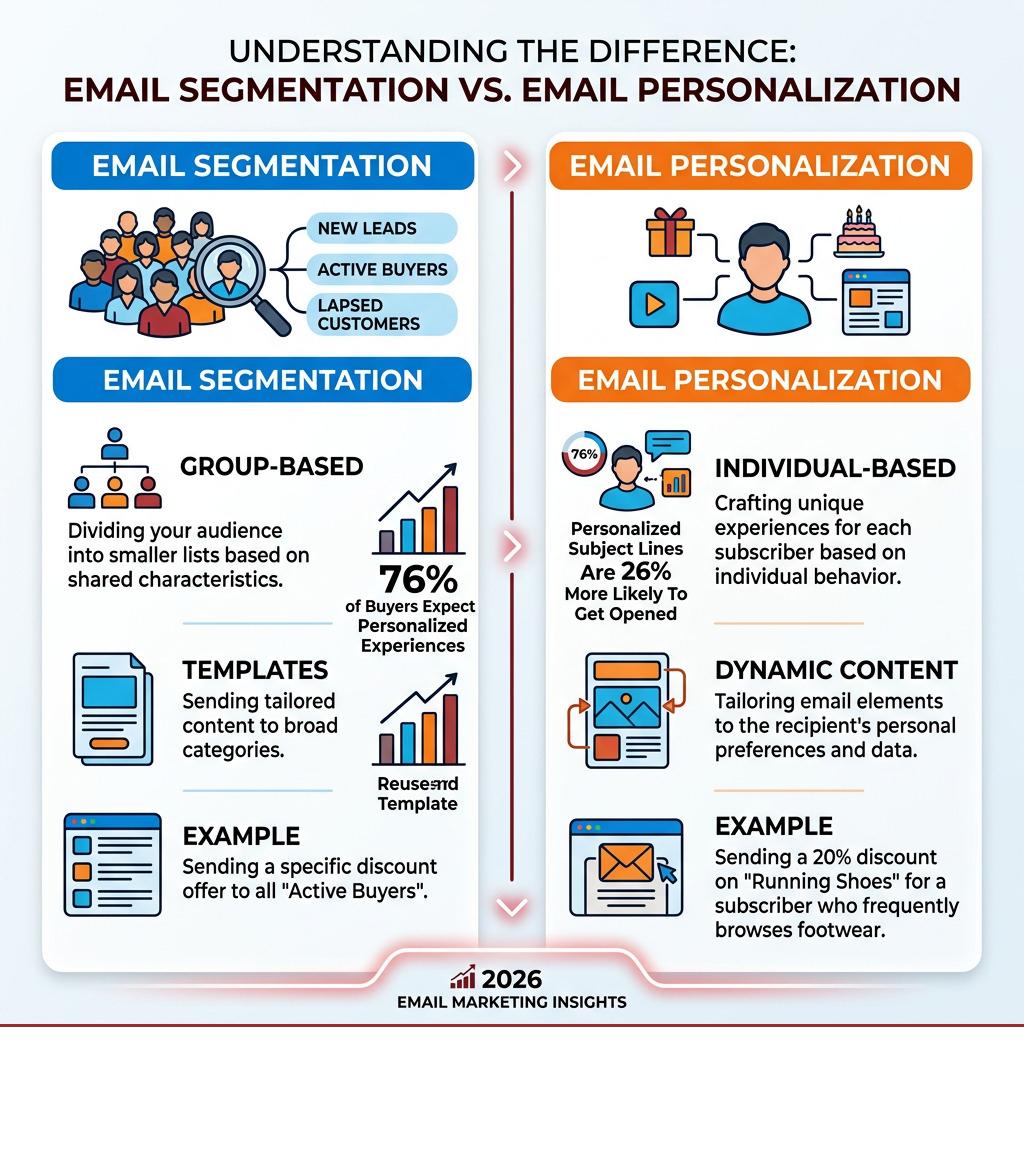
But what exactly is the difference between segmentation and personalization?
Think of segmentation as the foundation. It’s the process of grouping your audience based on shared traits—like all our clients in Rhode Island or everyone who signed up for a newsletter in Massachusetts. Personalization is what you build on top of that foundation. It uses individual data points to customize the actual content each person sees.
For example, segmentation tells you to send a winter maintenance checklist to your New England subscribers. Personalization allows you to say, “Hi Mark, since you live in Providence and we’re expecting six inches of snow tomorrow, here is a 10% discount on snow blower tune-ups.”
76% of buyers expect these tailored experiences because they reflect a brand’s commitment to understanding their specific needs. To stay ahead, you need to move beyond basic “Hi {First_Name}” tags and dive into advanced-email-analytics to understand what your users actually want.
| Feature | Basic Segmentation | Hyper-Personalization |
|---|---|---|
| Audience | Broad groups (e.g., “Men over 30”) | Individuals (e.g., “John Smith”) |
| Data Source | Static demographics | Real-time behavioral data |
| Content | Same message for the whole group | Unique content blocks per recipient |
| Timing | Scheduled blasts | Triggered by specific actions |
| Outcome | General awareness | High conversion & loyalty |
Solving Data Silos for Email Marketing Personalization Tips
The biggest hurdle most businesses face isn’t a lack of creativity—it’s a lack of organized data. If your customer information is scattered across sticky notes, different spreadsheets, and three different software platforms, you can’t personalize effectively.
To implement the best email marketing personalization tips, you need to understand the three types of data:
- Zero-Party Data: This is the “gold standard.” It’s information that customers intentionally and proactively share with you. Think of preference centers, surveys, or polls. If you ask a subscriber, “Are you interested in web design or SEO?” and they answer, they are giving you the keys to their heart.
- First-Party Data: This is data you collect through your own channels—website visits, purchase history, and email engagement. 83% of customers are willingly sharing this data for a more personalized experience.
- Second-Party Data: This is essentially someone else’s first-party data that you’ve acquired through a partnership.
Unifying this data into a single “source of truth” (usually a CRM) is essential. When your email tool talks to your sales data, magic happens. You can stop sending “Welcome” emails to people who have been customers for five years. Instead, you can follow our unlocking-the-power-of-email-a-step-by-step-guide to ensure your data flows seamlessly from sign-up to sale.
However, with great data comes great responsibility. Privacy compliance is not optional. Whether you’re dealing with local regulations in Massachusetts or international laws like GDPR, you must ensure you have explicit consent. Transparency builds trust; “creepy” personalization (using data the customer didn’t know you had) destroys it.
Using Dynamic Content to Fix Low Engagement
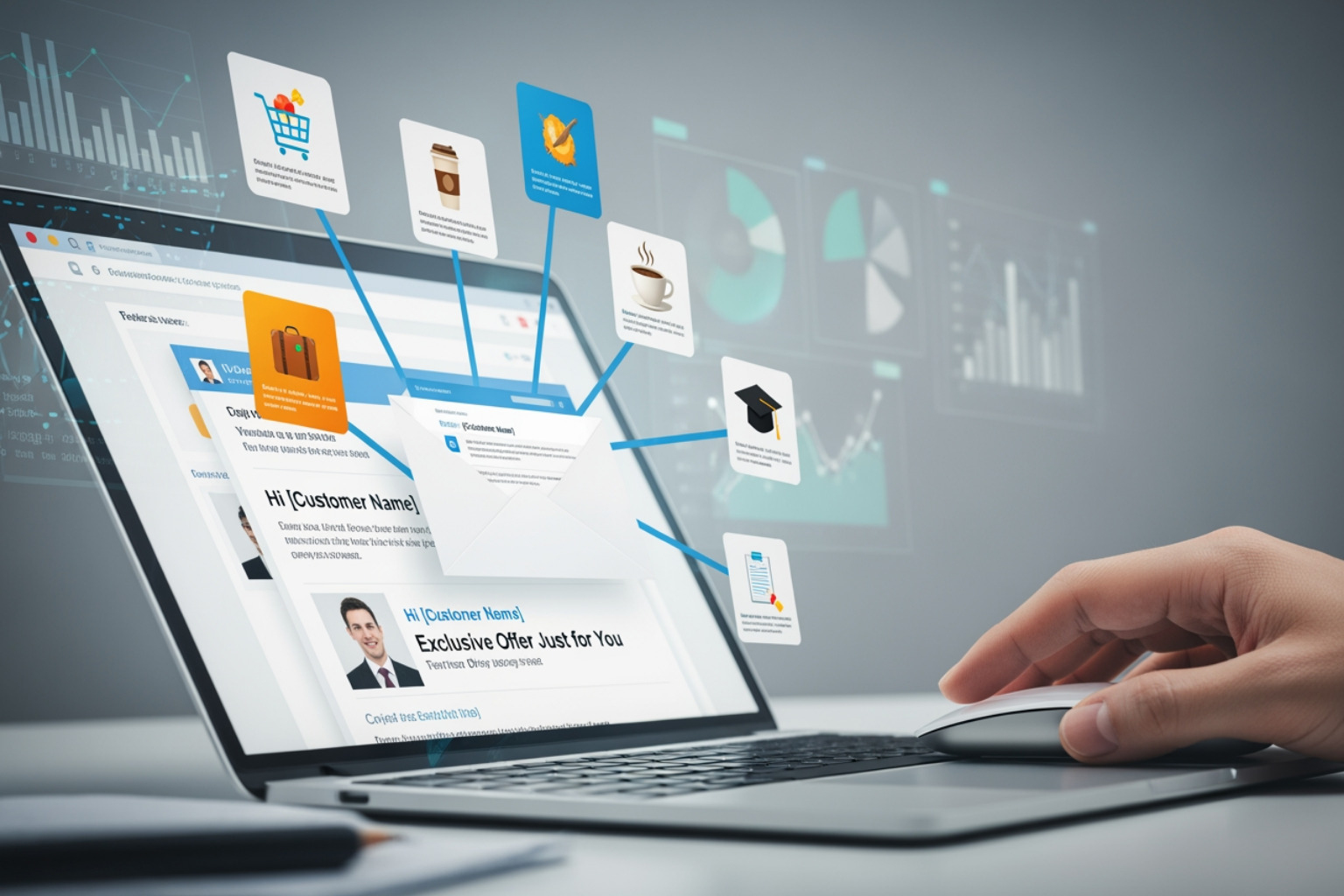
If you want to see an immediate jump in your metrics, stop sending static emails. Dynamic content allows you to swap out sections of an email based on who is reading it.
One of the most effective email marketing personalization tips is the use of behavioral triggers. When a user takes a specific action—like visiting a pricing page or leaving an item in their cart—an automated, personalized email should follow. These emails are 26% more likely to be opened because they are timely and relevant.
Consider these real-time elements to boost engagement:
- Countdown Timers: Great for creating urgency for a sale ending soon.
- Live Inventory: Showing that there are only “2 items left” in the subscriber’s specific size.
- Weather-Based Offers: If it’s raining in Warwick, RI, send a promotion for indoor services.
- Personalized Images: Using the recipient’s name or company logo within the actual graphics of the email.
By moving beyond-the-basics-unlock-your-inbox-potential-with-advanced-email-marketing, you can create emails that feel like a live conversation. Only 3% of marketers currently use live or real-time dynamic content, which means using these tactics gives you a massive competitive advantage in a crowded inbox.
Scaling Human Connection with AI Email Marketing Personalization Tips
We often get asked, “How can I possibly write a personal email for 5,000 people?” The answer is AI and machine learning. AI doesn’t replace the human touch; it scales it.
AI-orchestrated programs have been shown to deliver 10–30% gains in marketing-spend efficiency. Here is how we use it to enhance our email marketing personalization tips:
- Predictive Analytics: AI can look at a customer’s past purchase history and “predict” what they are likely to buy next, allowing you to send hyper-relevant product recommendations.
- Send-Time Optimization (STO): Instead of sending your blast at 9:00 AM to everyone, AI analyzes when each individual subscriber is most likely to open their mail and delivers it at that exact moment.
- Subject Line Optimization: AI can test thousands of variations to find the specific words that trigger an open for different segments of your list.
Implementing these tools doesn’t have to be overwhelming. Our email-marketing-service-complete-guide walks you through choosing the right tech stack that fits your business size and goals. The goal is to use machine learning to handle the data crunching so you can focus on the creative strategy.
Measuring Success and Avoiding Common Pitfalls
You can’t improve what you don’t measure. When you start implementing these email marketing personalization tips, you need to look beyond just “Open Rates.” While a 26% more likely to be opened subject line is a great start, the real victory is in the conversion lift and revenue growth.
We recommend tracking:
- Click-Through Rate (CTR): Are they engaging with the personalized content?
- Conversion Rate: Did the personalized recommendation lead to a sale?
- Unsubscribe Rate: If this goes up, your personalization might be crossing the “creepy” line or feeling too intrusive.
- Revenue per Email: This is the ultimate metric for ROI.
To ensure you’re on the right track, follow a Personalized Email Best Practices Checklist. One of the most common mistakes is “over-optimization.” If you try to personalize 20 different variables at once, you’re likely to break your template or end up with “Hello {NAME_ERROR}.” Always have a “fallback”—a default version of the content that looks great even if the data point is missing.
Another critical factor is mobile-first design. Since 47% of consumers view their email app on their phone, your personalized elements must be responsive. A beautiful dynamic block that looks broken on an iPhone is worse than no personalization at all.
At JPG Designs, we specialize in bridging the gap between great design and technical performance. Whether it’s creating mobile-first websites or improving your Google rankings through integrated digital-marketing-services, we know that every piece of the puzzle—including your emails—needs to work together to build brand trust.
Stop being a stranger in the inbox. By using these email marketing personalization tips, you’re not just sending more mail; you’re building actual relationships with your customers in Rhode Island, Massachusetts, and beyond.
Ready to turn your email list into a revenue engine? Sign up for a free account with a professional email marketing solution or reach out to us at JPG Designs to help you craft a strategy that sticks.