
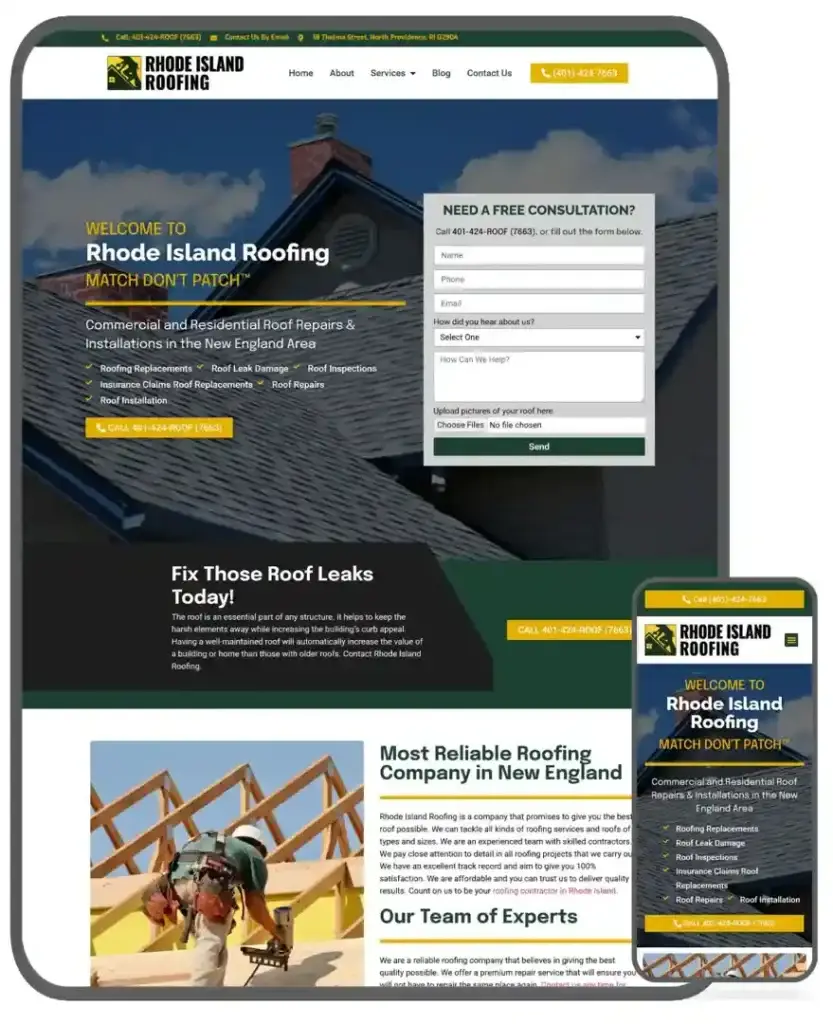
Why Website Design for Roofing Companies Can Make or Break Your Business
Website design for roofing companies is the process of building a professional, fast, and conversion-focused website that helps roofing businesses attract local homeowners, generate leads, and book more jobs.
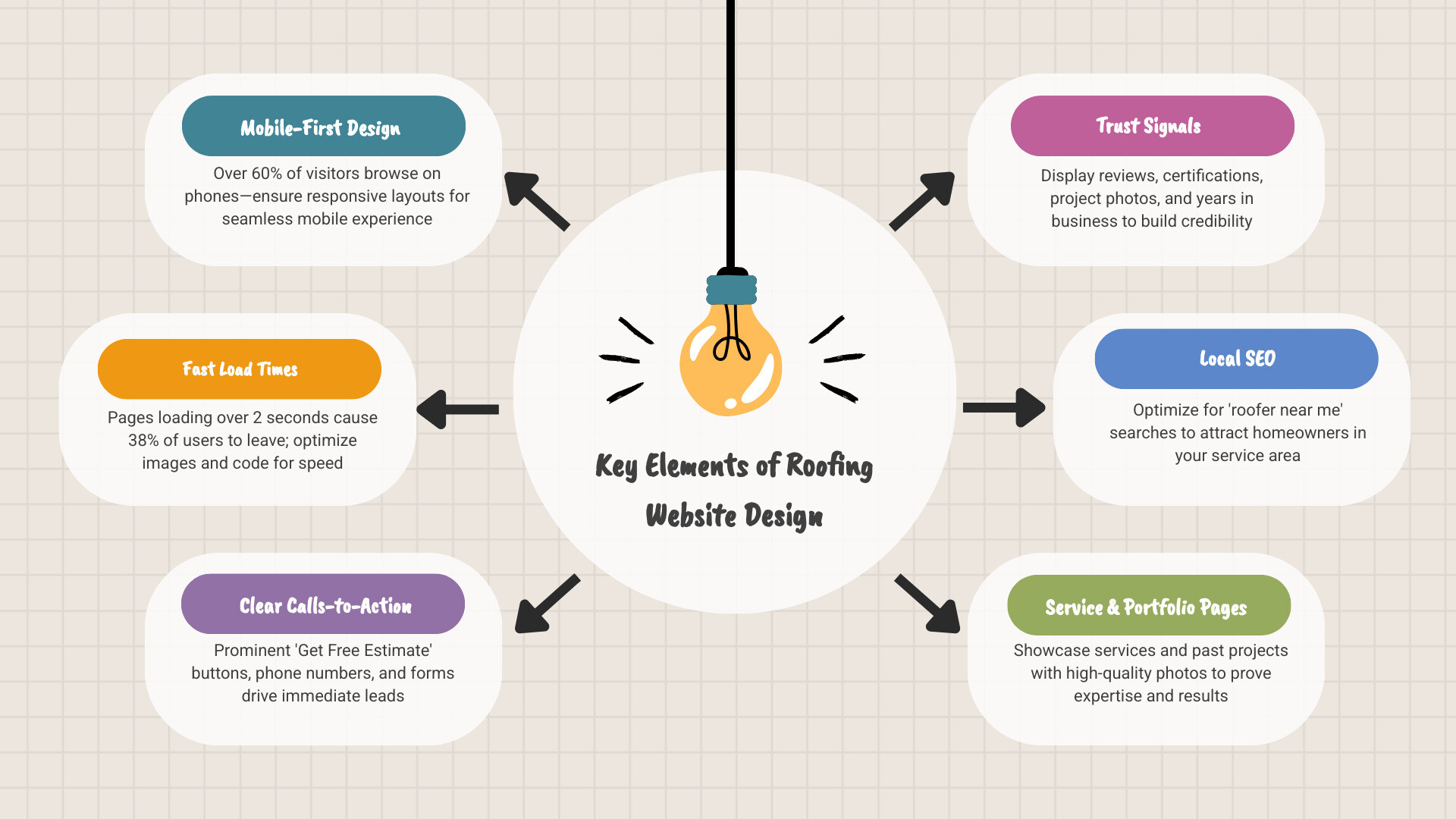
Here’s what a great roofing website needs:
- Mobile-first design — over 60% of visitors browse on their phones
- Fast load times — pages that take more than 2 seconds to load drive visitors away
- Clear calls-to-action — prominent phone numbers, “Get a Free Estimate” buttons, and contact forms
- Trust signals — reviews, certifications, project photos, and years in business
- Local SEO — so you show up when homeowners search “roofer near me”
- Service and portfolio pages — to showcase what you do and prove your work
If you’re a roofing company owner, here’s the hard truth: 78% of homeowners search online before hiring a roofer. If your website looks outdated, loads slowly, or is hard to navigate on a phone, those homeowners are clicking over to your competitor — fast.
An Adobe survey found that 38% of people will leave a site they feel is poorly designed. And in a high-ticket trade like roofing, one lost lead can mean thousands of dollars walking out the door.
A well-built roofing website isn’t just a digital business card. It’s your best salesperson — working 24/7, building trust before you ever pick up the phone.
I’m Jeff Pratt, owner of JPG Designs, and with over 15 years helping contractor and home-service businesses grow through high-converting websites and local SEO, I’ve seen what separates a roofing website that generates consistent leads from one that just takes up space — and in this guide, I’ll show you exactly what makes the difference.
Website design for roofing companies terminology:
What Makes a Great Roofing Website Design Stand Out Today?
In today’s market, a “pretty” website isn’t enough. The roofing industry is one of the most searched construction trades online, and the competition is fierce. To stand out, your website must be a high-performance engine that balances aesthetics with technical precision.
A great design today focuses on Search Engine Optimization (SEO), user-friendliness, and conversion. It’s not just about showing a picture of a roof; it’s about answering the homeowner’s questions before they even ask them. We see the best results when sites combine lightning-fast load times with interactive elements—like before-and-after sliders or 3D visualization tools—that keep users engaged.
Furthermore, the “vibe” of your site matters. While many contractors stick to traditional blue and white, we’ve seen success with bold, dark themes that make high-quality project photos pop. Whether you go for a “soft military” feel or a family-oriented, approachable look, your design should reflect your unique brand identity.
Why Roofing Companies Need a Professional Website
The days of relying solely on “word of mouth” or the Yellow Pages are long gone. For a modern roofer, a professional website is the foundation of your entire digital marketing for roofers guide.
- Credibility and Trust: A professional site proves you aren’t a “storm chaser.” When a homeowner sees a site with 40 years of history, hundreds of five-star reviews, and clear certifications, their anxiety levels drop.
- 24/7 Lead Generation: Your crew sleeps, but your website doesn’t. A well-placed “Request a Quote” form allows you to capture leads at 9:00 PM when a homeowner finally has a moment to deal with that leak.
- Competitive Advantage: If your competitor has a clunky, slow site and yours is sleek and mobile-responsive, you’ve already won the first round of the battle for the customer’s attention.
Essential Pages and Features Every Roofing Website Should Include
We recommend a specific structure to ensure your site covers all the bases. A “thin” website with only three pages won’t rank well and won’t convert.
The Homepage: Your Digital Storefront
Your homepage needs to pass the “50-millisecond test.” Research shows visitors make an impression in that tiny window of time. It should feature a bold headline, a clear Call-to-Action (CTA) like “Get a Free Inspection,” and immediate trust signals like your Google rating or industry badges.
Service Pages
Don’t just list “Roofing.” Create individual pages for residential roofing, commercial roofing, roof repair, and gutter installation. This is vital for web design roofing installation repair because it allows you to rank for specific search terms.
The Gallery/Portfolio
Pictures are worth a thousand words, especially in roofing. Use high-resolution images of your completed projects. Interactive maps showing where you’ve worked in Rhode Island or Massachusetts can also help homeowners see that you are active in their specific neighborhood.
About Us
Roofing is a personal business—you are literally standing on someone’s home. Use this page to introduce your team, show your face, and tell your story. Authenticity builds a bridge that a generic template never can.
Contact and Quote Forms
Keep these simple. We’ve found that forms with six or fewer fields perform best. Also, consider adding a “text for a quote” option, as many younger homeowners prefer texting over phone calls.
How Roofing Websites Optimize for SEO and Local Search Rankings
If your website is a billboard in the middle of the woods, no one will see it. You need to be on the main highway—the first page of Google.
Local SEO for roofers is about dominating your specific geographic area. This involves:
- Google Business Profile (GBP): Ensuring your website is perfectly synced with your GBP so you show up in the “Map Pack.”
- Keyword Integration: Using terms like “roof repair in Providence” or “Boston roofing contractor” naturally throughout your content.
- Location Pages: If you serve multiple areas across Rhode Island and Massachusetts, create dedicated landing pages for each major city.
For a deeper dive, check out our guide on how to dominate search results with smart roofing SEO.
Key Elements of User-Friendly Design for Roofing Sites
User experience (UX) is about making the visitor’s journey as frictionless as possible. If they have to hunt for your phone number, they’ll leave.
- Sticky Navigation: Keep your menu and “Call Now” button at the top of the screen as the user scrolls.
- Scannable Content: Use bullet points, short paragraphs, and bold headers. Most people skim websites; they don’t read them like a novel.
- Visual Hierarchy: Use size and color to draw the eye to the most important elements, like your “Free Estimate” button.
How Much Does It Cost to Design and Build a Roofing Company Website?
Budget is always a top concern. The market for professional roofing websites generally falls into these brackets:
- Professional Custom Build: Typically costs between $2,500 and $10,000. This range covers design, development, basic SEO, and content creation.
- High-End Enterprise Sites: For large companies needing complex integrations (like CRM syncing or advanced portals), costs can exceed $11,000.
- Ongoing Maintenance: Expect to pay a monthly fee (ranging from $100 to $500+) for hosting, security updates, and performance monitoring.
While $49 “budget” sites exist, they often lack the SEO power and custom functionality needed to actually generate a return on investment. A single roof replacement job can pay for a high-quality website several times over.
Best Website Builders or Platforms for Roofing Businesses
We have a clear favorite here: WordPress. It powers over 40% of the internet for a reason. It offers the best balance of SEO capabilities, customization, and ownership.
- WordPress: Best for SEO and long-term growth. You own the site entirely.
- Wix/Squarespace: Good for very small startups, but they often hit a “ceiling” when it comes to advanced local SEO and custom lead-capture features.
- Custom-Coded Solutions: Necessary for massive firms, but often overkill for the average local roofing company.
Choosing the Right Web Designer Specializing in Roofing Websites
Don’t just hire “your cousin’s friend.” You need a partner who understands the roofing industry. Look for a designer who:
- Has a portfolio of contractor sites (not just bakeries or law firms).
- Understands local SEO for roofers.
- Prioritizes mobile-first design.
- Offers transparent pricing and clear communication.
A specialist knows that a roofer needs “storm damage” pages and “insurance claim” workflows, whereas a generalist might miss those critical lead-gen opportunities.
Common Mistakes Roofing Companies Should Avoid in Website Design
We see the same errors over and over. Avoid these to stay ahead:
- Using Stock Photos Only: Homeowners want to see your trucks, your crew, and your finished roofs. Generic stock photos look fake and hurt trust.
- Slow Load Speeds: If your site takes more than 3 seconds to load, you lose half your mobile traffic.
- Ignoring Mobile Users: Over 60% of your leads will come from a smartphone. If your site is just a “shrunken” version of the desktop site, it’s failing.
- Self-Centric Content: Don’t just talk about how great you are. Talk about how you solve the customer’s problem (e.g., “We stop leaks fast so you can sleep easy”).
How Roofing Websites Effectively Convert Visitors into Leads
Conversion is the “Lead-Gen Blueprint.” To turn a visitor into a caller, you need:
- Prominent CTAs: Use a contrasting color for your “Get a Quote” buttons.
- Lead Magnets: Offer something of value, like a “Free 21-Point Roof Inspection Guide.”
- Social Proof Near Forms: Place a “5-star” badge or a quick testimonial right next to your contact form to give that final nudge of confidence.
For more strategies, see the lead-gen blueprint for roofers: how to fill your pipeline.
The Role of Trust Factors: Testimonials, Reviews, and Certifications
In roofing, trust is the primary currency. High-ticket jobs ($7,500–$14,500+) require a high level of confidence.
- Google Reviews: Showcase these prominently. A company with over 120 five-star reviews is an easy choice for a homeowner.
- Manufacturer Badges: Being a GAF Master Elite or Owens Corning Preferred Contractor carries weight.
- Longevity: If you’ve been in business for 40 years, shout it from the rooftops (pun intended).
Templates vs. Custom Website Design for Roofing Companies
Should you use a template or go custom?
- Templates: Cheaper and faster to launch. However, they can make you look exactly like your competitor and often come bloated with “code junk” that slows down your site.
- Custom Design: Built specifically for your brand and your local market. It’s optimized for speed and conversion from day one.
In the long run, roofing company websites that invest in custom design see a much higher ROI because they rank better and convert more visitors.
Importance of Mobile Responsiveness and Fast Loading Speed
This is our specialty at JPG Designs. Google uses mobile-first indexing, meaning it looks at the mobile version of your site to determine your ranking.
- Speed: Use WebP image compression and caching plugins to keep load times under 2 seconds.
- Responsiveness: Ensure buttons are large enough to be clicked by a thumb and that phone numbers are “click-to-call.”
Content Strategies That Work: Blogs and Beyond
A blog isn’t just for fun; it’s an SEO goldmine. Topics like “How to Spot Hail Damage” or “The Best Shingles for New England Weather” attract homeowners who are in the “research phase.”
- Educational Content: Build authority by answering common questions.
- Video Content: A 30-second video of an inspection or a drone flyover of a completed job can drastically increase the time a user spends on your site.
Check out our roofer marketing strategies for more content ideas.
Showcasing Services, Portfolios, and Past Projects Effectively
Don’t just dump photos into a folder. Organize your portfolio by:
- Service Type: (e.g., Asphalt Shingle, Metal Roofing, Slate).
- Location: (e.g., “Recent Projects in Warwick, RI”).
- Before and After: This is the most powerful way to demonstrate value. Use a slider tool to let customers see the transformation for themselves.
Conclusion: Building Your Digital Revenue Engine
Website design for roofing companies is an investment in your company’s future. By focusing on speed, mobile-first design, and local SEO, you transform your website from a static page into a “revenue engine.”
Whether you are looking to dominate the search results in Rhode Island or expand your reach in Massachusetts, your website is the most critical tool in your shed. Ready to stop leaving money on the table?
Explore our additional resources for roofers:
- Roofing Websites Complete Guide
- PPC for Roofers
- Beyond the Hammer: Essential Internet Marketing Services for Roofers
At JPG Designs, we specialize in building these high-performance sites. Let’s build something that works as hard as your crew does.