

Why Understanding “Full Service” Can Change How You Grow Your Business
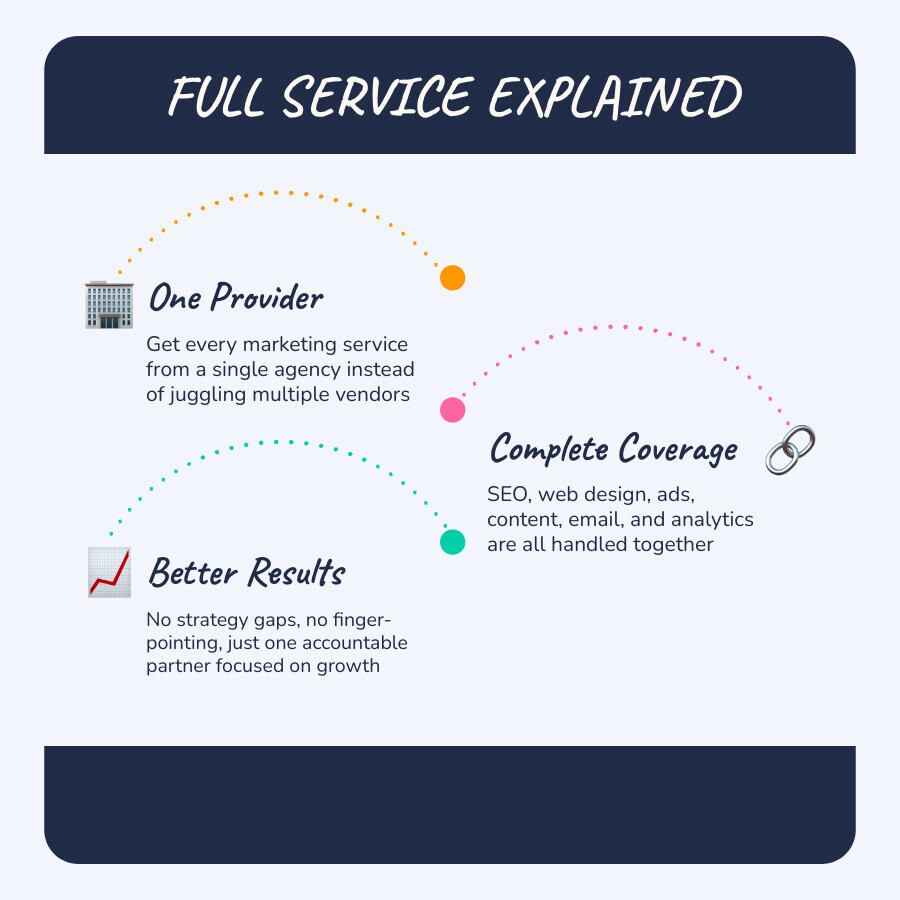
What is full service? In simple terms, it means getting everything you need from one provider — rather than stitching together a dozen different vendors.
Quick answer:
| Context | What “Full Service” Means |
|---|---|
| General business | A complete package of related services offered in one place |
| Digital marketing | One agency handles SEO, web design, ads, content, and more |
| Hospitality/hotels | All amenities included — dining, concierge, room service |
| Automotive | Mechanic handles all inspections, fluids, filters, and checks |
| Restaurants | Table service with full wait staff and a complete menu |
The core idea is the same across every industry: one source, complete coverage, less hassle for the customer.
For small and mid-sized business owners, this matters a lot. You’re already stretched thin. Managing separate vendors for your website, SEO, ads, and content is exhausting — and often leads to fragmented strategies, inconsistent messaging, and wasted budget.
A full-service digital marketing provider solves that by handling your entire growth system under one roof. No finger-pointing between vendors. No strategy gaps. Just one accountable partner focused on your results.
I’m Jeff Pratt, owner of JPG Designs — a Rhode Island digital agency with over 15 years of experience helping businesses answer What is full service? in a way that actually drives leads, rankings, and revenue. In this guide, I’ll break down exactly what full-service digital marketing includes, what it doesn’t, and how to choose the right partner for long-term growth.
What is full service? basics:
- What are marketing services?
- agencia de marketing digital
- digital marketing expert
What is full service? A clear definition for businesses and marketers
In the broadest sense, the term refers to a business model designed to meet a customer’s needs entirely within one location or through one contract. Whether you are looking for a full-service definition and meaning in a dictionary or searching for a partner to handle your company’s online presence, the goal is convenience and value.
For us at JPG Designs, providing a “complete package” means we don’t just build you a website and wish you good luck. We handle the technical SEO, the mobile-first design, and the ongoing lead generation strategies that keep your phone ringing in Rhode Island, Massachusetts, and beyond.
From a business perspective, the meaning and examples of full service revolve around building customer loyalty. When a business provides everything a client needs, it creates a “one-stop-shop” environment that encourages repeat business. However, offering this model requires a deep understanding of costs. A provider must balance direct costs (the labor and materials for the specific task) with indirect costs (rent, insurance, and software) to ensure the price reflects the perceived value to the customer.
What is full service? The general meaning across industries
To understand why this model is so popular today, it helps to look at how other industries use it:
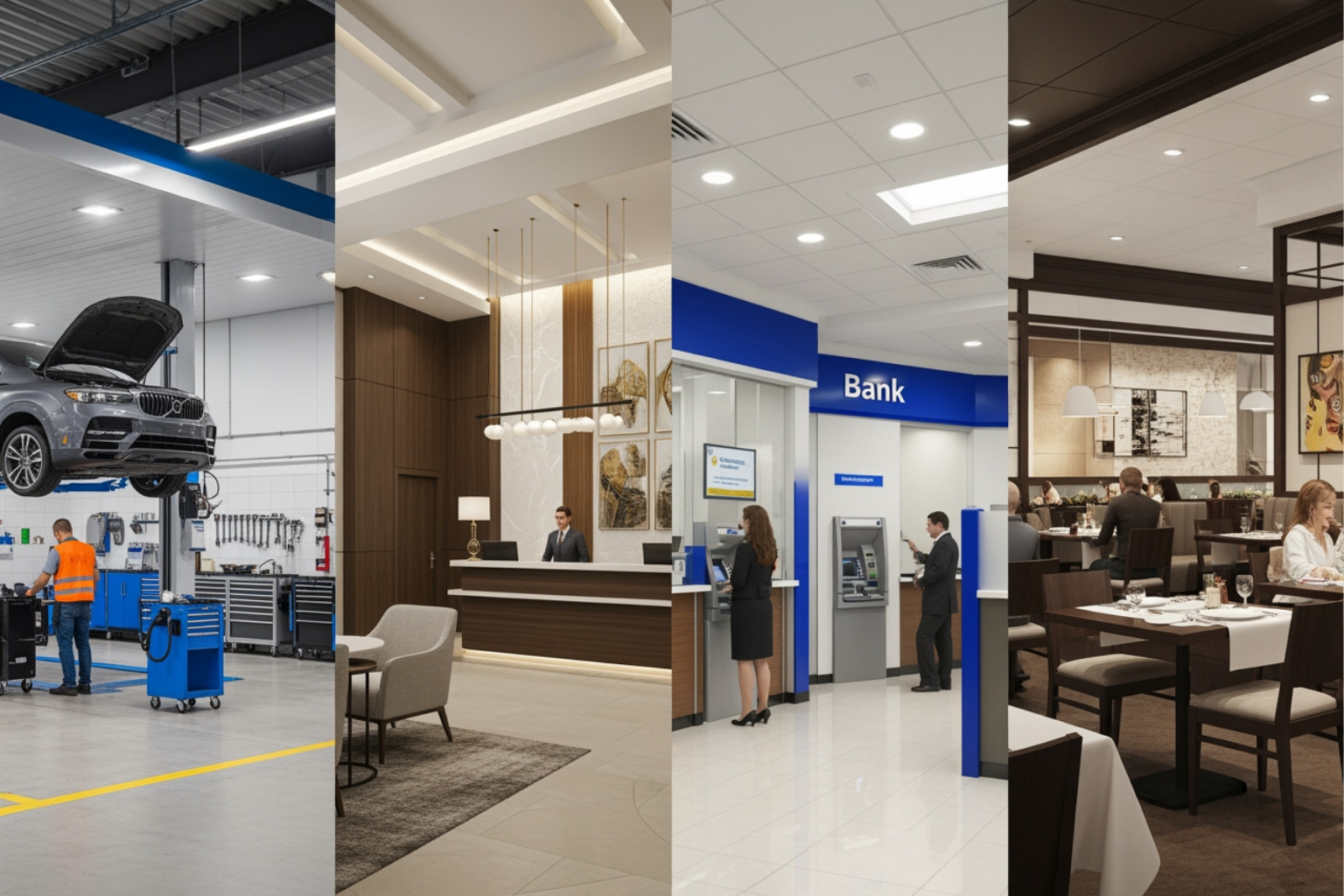
- Automotive: A full car service is a comprehensive health check for your vehicle. Unlike a quick oil change, a full service typically takes about 1 hour and 30 minutes and is recommended every 12,000 miles. It includes engine oil and filter changes, battery checks, fluid top-ups, and inspections of the brakes and suspension.
- Hospitality & Hotels: A full-service hotel goes beyond a bed and a bathroom. It includes on-site restaurants, room service, a fitness center, and often a concierge to help you navigate the local area.
- Restaurants: According to a complete guide for restaurant owners, a full-service establishment is one where guests are seated by a host, orders are taken at the table, and the meal is delivered by waitstaff. It’s about the experience and hospitality as much as the food.
- Banking: Modern full-service banks provide more than just a checking account; they offer investment products, loans, and financial planning all under one roof.
- Gas Stations: While rare today, the classic full-service gas station involved an attendant who pumped your fuel, washed your windows, and checked your tire pressure while you stayed in the car.
What is full service in digital marketing specifically?
The “full service” label means an agency has the internal expertise to handle the entire “customer journey.” Instead of hiring a separate designer, a separate SEO guy, and a separate ad manager, you hire one team that ensures all those pieces talk to each other.
A truly integrated agency model includes:
- Strategy: Mapping out how to get from where you are to where you want to be.
- Web Design & Development: Creating a website design service that works perfectly on mobile devices.
- SEO (Search Engine Optimization): Ensuring you show up when customers in Connecticut or New Hampshire search for your services.
- PPC (Pay-Per-Click): Managing Google Ads to get instant traffic.
- Content & Email Marketing: Keeping your brand top-of-mind with helpful info and email marketing services.
- Analytics & Reporting: Showing you exactly where your money is going and what kind of ROI you’re getting.
By choosing this route, you ensure that your marketing services and their impact are consistent. Your ads will match your landing pages, and your blog posts will support your SEO goals.
How full service differs from specialized or piecemeal marketing help
Many business owners start by hiring a freelancer for a logo or a niche agency for just one social media platform. While this can seem cheaper upfront, it often leads to “coordination chaos.”
| Feature | Full-Service Agency | Specialized/Piecemeal |
|---|---|---|
| Strategy | Unified and holistic | Fragmented and narrow |
| Communication | One point of contact | Multiple vendors to manage |
| Messaging | Consistent brand voice | Risk of “brand personality” split |
| Accountability | The agency owns the results | Vendors may blame each other |
| Execution | Faster (internal teams) | Slower (waiting on external handoffs) |
When you use piecemeal help, you become the project manager. You have to explain your goals to four different people and hope they all play nice together. The role of a cutting-edge marketing agency is to take that burden off your shoulders so you can actually run your business.
What a full service digital marketing provider includes and why it solves common growth problems
Small businesses often hit a “growth ceiling.” You’re doing okay, but you can’t seem to break through to the next level of revenue. Usually, this is because your marketing is reactive rather than proactive. You might post on Facebook when you remember, or fix a broken link on your site when someone complains.
A full-service provider switches you to a “solution-first” mindset. We look at your business goals — like wanting 20 new leads a month — and build the entire conversion path to make it happen.
Core services usually included in a full service marketing package
When you partner with a team like ours, you aren’t just buying hours; you’re buying a system. Here is what typically lives inside that system:
- Mobile-First Web Design: Since Google now uses mobile-first indexing, your site must look and work better on a phone than on a desktop. This is our specialty at JPG Designs.
- Search Engine Optimization: This includes SEO services Rhode Island businesses need to beat local competitors, as well as technical SEO to keep the “engine” of your site running smoothly.
- Lead Funnels & Landing Pages: We don’t just send traffic to your homepage; we build specific pages designed to turn visitors into callers.
- Google Ads & Local SEO: We make sure you appear in the “Map Pack” and at the top of search results exactly when someone is looking for you.
- Website Maintenance: Keeping your site secure and updated so it never goes down when a customer needs you.
Common misconceptions about “full service” and what it does not automatically include
It is a common myth that “full service” means “infinite work for one flat fee.” That isn’t quite how it works. A full service contract definition usually specifies a scope of work. For example, in elevator maintenance, a full-service contract might cover all labor and parts, but it doesn’t mean the contractor will also paint the lobby for free.
In marketing, “full service” does not automatically include:
- Unlimited Budget: You still pay for your actual ad spend (the money that goes to Google or Meta).
- Sales Guarantees: We can lead the horse to water (get the lead to your inbox), but your team still has to close the sale.
- Creative Ownership: Always check your contract to ensure you own the assets created for you once the bill is paid.
- Instant Results: SEO takes time. A “full service” approach is a marathon, not a sprint.
Why context matters when people search “what is full service?”
It’s important to note that the phrase What is full service? can lead to very different search results depending on the industry.
For example, in the sex work or escort industry, “full service” (often abbreviated as FSSW) has a very specific meaning. It typically indicates that a provider offers penetrative intercourse as part of their services, distinguishing them from providers who only offer non-penetrative options like body rubs or “hand jobs.” While this is a vastly different world from digital marketing, it highlights why What is full service? is such an ambiguous term.
Similarly, in the legal world, a “full service contract” might refer to an aviation deal where a company provides the aircraft, the pilots, the fuel, and the catering for a single fee. Because of this search ambiguity, it is vital to be clear about the context when you are vetting a provider. Always ask for a detailed list of deliverables to avoid any confusion.
How to choose the right full service marketing agency for safer, smarter long-term growth
Choosing an agency is like choosing a business partner. You want someone who understands the local landscape in New England — from the coastal vibes of Maine to the busy streets of Providence, Rhode Island.

Questions to ask before hiring a full service provider
Before you sign a contract, you need to peel back the curtain. Use this list of vetting questions:
- What is your experience with mobile-first indexing? (If they don’t mention this, run! It’s how Google ranks sites today).
- Can you show me web design and development examples from my industry?
- Who owns the data and the website if we stop working together? (You should always own your assets).
- What is the reporting cadence? Will you get a dashboard or a monthly call to review KPIs?
- How do you handle local SEO for businesses in Massachusetts or Connecticut?
- What is included in the monthly fee versus what is an “add-on”?
Final takeaway: the best full service provider acts like a growth partner, not just a vendor
At the end of the day, a vendor just checks boxes. A partner cares about your bottom line. When you find the right digital marketing services, you stop worrying about “the algorithm” and start focusing on your customers.
A full-service approach leads to better rankings, a stronger user experience (UX), and sustainable growth that doesn’t disappear the moment you stop paying for ads. It’s about building a digital asset that works for you 24/7.
If you’re tired of managing five different freelancers and seeing zero results, it might be time to consolidate. Let’s talk about how a unified strategy can help your business thrive across the Northeast.
Ready to simplify your growth?