Why Marketing Services Matter for Your Business Growth
What are marketing services? Marketing services are professional activities that help businesses analyze their market position, build their brand, connect with customers, and drive sustainable growth through strategic planning and execution.
Quick Answer:
- Market Analysis – Understanding your competitive landscape and customer needs
- Branding & Positioning – Defining how your business is perceived in the marketplace
- Strategic Planning – Creating data-driven campaigns that reach your target audience
- Execution & Optimization – Implementing and refining marketing tactics across channels
- Performance Measurement – Tracking results and adjusting strategies for better ROI
By the mid-20th century, for the first time in U.S. history, more people worked in service industries than in manufacturing. That shift changed everything about how businesses compete and grow. Today, nearly every business depends on some form of marketing services to survive and thrive in an increasingly digital marketplace.
But here’s the challenge: most business owners are experts at what they do, not necessarily at marketing what they do. You might run an excellent HVAC company, manufacturing operation, or nonprofit organization — but struggle to clearly communicate your value to potential customers. That’s where marketing services come in.
Marketing services solve a critical problem: loss of objectivity. When you’re deeply embedded in your own business, it’s hard to see what messaging resonates with outsiders or which channels will actually drive results. Professional marketing services bring fresh perspective, specialized expertise, and proven frameworks to help you grow.
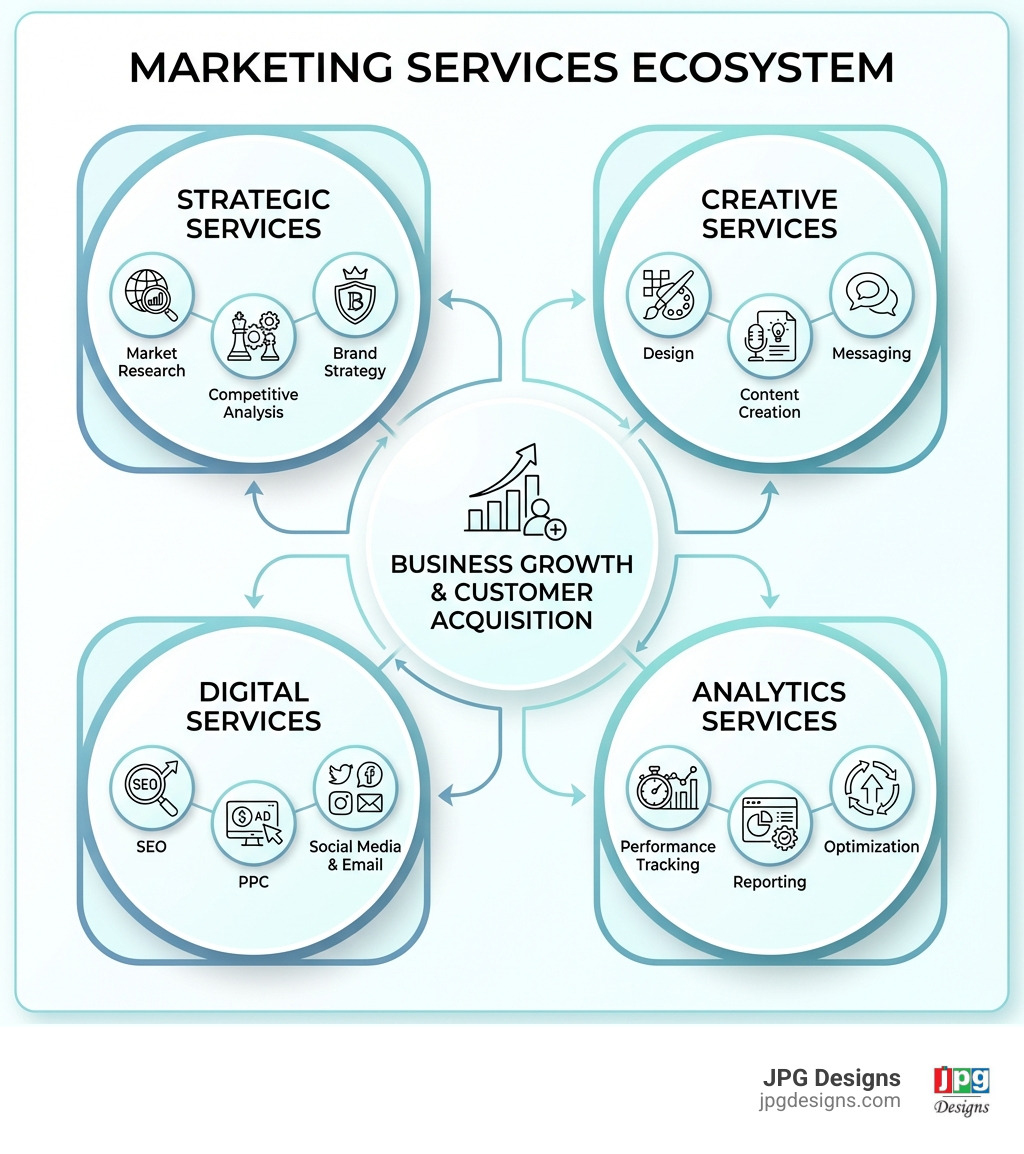
The marketing services landscape has expanded dramatically beyond traditional advertising. It now includes everything from search engine optimization (SEO) and pay-per-click advertising to content creation, social media management, email marketing, and website design. These services share one common goal: helping businesses connect their products or services with the right customers at the right time.
I’m Jeff Pratt, owner of JPG Designs, and for over 15 years I’ve helped hundreds of businesses understand what are marketing services and how to leverage them for measurable growth. Whether you’re a contractor needing more qualified leads or a B2B manufacturer trying to reach procurement teams, I’ve built marketing systems that turn websites into revenue-producing assets.
This guide breaks down everything you need to know about marketing services — from their formal definition to how they differ from physical goods, the expanded marketing mix that makes them work, and how to measure their impact on your bottom line.
What are marketing services? basics:
What are marketing services? A Formal Definition

To truly understand marketing services, we have to look past the simple act of “selling.” Formally, marketing services encompass all the activities involved in identifying, anticipating, and satisfying customer requirements profitably. Unlike a physical product you can hold in your hand, a marketing service is a series of intangible processes designed to create value for a brand.
At its core, this includes market analysis, where we dive deep into who your competitors are and what your customers actually want. It involves branding, which is the art of defining your company’s identity and how it is perceived by the public. Then there is product positioning—ensuring that your offering sits in the right “slot” in the consumer’s mind compared to everyone else.
Underpinning all of this is consumer psychology. We aren’t just throwing spaghetti at the wall; we are using data to understand why people click, why they trust, and why they buy. Whether you are looking for professional services to overhaul your corporate image or a specialized team to handle your lead generation, the formal definition remains rooted in the strategic alignment of business goals with consumer needs.
The Core Purpose of Marketing Services
The primary goal of any marketing service is value communication. You might have the best plumbing business in Rhode Island, but if no one knows you exist or understands why you’re better than the “cheap guy” down the street, your talent is wasted.
Marketing services build brand awareness so that your name is the first one that comes to mind during a crisis. They foster customer relationships by engaging with your audience through digital marketing services like social media and email. They provide the engine for sustainable growth, ensuring that your sales pipeline doesn’t dry up the moment you stop looking for work.
Why Your Business Needs Professional Marketing Services
We often see business owners in Massachusetts and Rhode Island who are “too close” to their work. This results in messaging clarity issues. For example, a business that started selling toasters might gradually expand into full kitchen appliances, but their website and tagline still only talk about toasters.
Professional services provide the objectivity needed to see these gaps. We help with:
- Resource Allocation: Ensuring you aren’t wasting money on platforms where your audience doesn’t hang out.
- ROI Tracking: Using data to see exactly where your leads are coming from.
- Strategic Direction: Moving from “random acts of marketing” to a cohesive plan.
By maximizing your ROI with SEO and Google Ads, you stop guessing and start growing based on what the numbers tell us.
The Unique Characteristics of Services vs. Physical Goods
Marketing a service—like a haircut, a legal consultation, or web design—is fundamentally different from marketing a pair of shoes. Because services are intangible, they carry a higher perceived risk for the consumer. You can’t “test drive” a marketing strategy before you buy it in the same way you can try on a jacket.
| Characteristic | Physical Goods | Marketing Services |
|---|---|---|
| Tangibility | Tangible (can be touched/seen) | Intangible (cannot be held) |
| Separability | Produced, then sold, then used | Produced and consumed at once |
| Perishability | Can be stored in inventory | Cannot be stored; “perishes” if unused |
| Variability | Standardized (mass produced) | Variable (depends on the human element) |
Managing Intangibility and Variability
Because a service is intangible, customers look for “clues” of quality. This is why your website’s design and your online reviews are so critical—they are the “physical” stand-ins for your service quality.
Variability is another challenge. A burger at a major fast-food chain is supposed to taste the same in Providence as it does in Boston. But a service depends on the person delivering it. We manage this through standardization and quality control. By providing clear SEO tips for small businesses, we help our clients create consistent online experiences that build trust even before a phone call is made.
Overcoming Perishability in Service Delivery
In services, “time is money” in a very literal sense. If a hotel room sits empty for a night, that revenue is gone forever; you can’t sell “last night’s room” today. This is perishability.
To manage this, we use demand forecasting and capacity management. By understanding time series basics, businesses can predict peak seasons (like HVAC repairs in a New England winter) and manage “idle time” during the off-season. Strategies like dynamic pricing or off-peak promotions help balance the scales so your team stays busy year-round.
Expanding the Mix: The 7 Ps of Services Marketing
You’ve likely heard of the 4 Ps of marketing: Product, Price, Place, and Promotion. However, for services, this model is too thin. To effectively market a service, we must move from a simple marketing mix to relationship marketing by adding three more elements: People, Process, and Physical Evidence.
- Product: The core benefit (e.g., a functional website).
- Price: Not just the dollar amount, but the time and effort the customer spends.
- Place: Where the service is delivered (increasingly, this is the digital “place”).
- Promotion: How you tell the world about it.
- People: Every person who interacts with the customer.
- Process: The “how” of the service delivery—is it easy to work with you?
- Physical Evidence: The tangible cues (your office, your website, your reports).
The Role of People and the Servicescape
In a service business, your People are the product. A rude receptionist or an unhelpful technician can ruin a brand’s reputation faster than a bad ad campaign. This is why employee training and internal communication are vital parts of marketing.
The Servicescape (the physical or digital environment) also plays a massive role. If you walk into a dirty dental office, you probably won’t trust the dentist’s technical skills. The same applies to your digital presence. Brand management on social media is about creating a “digital servicescape” that feels professional, welcoming, and authoritative.
Optimizing the Service Process
The Process is the series of steps a customer takes from the moment they find you to the moment the job is done. Have you ever been stuck in a “waiting line” on a website that takes too long to load? That’s a process fail.
We use service blueprinting to map out the customer journey and identify “fail points.” By using online marketing strategies to improve local business traffic, we ensure that the process—from the first Google search to the final conversion—is seamless and stress-free for the customer.
Measuring Success: Service Quality and Contemporary Logic
How do you know if your marketing services are actually working? Unlike a manufacturing plant that can count “defects” per 1,000 units, service quality is subjective.
The SERVQUAL model is a common tool used to measure this. It looks at the “gap” between what a customer expects and what they perceive they received across five dimensions:
- Reliability: Can you provide what you promised?
- Assurance: Do your employees inspire trust?
- Tangibles: Does your physical/digital evidence look good?
- Empathy: Do you care about the customer’s specific needs?
- Responsiveness: Do you get back to people quickly?
As we discuss in The Evolution of Services, the field has moved from just fixing “gaps” to a more holistic understanding of value.
Modern Perspectives on What Are Marketing Services?
The latest thinking in our industry is called Service-Dominant Logic (SDL). This perspective suggests that everything is a service. When you buy a car, you aren’t just buying metal and rubber; you’re buying a “transportation service.”
This shift emphasizes value co-creation. We don’t just “do” marketing to you; we create value with you. By using strategies for effective social media marketing, we help you engage in a two-way conversation with your customers, making them part of your brand’s story.
Performance-Only Approaches to Quality
While SERVQUAL is great, some researchers prefer the SERVPERF model, which focuses solely on performance. Instead of worrying about what the customer expected (which can be unrealistic), it measures exactly how the service performed.
This involves looking at both Technical Quality (did the website rank on Google?) and Functional Quality (was the team easy to talk to during the process?). A service quality model helps us refine our internal processes to ensure we are hitting both marks every time.
Frequently Asked Questions about Marketing Services
What are marketing services in the digital age?
Marketing services have shifted from one-way broadcasts (like billboards) to interactive experiences. This includes SEO to help you get found, PPC for immediate visibility, and Social Media for community building. If you’ve ever wondered what are Google Ads and why your business should use them, the answer is simple: they put you in front of people exactly when they are looking for your service.
How do marketing services improve customer experience?
By using journey mapping and personalization, marketing services ensure that a customer feels seen and heard. For instance, our email marketing service guide explains how to send the right message to the right person at the right time, rather than blasting your entire list with irrelevant info.
What are the 7 Ps of services marketing?
The 7 Ps are Product, Price, Place, Promotion, People, Process, and Physical Evidence. Adding People, Process, and Physical Evidence to the traditional mix allows service providers to address the unique challenges of intangibility and human variability.
Conclusion
Understanding what are marketing services? is the first step toward changing your business from a “best-kept secret” into a market leader. Whether you are operating in the busy streets of Providence or the industrial hubs of Massachusetts, your growth depends on how effectively you communicate your value.
At JPG Designs, we specialize in the “Physical Evidence” and “Process” parts of the 7 Ps. We build mobile-first websites because we know that’s where your customers are. We focus on improving Google rankings because we know that visibility equals opportunity. Our unique expertise in leveraging mobile-first indexing ensures that your business doesn’t just have a website—it has a powerful marketing tool that works as hard as you do.
Ready to see the impact professional marketing services can have on your bottom line? Get started with our digital marketing services today and let’s build something great together.