
Why Understanding SSL Certificate Costs Matters for Your Business
How much SSL certificate costs depend on the type of certificate and validation level you choose. Here’s what you need to know:
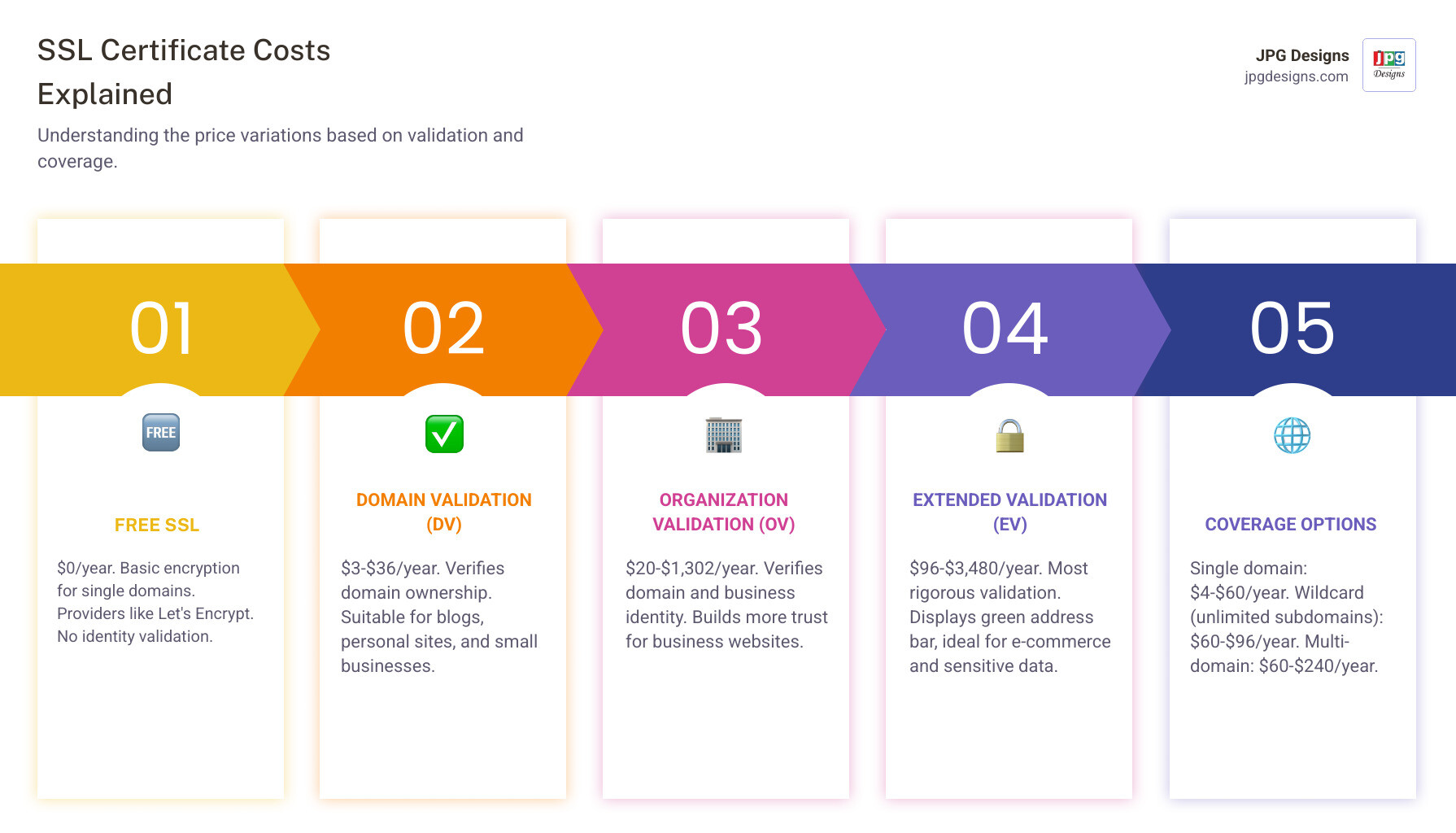
- Free SSL certificates: $0/year (Let’s Encrypt, ZeroSSL, Cloudflare)
- Domain Validation (DV): $3-$36/year – verifies domain ownership only
- Organization Validation (OV): $20-$1,302/year – verifies domain and business identity
- Extended Validation (EV): $96-$3,480/year – most thorough validation with green address bar
- Single domain: $4-$60/year
- Wildcard (unlimited subdomains): $60-$96/year
- Multi-domain (multiple sites): $60-$240/year
The average SSL certificate costs around $60/year, but prices vary based on validation level, number of domains protected, warranty coverage, and the Certificate Authority issuing it.
If you’ve ever seen a “Not Secure” warning in your browser, you know the sinking feeling it creates. That warning doesn’t just scare visitors away – it tells Google your site isn’t trustworthy. SSL certificates fix this problem by encrypting data between your website and your visitors’ browsers. They also authenticate your identity, which is why some cost more than others.
The challenge is figuring out what you actually need. Should you go with a free option? Is the cheapest paid certificate good enough? When does it make sense to invest in a premium Extended Validation certificate that costs hundreds or even thousands per year?
The answer depends on your business type, the data you handle, and the level of trust you need to build with visitors. An e-commerce site handling credit cards needs more validation than a basic blog. A multi-location business with several domains needs different coverage than a single website with a few subdomains.
As Jeff Pratt, owner of JPG Designs, I’ve helped hundreds of businesses steer how much SSL certificate investment makes sense for their specific needs – from contractors and manufacturers to nonprofits and local service providers. Through years of implementing SSL across diverse industries, I’ve learned that the right certificate isn’t about spending the most or the least – it’s about matching your security needs to your business goals.
Simple How much SSL certificate? glossary:
Understanding the Factors: How Much SSL Certificate Costs Depend on Validation
When we talk about SSL (Secure Sockets Layer) or its modern successor TLS (Transport Layer Security), we aren’t just talking about a single product. Think of it like a driver’s license versus a high-level security clearance. Both prove who you are, but the process to get them—and the trust they command—is vastly different.
The primary driver of cost in the SSL world is the validation level. This refers to the depth of the background check performed by the Certificate Authority (CA) before they issue the certificate to you. While every certificate provides the same 256-bit SHA2 encryption, the “identity” part of the certificate is what you are paying for.
How much SSL certificate validation levels impact price
Validation is the process of proving you are who you say you are. If you are just running a personal blog in Rhode Island, you might only need to prove you own the domain. But if you are a major e-commerce player in Massachusetts, your customers need to know that your business is a legally registered entity.
- Domain Validation (DV): These are the entry-level certificates. They are issued almost instantly because the CA only checks if you have control over the domain name.
- Organization Validation (OV): These require a human to check your business registry. The CA verifies your organization’s name, physical address, and telephone number.
- Extended Validation (EV): This is the “gold standard.” It involves a rigorous 16-point check, including verifying your legal, physical, and operational existence.
Understanding why your website needs an SSL certificate goes beyond just the technical encryption; it’s about establishing a professional presence that prevents users from bouncing when they see security warnings.
The cost of trust: From DV to EV
The price range for validation is wide, spanning from $3 to $3,480 per year.
- DV Certificates ($3 – $36/year): Perfect for blogs, portfolios, or internal test sites.
- OV Certificates ($20 – $1,302/year): Recommended for small business websites that collect user data through forms but don’t necessarily process high-volume payments.
- EV Certificates ($96 – $3,480/year): Essential for banks, insurance companies, and large e-commerce stores. These certificates used to be famous for the “green bar” in the browser, and while many browsers have simplified this look, clicking the padlock still reveals the full authenticated company name, which provides maximum trust.
When considering the purchasing process for an SSL certificate, you aren’t just buying a file; you’re buying the reputation of the Certificate Authority that signs it.
Pricing by Coverage: Single, Multi-Domain, and Wildcard
The second major factor in determining how much SSL certificate you’ll pay for is the “scope” of the protection. Do you have one website, or do you have a main site with dozens of subdomains like shop.yourbrand.com and blog.yourbrand.com?
How much SSL certificate coverage do you need?
Depending on your site structure, you’ll choose one of these three types:
- Single Domain ($4 – $60/year): This covers one Fully Qualified Domain Name (FQDN). For example, it protects
www.example.com. - Wildcard SSL ($60 – $96/year): This is a huge money-saver for growing businesses. A single Wildcard certificate protects your main domain and an unlimited number of subdomains. If you have
mail.example.com,dev.example.com, andstore.example.com, a Wildcard covers them all for one flat fee. - Multi-Domain (SAN) SSL ($60 – $240/year): Also known as UCC (Unified Communications Certificates), these allow you to secure multiple different domains (e.g.,
example.com,example.net, andmyotherbusiness.com) under a single certificate.
For those just starting out, our guide on how to start a website breaks down these technical requirements in even simpler terms.
Scaling security for growing businesses
As your business grows, managing 10 different SSL certificates with 10 different expiration dates becomes a nightmare. This is where Multi-Domain or Portfolio Management tools come in.
For a small business needing an online presence, we often recommend a Wildcard SSL if they plan on adding a shop or a client portal in the future. It’s much cheaper to pay $90 once than to pay $15 for five different subdomains and handle five different installations.
Free vs. Paid: Is a $0 Certificate Enough for Your Business?
This is the question we get most often at JPG Designs. With the rise of “Let’s Encrypt,” free SSL certificates have become the industry standard for millions of websites. But are they right for your business?
Limitations of free SSL options
Free certificates are fantastic for security, but they come with significant strings attached:
- Short Validity: Most free certificates expire every 90 days. While many hosts automate this, if the automation fails, your site goes down with a “Not Secure” warning.
- No Warranty: Paid certificates come with warranties (ranging from $10,000 to $2 million). If the encryption is ever cracked and a customer loses money, the warranty covers the damages. Free certificates offer $0 in protection.
- DV Only: You cannot get a free OV or EV certificate. If you need to prove your business legitimacy, you must pay.
- No Support: If something goes wrong with a Let’s Encrypt certificate, there is no help desk to call.
We always tell clients to check our website design dos and don’ts—and failing to plan for long-term security is a major “don’t.”
When to invest in a premium certificate
If you are running an e-commerce store, a paid certificate isn’t just a “nice to have”—it’s often a requirement for PCI-DSS compliance. Customers are savvy; they look for trust seals. A paid certificate allows you to display a “Dynamic Site Seal” that visitors can click to see your verified business details.
When you plan and prepare for a new website design, budgeting $15–$150 a year for a professionally signed certificate from a CA like Sectigo or DigiCert is a small price for the peace of mind it gives your customers.
Beyond the Price Tag: The ROI of Website Security
Investing in an SSL certificate isn’t just about avoiding a warning; it’s a strategic move for your bottom line.
Solving the “Not Secure” pain point
The “Not Secure” warning is a conversion killer. Research shows that most users will immediately leave a site if they see a security alert. This increases your bounce rate and tells Google that your site isn’t providing a good user experience.
- SEO Boost: For years, Google has used HTTPS as a ranking signal. Secure sites get a slight edge over non-secure ones.
- Mobile-First Indexing: As experts in mobile-first design, we know that mobile browsers are even stricter with security warnings. A secure site is essential for ranking in today’s mobile-heavy search landscape.
- Brand Reputation: An SSL certificate shows you care about your customers’ privacy.
The true value of a website for a small business is found in its ability to generate leads and sales. If a $60/year certificate prevents even one customer from leaving, it has already paid for itself.
Frequently Asked Questions about SSL Costs
Does a more expensive SSL certificate provide better encryption?
No. Whether you pay $0 or $3,000, the actual encryption “tunnel” is the same (usually 256-bit AES). The higher price pays for the identity validation and the warranty. A bank pays more so that the browser can verify they are truly “Bank of America” and not a phishing site.
Are there hidden costs associated with SSL certificates?
Sometimes.
- Dedicated IP: Older servers required a dedicated IP address for SSL, which can cost $2–$5/month. Most modern servers use SNI, which removes this requirement.
- Installation Fees: Some hosting companies charge a one-time fee to install a certificate if you didn’t buy it through them.
- Renewal Hikes: Always check the renewal price. Some providers offer a “teaser” rate of $4.99 for the first year, but then jump to $30 upon renewal.
How often do I need to pay for my SSL certificate?
Most paid certificates are sold on a 1-year subscription. Due to industry security standards, certificates can no longer be issued for longer than about a year. You will need to renew and re-install your certificate annually to keep your site secure.
Conclusion
Determining how much SSL certificate protection your business needs doesn’t have to be a headache. For a simple blog, a free or $10/year DV certificate is plenty. For a growing small business in Rhode Island or Massachusetts, a $60/year OV certificate provides the perfect balance of trust and affordability. And for the e-commerce giants, the $150+ EV certificate is a necessary investment in customer confidence.
At JPG Designs, we specialize in more than just making things look pretty. We build secure, mobile-first websites that rank. Whether you need a brand-new build or want to secure your existing site, we’re here to help.
Ready to secure your site and boost your rankings? Contact JPG Designs for a secure website today.