
Why Your Local Business is Invisible Online (And How to Fix It)
How to rank locally? Here’s the quick answer:
- Claim and optimize your Google Business Profile – Fill out every section, add photos, verify your listing, and keep your Name, Address, and Phone (NAP) consistent everywhere online.
- Optimize your website for local search – Add location-based keywords to your title tags, meta descriptions, and content. Embed a Google Map and implement local business schema markup.
- Get more customer reviews – Encourage happy customers to leave Google reviews and respond professionally to every review you receive.
- Build local citations – List your business consistently across directories, data aggregators, and local websites.
- Earn local backlinks – Partner with local businesses, sponsor community events, and get featured in local news.
- Create location-specific content – Build dedicated pages for each city or service area you want to rank in.
- Make your site mobile-friendly – 84% of “near me” searches happen on mobile devices, so responsive design and fast load times are essential.
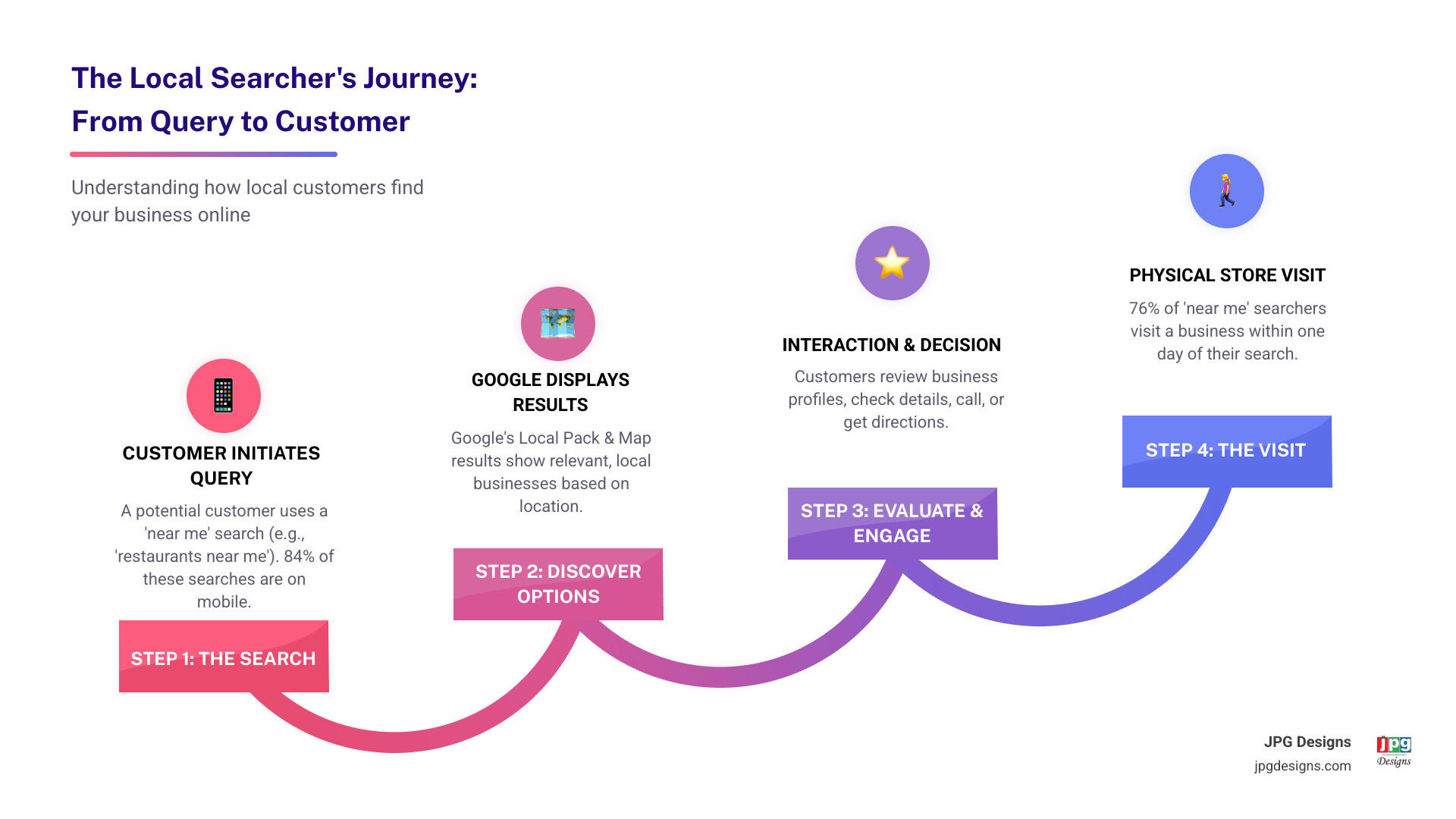
Have you ever been asked, “what should we do for dinner?” and immediately pulled out your phone to search for “restaurants near me”? That’s the power of local search. When someone searches for a business like yours, they’re not browsing casually—they’re ready to buy. In fact, 76% of consumers who search “near me” visit a business within a day.
The problem? Most small business owners are invisible in these high-intent local searches. You might have a great business, excellent service, and happy customers—but if you’re not showing up in Google’s Local Pack (that map with three business listings) or the local organic results below it, you’re losing customers to competitors who’ve figured out how to rank locally.
Local SEO isn’t just about getting more website traffic. It’s about connecting with people in your community who are actively looking for what you offer right now. When you search for “plumber near me” or “coffee shop downtown,” Google doesn’t show you results from across the country. It shows you businesses nearby that are relevant, prominent, and match what you’re looking for.
The good news? You don’t need a massive marketing budget or a computer science degree to improve your local rankings. You need a clear strategy focused on three core areas: optimizing your Google Business Profile, strengthening your website’s local signals, and building authority through reviews and local backlinks.
I’m Jeff Pratt, owner of JPG Designs, a Rhode Island-based digital agency. For over a decade, I’ve helped hundreds of local businesses—from HVAC contractors to medical offices to nonprofits—master how to rank locally and generate consistent leads from Google search.
The Foundation: Mastering Google’s Local Ranking Signals
When potential customers in Rhode Island or Massachusetts search for businesses like yours, Google’s algorithm springs into action, trying to deliver the most relevant local results. These results often appear in two prominent spots: the Local Pack (or Map Pack) and the local organic results. The Local Pack is that highly coveted box at the top of the search results page, often featuring a map and three business listings. This is prime real estate for any local business looking to answer the question, How to rank locally?

Google doesn’t just randomly pick these businesses. It uses a sophisticated set of ranking factors to determine which businesses are most likely to satisfy the searcher’s intent. According to Google itself, these factors are primarily relevance, distance, and prominence. Understanding and optimizing for these “Big Three” is the bedrock of any successful local SEO strategy. We need to tell Google, in no uncertain terms, that your business is the best fit for local searchers. To dive deeper into Google’s official advice, check out these Tips to improve your local ranking on Google.
Optimizing Your Google Business Profile for Maximum Visibility
Your Google Business Profile (GBP) is your digital storefront, the single most important tool for any business looking to master how to rank locally. Think of it as your business’s resume for Google, showcasing your services, location, hours, and reputation. Businesses with complete and accurate information are far more likely to show up in local search results.
Here’s how we ensure your GBP shines:
- Claim and Verify: The first step is always to claim and verify your business on Google. This proves you’re the legitimate owner and gives you control over your listing.
- NAP Consistency: This is non-negotiable. Your business’s Name, Address, and Phone number (NAP) must be identical across your GBP, your website, and all other online directories. Inconsistencies can confuse Google and hurt your rankings.
- Business Categories: Choose the most specific and relevant primary category for your business, then add secondary categories. Don’t be too broad! For example, if you’re a “Mexican Restaurant” in Providence, don’t just pick “Restaurant.” This helps Google understand exactly what you offer.
- Services and Products: Detail all the services and products you offer. The more comprehensive your profile, the better Google can match your business to relevant searches.
- High-Quality Photos: Upload plenty of high-resolution photos of your storefront, interior, products, and team. Businesses with photos are more engaging and trustworthy.
- GBP Posts: Use GBP Posts to share updates, offers, events, and news. This keeps your profile fresh and gives Google more content to index.
- Q&A Feature: Monitor and answer questions posted by users in your GBP’s Q&A section. This shows you’re engaged and helpful.
For a detailed walkthrough, our guide on How to Optimize GMB Profile provides all the steps.
Understanding Google’s “Big Three” Local Factors
Let’s break down Google’s core local ranking factors: relevance, distance, and prominence. These are the pillars determining how to rank locally effectively.
- Relevance: How well does your Business Profile match what someone is searching for? If a customer searches for “HVAC repair in Boston,” Google wants to show them an HVAC repair business in Boston. To maximize relevance, we ensure your GBP is fully optimized with accurate business categories, services, and a detailed description that uses relevant keywords naturally. The more complete and detailed your information, the better Google can understand your business and match it to relevant searches.
- Distance: This is straightforward – how far is your business from the searcher? Google uses the searcher’s location (if available) to prioritize nearby businesses. While we can’t change your physical location, we can ensure your address is accurate on your GBP and website, helping Google correctly identify your proximity to potential customers in cities like Worcester or Springfield.
- Prominence: This refers to how well-known your business is. Google considers factors like the number and quality of reviews, links from other websites, and mentions across the web. A business with many reviews and a high star rating is generally seen as more prominent. Similarly, a strong online presence, including local citations and backlinks, signals to Google that your business is a well-established and trusted entity in the community. More reviews and positive ratings can significantly improve your local ranking, as 87% of consumers use Google to evaluate businesses and trust its reviews more than any other site.
Your Digital Storefront: On-Page SEO and Mobile Optimization
While your Google Business Profile is crucial, your website remains your ultimate digital storefront. It’s where potential customers go after finding you on Google to learn more, build trust, and ultimately convert. Therefore, optimizing your website is a critical part of answering how to rank locally. A well-optimized website provides a seamless user experience and sends strong signals to Google about your local relevance.
How to Rank Locally with On-Page Website Signals
Your website needs to speak Google’s language – and that language includes local signals. Here are the key on-page optimizations we implement:
- Local Keyword Research: We identify keywords that combine your services with local place names (e.g., “plumber Providence RI,” “electrician Worcester MA”). These aren’t just for content; they influence your entire on-page strategy. Tools like Ubersuggest can help uncover these high-intent local phrases.
- Title Tags & Meta Descriptions: These are the first things searchers see. We embed your primary local keywords and city names into compelling title tags and meta descriptions for your homepage and key service pages. This tells both users and Google what your page is about and where you serve.
- NAP on Website Footer: Maintain your consistent Name, Address, and Phone (NAP) information prominently in your website’s footer, ensuring it’s present on every page. This reinforces your local presence for both users and search engines.
- Embedded Google Map: Include an interactive Google Map of your business location on your contact page or footer. This visually confirms your location to users and provides an additional local signal to Google.
- Schema Markup: This is a powerful,, tool. We add local business schema markup to your website’s code. This structured data tells search engines specific details about your business (e.g., type of business, address, hours, reviews) in a format they easily understand, enhancing your visibility and helping you appear in rich results. For more on optimizing your pages, check out our 7 Tips to Get the Best On-Page SEO Results.
Why Mobile-First is Non-Negotiable for Local SEO
Imagine searching for a locksmith in Cranston, Rhode Island, on your phone. You click a result, and the website loads slowly, is difficult to steer, and you can’t find the phone number. Frustrating, right? You’d likely hit the back button. This highlights why mobile optimization is absolutely critical for answering how to rank locally.
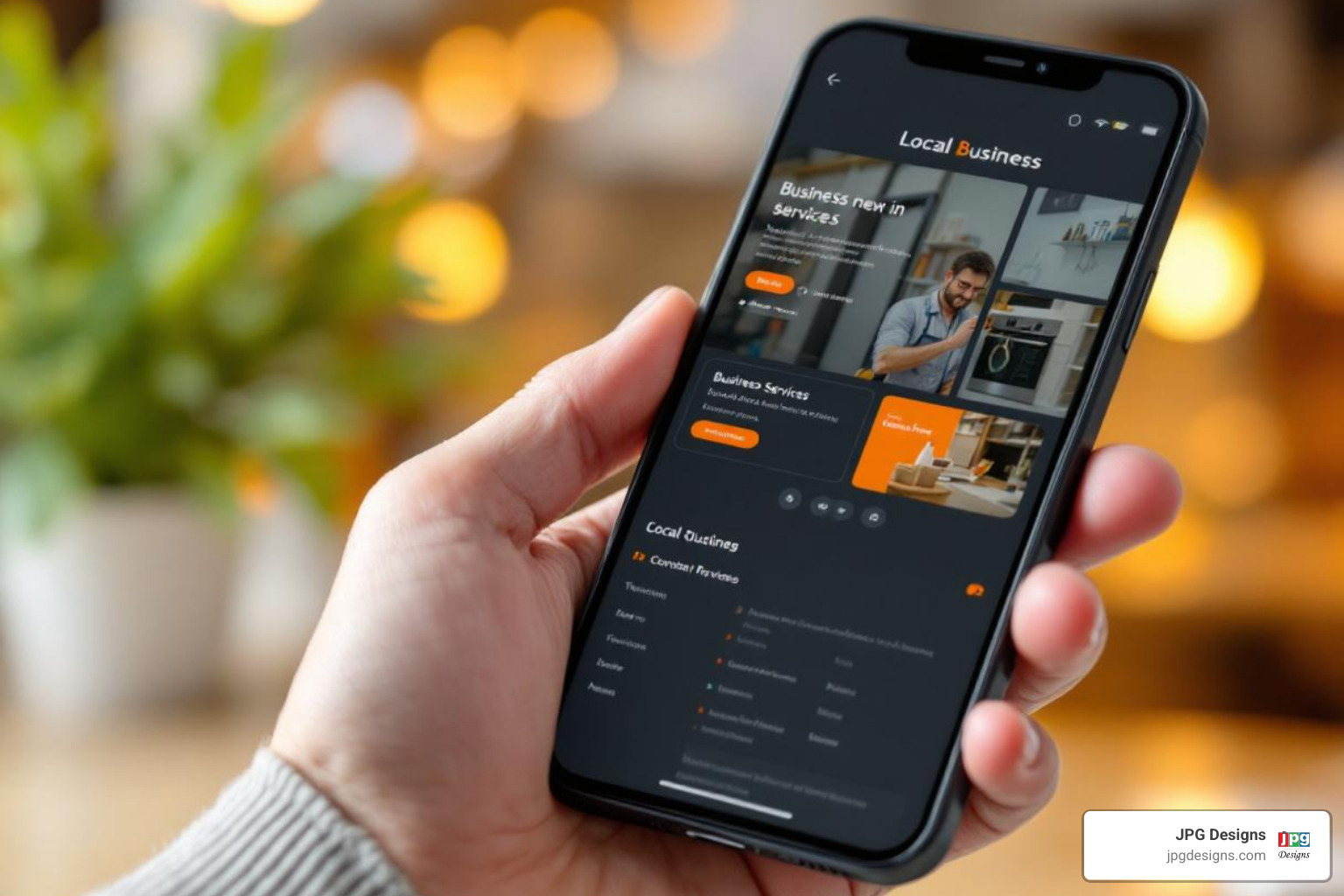
Consider these statistics: a whopping 84% of ‘near me’ searches are done on mobile devices. These searchers often have immediate needs and are on the go. If your website isn’t optimized for mobile, you’re essentially turning away 84% of your most motivated local customers.
Our approach to mobile optimization includes:
- Responsive Design: Your website must automatically adapt to any screen size, from desktops to tablets to smartphones, providing an optimal viewing experience.
- Page Load Speed: Slow websites kill conversions. We optimize your site for lightning-fast load times, especially on mobile networks, because every second counts for impatient mobile users.
- Click-to-Call Buttons: For local businesses, phone calls are gold. We implement prominent click-to-call buttons so mobile users can contact you with a single tap.
- Mobile User Experience: We design with mobile users in mind, ensuring easy navigation, readable text, and simple forms. Your website should be a helpful tool, not a hurdle, for potential customers.
As a web design and digital marketing company, we specialize in creating mobile-first websites and leveraging mobile-first indexing to improve online visibility. If you’re looking for expert Web Design/Rhode Island, we’ve got you covered.
How to Rank Locally by Building Unshakeable Authority
Beyond optimizing your Google Business Profile and website, building authority and trust is paramount for how to rank locally. This is where off-page SEO comes into play, focusing on signals that tell Google your business is respected, credible, and well-regarded in your local community. This directly ties into Google’s “prominence” factor.
The Power of Reviews: Your Secret Weapon for How to Rank Locally?
Customer reviews are arguably one of the most powerful trust signals a local business can have. They act as digital word-of-mouth, influencing both potential customers and Google’s ranking algorithm. The stats don’t lie: 99.9 percent of people check reviews when shopping online, and 57 percent of consumers specifically read reviews for brick-and-mortar stores when considering a purchase.
Here’s how we help you harness the power of reviews:
- Generating Reviews: Proactively encourage happy customers to leave reviews. We can help you create a shareable Google review link to make it easy for them. Remind customers at key touchpoints – after a purchase, during follow-up emails, or even with a sign at your checkout counter. However, Google doesn’t permit offering incentives for reviews, and some platforms like Yelp forbid requesting reviews entirely. Always check platform guidelines!
- Responding to All Reviews: This is critical. Responding shows you’re engaged, value customer feedback, and are committed to good service. 92% of consumers consider business owner responses to reviews to be part of providing high-quality, modern customer service. Even a simple “thank you” for positive reviews or a professional, empathetic response to negative ones can significantly strengthen your local presence.
Reviews build social proof, which is essential for converting hesitant searchers into loyal customers.
Building Local Citations and Backlinks
Think of local citations and backlinks as votes of confidence for your business. They tell Google that other websites and directories recognize your business and its local relevance.
- NAP Citations: A citation is any online mention of your business’s Name, Address, and Phone (NAP). Consistency here is key. We ensure your NAP is uniform across all platforms – Google Business Profile, your website, and third-party directories. Inconsistent information can confuse search engines and dilute your local SEO efforts. While less impactful than they once were, NAP citations still account for about 7% of the algorithm in the local pack and local organic results.
- Data Aggregators: These are major players that distribute business information to hundreds of directories. For U.S. companies, examples include Data Axle, Localeze, and Foursquare.
- Local & Industry Directories: Listing your business in local web directories (e.g., your town’s chamber of commerce, local business associations) and industry-specific directories (e.g., for plumbers, electricians, or roofers) further cements your local presence.
- Local Link Building: Backlinks from other reputable websites in your local community are powerful signals of prominence. When a local news site, a community blog, or another local business links to your website, it’s like an endorsement.
- Community Partnerships: Collaborate with other local businesses. If you’re a landscaper, partner with a local nursery and link to each other’s websites.
- Event Sponsorships: Sponsor local events, charities, or sports teams in Rhode Island or Massachusetts. Often, event organizers will link to their sponsors’ websites.
- Local Press: Pitch interesting stories about your business to local news outlets. A feature article can provide valuable backlinks and expose your business to a wider local audience.
These strategies contribute significantly to your overall Online Marketing Strategies to Improve Local Business Traffic.
Advanced Strategies: Expanding Your Reach and Tracking Success
Once you’ve mastered the foundational elements, we can implement advanced strategies to further expand your reach and ensure your efforts are paying off. This is particularly important for service-area businesses (SABs) or online-only businesses that want to know how to rank locally beyond a single physical address.
Dominate Surrounding Areas with Location-Specific Pages
Many businesses serve clients in multiple towns or cities beyond their immediate physical location. While your Google Business Profile is tied to one address, you can still target surrounding areas effectively using location-specific landing pages, often called “city pages.”
Here’s how we approach creating powerful city pages:
- Unique Content: Each city page must have unique, long-form content that speaks directly to the needs and interests of customers in that specific town (e.g., “HVAC Repair in Providence, RI” or “Web Design Services in Boston, MA”). Avoid generic, templated content at all costs, as Google penalizes duplicate content.
- Localized Testimonials: Feature testimonials from clients in that specific city. This adds authenticity and relevance.
- Elements for a Perfect City Page:
- Optimized Title Tags & Meta Descriptions: Include the city name and your target keyword.
- Sensible URL Structure:
yourdomain.com/service/city-name/ - Localized Content: Discuss local landmarks, community issues your service addresses, or specific regulations relevant to that area.
- Images: Use images relevant to that specific city, not just generic stock photos.
- Internal & External Links: Link to other relevant pages on your site and to reputable local resources in that city.
- Clear Call to Action: Make it easy for visitors from that city to contact you.
The goal is to convince Google that your business is a relevant resource for searchers in that specific area, even if your physical storefront is a few towns over. For businesses like roofers, who often serve a wide geographic area, creating robust Local SEO for Roofers pages for each target city is a game-changer.
Is It Working? How to Track Your Local SEO Efforts
Implementing local SEO strategies without tracking their effectiveness is like driving with your eyes closed. We need to know what’s working, what isn’t, and where to adjust our focus. Understanding how to rank locally also means understanding how to measure that ranking.
- Rank Tracking Tools: While manual Google searches (especially in Incognito mode and with specified locations) can give a snapshot, they aren’t scalable or accurate for consistent monitoring. Specialized local rank tracking tools (like Semrush’s Map Rank Tracker) allow us to monitor your position in the Local Pack and organic results for specific keywords across various locations, giving us a granular view of your visibility.
- Monitoring Map Rankings (Geo-Grids): These tools can show your ranking across a grid of points within a city or region (e.g., a 7×7 grid covering Providence). This visual representation helps identify neighborhoods where you’re strong and areas where you need to improve.
- Organic Local Rankings: We monitor your website’s performance in standard organic search results for local keywords using tools like Google Search Console and Semrush.
- Tracking Calls and Form Submissions: Local SEO aims to drive leads. We set up call tracking and contact form tracking (often through Google Analytics) to measure how many inquiries are coming directly from your local SEO efforts. This provides tangible data on your ROI.
- Common Mistakes to Avoid: A big mistake is forgetting to track your progress. Knowing which customers are reaching you and how (phone, form, walk-in) is essential for refining your strategy. Another common error is creating too many city pages (more than 10 can be problematic) or using redundant content across them.
Frequently Asked Questions about How to Rank Locally?
How long does local SEO take to work?
Local SEO isn’t a magic bullet; it’s a marathon, not a sprint. While some initial improvements, especially from GBP optimization, can be seen within weeks, significant results often take several months. The timeline depends on factors like your industry’s competitiveness, the demand for your service, and the consistent effort invested. Consistency in updating your profile, generating reviews, and creating fresh, local content is key for long-term success.
Can I do local SEO if I don’t have a physical storefront?
Absolutely! This is a common question, particularly for service-area businesses (SABs) like plumbers, electricians, or landscapers who operate out of their homes or offices but serve clients across Rhode Island and Massachusetts. It’s also relevant for online-only businesses that target specific geographic regions.
Here’s how:
- Google Business Profile: You can set up your GBP as a service-area business, hiding your physical address but defining the areas you serve. This allows you to appear in searches for those regions.
- Location-Specific Landing Pages: As discussed, creating dedicated city pages on your website is crucial. These pages target specific areas you serve, even without a physical location there, providing valuable content for local searchers.
What is the most important aspect of local SEO?
While all the elements we’ve discussed are interconnected, a well-optimized Google Business Profile is arguably the single most important aspect of local SEO. It’s your direct line to the Local Pack, which dominates local search visibility. Without a strong GBP, your chances of ranking for “near me” searches plummet. However, it’s crucial to remember that GBP works in conjunction with strong on-page SEO (your website) and off-page signals (reviews and backlinks). A holistic approach that integrates all these elements is truly the best way to achieve local dominance.
Conclusion: Your Next Step to Local Dominance
Navigating the local search landscape can feel daunting, but as we’ve explored, it’s a powerful avenue for connecting with high-intent customers right in your backyard. Mastering how to rank locally isn’t just about showing up; it’s about building trust, demonstrating relevance, and making it incredibly easy for your community to choose you.
We’ve covered the key pillars:
- Optimizing your Google Business Profile to act as a magnet for local searchers.
- Strengthening your website’s on-page SEO and ensuring it’s mobile-first for an impeccable user experience.
- Building unshakeable authority through genuine customer reviews and strategic local citations and backlinks.
- Expanding your reach with location-specific pages and diligently tracking your progress to adapt and conquer.
Local SEO is an ongoing process, not a one-time fix. It requires consistent effort, attention to detail, and a deep understanding of how local customers search. That’s where we come in. At JPG Designs, we specialize in helping businesses in Rhode Island and Massachusetts transform from local zeros to local heroes, leveraging our expertise in web design and digital marketing to improve your Google rankings and drive real results.
Don’t let your competitors steal your local customers. Take action today and let us help you get found online. Get started with our expert digital marketing services and turn those “near me” searches into loyal customers.