

Why Small Businesses Need SEO Now More Than Ever
Competing online doesn’t require a massive budget. Here’s the essential roadmap for how to do SEO for small business:
- Build a quality, mobile-friendly website that loads fast and works on all devices
- Research keywords your customers actually use when searching
- Claim and optimize your Google Business Profile for local visibility
- Create helpful content that answers customer questions
- Optimize on-page elements like titles, headers, and meta descriptions
- Build quality backlinks from local directories and trusted sites
- Track your progress using free tools like Google Analytics and Search Console
Feeling invisible online as competitors dominate search results is a common struggle for small business owners. The good news? SEO is your most cost-effective marketing strategy. It works 24/7 to generate qualified leads and deliver long-term results, free from the ongoing costs of paid ads.
The numbers prove it: 53.3% of all website traffic comes from organic search, and 46% of all Google searches are looking for local information. Better yet, 72% of consumers who perform a local search visit a store within five miles. People are actively looking for businesses like yours; you just need to be visible.
What holds most small businesses back? SEO feels complicated. Terms like “schema markup,” “mobile-first indexing,” and “E-E-A-T” can sound like a foreign language, and learning a new technical discipline while running a business feels overwhelming.
That’s why we created this guide. We’ll break down SEO into simple, actionable steps you can implement today—no computer science degree required.
I’m Jeff Pratt, owner of JPG Designs. For nearly two decades, I’ve helped small businesses in Rhode Island and Massachusetts grow with strategic SEO and mobile-first web design. This guide will show you exactly how to do SEO for small business based on what works in today’s local markets.
Relevant articles related to how to do seo for small business:
- what does seo stand for
- what is seo and how it works for small businesses
- best seo services for small business
Understanding the SEO Landscape for Small Businesses
A common pain point for small business owners is feeling invisible online against big companies with huge marketing budgets. The solution is to leverage SEO to attract local customers who are actively searching for you.
SEO (Search Engine Optimization) is the process of improving your website’s visibility in search engines like Google. The goal is to rank highly when potential customers in Rhode Island or Massachusetts search for your products or services, making your business easy to find online.
SEO is vital because people are already searching for what you sell. It’s an inexpensive way to improve your online presence that, unlike paid ads, builds a lasting foundation. Organic results generate 8.5 clicks for every one paid click, delivering a higher ROI and making SEO a cost-effective long-term strategy.
Effective SEO also boosts brand credibility. With 80-90% of customers checking online reviews before a purchase, appearing prominently in search results with positive reviews builds essential trust and authority.
Local SEO vs. General SEO
While general SEO targets a broad audience, local SEO focuses on making your business findable to customers in your immediate area. For businesses in Rhode Island or Massachusetts, local SEO is a game-changer.
Nearly half of all Google searches have local intent. Of those, 76% of local smartphone searchers visit a business within a day, and 28% result in a purchase. This shows that searches like “plumber near me” often lead directly to business. We dive deeper into this in our article Why Your Business Can Benefit Greatly From Local SEO.
Small businesses must balance these approaches. A local restaurant in Providence relies on local SEO, while an online craft store in Massachusetts selling nationwide needs general SEO. Most businesses benefit from a blend of both.
The Foundational 4: Setting Up for SEO Success
“I’m not technical and don’t know where to start.” This is a common hurdle. The technical side of SEO can feel daunting, but we’re here to guide you. These four essential steps build a strong SEO foundation, focusing on user experience (UX), keyword research, your Google Business Profile (GBP), and analytics. By mastering these, you’ll understand how to do SEO for small business.
Step 1: Build a High-Quality, Mobile-First Website
Your website is a potential customer’s first impression. A high-quality site is about functionality, speed, and user experience. As web design experts, we build mobile-first websites.
Mobile-first indexing means Google primarily uses your site’s mobile version for ranking. With over 60% of traffic from mobile, a site not optimized for smartphones misses potential customers. A mobile-first design adapts to all screens for a seamless user experience. Learn more in Responsive Web Design: A Must-Have for Modern Websites.
Beyond mobile responsiveness, your website needs:
- Fast loading speed: A site taking more than three seconds to load loses customers and rankings. Optimize images and code for speed. Check your site with Google PageSpeed.
- Clear navigation: An intuitive structure helps users and search engines find content easily.
- Secure website (HTTPS): Use HTTPS to protect user data, a key Google ranking factor. Get an SSL certificate from your host or use a plugin like Really Simple SSL for WordPress.
- User engagement: A great user experience can increase conversions by up to 400%. Keep users on your site with clear calls-to-action and readable content.
Step 2: Conduct Foundational Keyword Research
Keyword research is the process of identifying the words and phrases your potential customers use on Google. Think like your customers. What problems are they solving? A plumber in Rhode Island might target “leaky faucet repair Providence RI” or “emergency plumber Warwick RI.”
When researching keywords, consider:
- Search intent: Understand what the user wants—information, a purchase, or a local business. Your content must match this intent.
- Long-tail keywords: These longer, specific phrases (e.g., “best Italian restaurant in Federal Hill Providence RI”) have lower search volume but higher conversion rates because they match specific needs.
- Competitor analysis: Analyze the keywords your competitors rank for. A simple Google search offers insights, or use free tools like Keyword Surfer.
- Search volume vs. difficulty: Balance high-volume, competitive keywords with lower-difficulty ones you can realistically rank for, especially local long-tail keywords.
Step 3: Claim and Optimize Your Google Business Profile
For local businesses in Rhode Island and Massachusetts, your Google Business Profile (GBP) is your most important local SEO tool. This free listing appears in Google Maps and the local search pack. To get started, claim your business or create a new profile at business.google.com.
Once claimed, optimize it fully:
- Complete every section: Fill out your hours, phone, website, and description. Complete profiles are 70% more likely to get visits.
- Business information consistency (NAP): Your Name, Address, and Phone number (NAP) must be identical everywhere online to avoid confusing search engines and customers.
- Customer reviews: Encourage and respond to reviews. Positive reviews are a strong local ranking signal, and responding shows you value customer feedback.
- Google Maps visibility: An optimized GBP ensures you appear prominently in Google Maps searches. Our guide on How to Setup and Optimize Your GMB Google My Business can help.
Step 4: Install Essential Tracking Tools
Without tracking, you’re flying blind. Essential tools allow you to make data-driven decisions, showing what’s working and where to focus your efforts.
- Google Analytics: This free tool tracks traffic, user behavior, and conversions. See where visitors come from, what pages they view, and what actions they take. Get started by creating a Google Analytics account.
- Google Search Console: This free tool monitors your site’s performance in Google Search. It shows which queries bring users to your site, your search visibility, and any indexing issues. Get familiar with Search Console and check it monthly.
A Practical Guide on How to Do SEO for Small Business
“I’m set up, but what do I actually do to rank higher?” With your foundation in place, it’s time to implement core strategies. We’ll focus on on-page SEO, content marketing, and link building—the trifecta for climbing search rankings.
Mastering On-Page and Technical SEO: A Key Part of How to Do SEO for Small Business
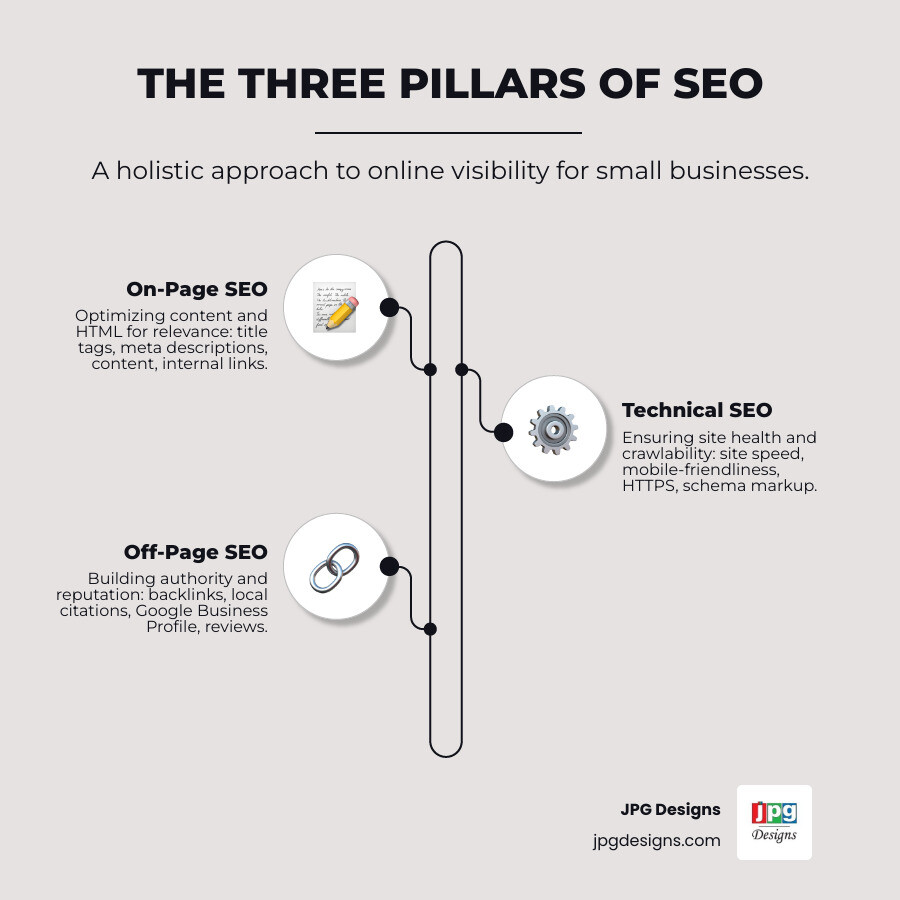
On-page SEO involves optimizing elements directly on your website, while technical SEO ensures search engines can crawl and index it effectively. Together, they create a user-friendly and search-engine-friendly site. Learn more in our guide on SEO Elements: Website Design and Optimization.
Here are the essential elements to master:
- Title tags: The clickable headlines in search results. Keep them under 60 characters, include your primary keyword near the start, and make them compelling.
- Meta descriptions: The text snippets below the title in search results. While not a direct ranking factor, a good description (under 160 characters) with a call-to-action improves click-through rate (CTR).
- Header tags (H1, H2, etc.): These organize content. Your H1 should contain the primary keyword. Use H2s and H3s for subheadings with related keywords.
- Image alt text: This describes images for search engines and visually impaired users. Add descriptive alt text with natural keywords (e.g., “woman cleaning a bathroom sink with vinegar”).
- SEO-friendly URLs: Keep URLs simple, short, and include keywords, like
yourbusiness.com/services/water-heater-repair. - Internal linking: Link to relevant pages on your own site. This helps search engines understand your site’s structure, passes authority between pages, and improves user experience.
- Schema markup: This structured data helps search engines understand your content. It can help you earn rich snippets (like star ratings) in search results, improving visibility and CTR. See examples in Google’s Rich Snippet Gallery.
Creating Content That Ranks and Converts
High-quality, relevant content that satisfies user intent is king. Create helpful, people-first content that demonstrates E-E-A-T (Experience, Expertise, Authoritativeness, and Trustworthiness), which is crucial for Google. Learn more in Content is King: Creating High-Quality SEO Optimized Content.
- Answering user questions: Directly address your audience’s questions. If they search “HVAC repair costs in Cranston RI,” provide clear answers.
- Writing for humans: Write for your audience first, then optimize. Use natural language and clear headings. Avoid keyword stuffing, a spammy practice that can lead to penalties. Google advises against including irrelevant keywords or content that is stuffed.
- Keyword integration: Naturally weave target keywords into your title, headings, and body text without sounding forced.
- Blog posts: Use high-quality blog posts to target long-tail keywords and demonstrate expertise. A landscaper in Massachusetts could write about “best drought-resistant plants for New England.”
- Service pages: Create detailed pages for each service, rich with information, keywords, and localized content (e.g., a “drain cleaning services Providence RI” page).
- Localized content: Mention your service areas, including city and state names, in your website copy and blog posts to attract local searchers.
Building Authority with Links and Local Signals
Backlinks are votes of confidence from other reputable websites. Search engines view them as a sign of authority, making them a critical part of off-page SEO. Top-ranking pages often have the most backlinks.
- Local citations: These are mentions of your business’s NAP (Name, Address, Phone Number) online. Consistent NAP across directories like Yelp and local chambers of commerce is vital for local rankings.
- Directory listings: Get listed in relevant industry-specific and general business directories.
- Managing online reviews: Actively solicit and respond to reviews on Google, Yelp, and other platforms to boost local SEO and build trust.
- Guest blogging: Write content for other reputable sites in your industry to earn high-quality backlinks and establish your expertise.
- Community partnerships: Partner with local non-profits, sponsor events, or get featured in local news in Rhode Island or Massachusetts to earn backlinks and visibility. For more, read our guide: Turbocharge Your Local Business: A Comprehensive Guide to Local SEO for Small Business Owners.
Measuring Success and Avoiding Common Pitfalls
“How do I know if this is working, and what mistakes should I avoid?” It’s time to measure your performance and steer clear of common traps. Tracking your SEO and avoiding pitfalls are crucial for long-term success.
Tracking Your SEO Performance
Tracking SEO performance helps you understand ROI and adjust your strategy. Here are the Key Performance Indicators (KPIs) to focus on:
- Organic traffic growth: Use Google Analytics or Search Console to monitor visitors from search engines.
- Keyword ranking changes: Track where your target keywords rank in search results to see if your efforts are working.
- Click-through rate (CTR): The percentage of people who click your listing in search results. A higher CTR suggests a compelling title and meta description.
- Conversion tracking: Track the business impact by monitoring phone calls, form submissions, or quote requests from organic search. Set up event tracking in Google Analytics and monitor call logs from your GBP.
- Bounce rate: The percentage of visitors who leave after viewing only one page. A high bounce rate can signal a poor user experience or mismatched content. Learn more in our article What are KPIs?.
Common SEO Mistakes to Avoid
Even with the best intentions, small businesses can fall into common SEO traps.
- Keyword stuffing: Excessively repeating keywords makes content unreadable and can lead to Google penalties. Avoid irrelevant keywords or content that is stuffed.
- Ignoring mobile experience: A non-mobile-friendly website alienates a massive audience and hurts your rankings.
- Poor user experience (UX): A slow site with confusing navigation drives users away, increasing bounce rate and signaling low value to search engines.
- Buying low-quality links: Buying spammy links can damage your site’s authority and lead to penalties. Focus on earning high-quality, natural links.
- Inconsistent business information (NAP): Inconsistent Name, Address, and Phone number across directories is a major red flag for local SEO.
How to do SEO for small business: DIY vs. Hiring a Pro
This is a question every small business owner grapples with. Can you tackle how to do SEO for small business yourself, or should you hire professionals?
- DIY SEO: You can do basic SEO yourself with free tools and guidance. This saves money but requires a significant time investment for tasks like keyword research, GBP optimization, and on-page SEO.
- Hiring a Pro: When time is short or issues are complex, hiring an SEO specialist is a wise investment for accelerating results. They bring expertise and advanced strategies. Costs vary, but consider it an investment that generates long-term returns. This often goes hand-in-hand with professional web design, as we discuss in Why Hiring Professional Web Design Is Always Better Than Going DIY.
The choice depends on your budget, time, and comfort level with the technical aspects. Many small businesses start with DIY and gradually bring in professionals for specific tasks as their needs grow.
Frequently Asked Questions about Small Business SEO
How long does it take to see SEO results?
SEO is a marathon, not a sprint. Minor improvements may appear in 3-6 months, but significant results typically take 6-12 months of consistent effort. Search engines need time to index your changes, and competitors are always active. Committing to a long-term strategy is key, as the compounding returns are well worth the wait.
How much does SEO for a small business typically cost?
SEO costs vary. DIY SEO costs your time, plus any tool subscriptions. Hiring professionals is an investment that provides lasting results, unlike paid ads which stop when you stop paying. Costs can range from hourly freelance rates to monthly agency retainers, and the investment level often correlates with the speed and quality of results.
How is AI changing SEO for small businesses?
AI is changing the search landscape. AI-powered search (like Google’s SGE) summarizes information directly in results, leading to more “zero-click searches” where users get answers without visiting your site.
To adapt, you must:
- Focus on E-E-A-T: Google’s emphasis on Experience, Expertise, Authoritativeness, and Trustworthiness is critical. High-quality, authoritative content is more likely to be cited by AI and rank well.
- Use conversational keywords: Adapt your keyword strategy for natural, question-based phrases as people use more conversational language with AI.
- Create unique, expert content: Offer unique insights, personal experiences, and a human touch that AI cannot replicate to stand out from AI summaries.
- Become a cited source: The new goal is to be the definitive source AI uses to answer queries by providing clear, accurate information. We explore this in Optimize Website Semantic Search.
The age of AI demands that small businesses double down on creating truly valuable, trustworthy content and optimizing for new forms of search interaction.
Conclusion
With nearly half of all Google searches having local intent that leads to a visit or purchase, SEO is an essential investment for small businesses in Rhode Island and Massachusetts. It levels the playing field, letting you compete with larger businesses by connecting with customers actively searching for you.
The journey of how to do SEO for small business begins with a commitment to user value. Create an experience that encourages visitors to convert. Start with a mobile-first website, conduct keyword research, optimize your Google Business Profile, and consistently create high-quality content. Consistency is key, as SEO is an ongoing process with compounding returns.
At JPG Designs, we help small businesses grow their online presence with expert mobile-first web design and targeted SEO. We understand the local Rhode Island and Massachusetts markets and can help you steer SEO’s complexities to attract more customers.
Ready to transform your online presence from zero to hero? Explore our Digital Marketing Services to see how we can help.