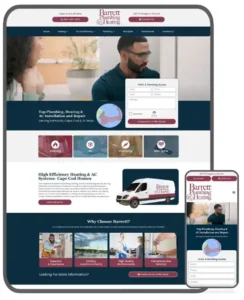
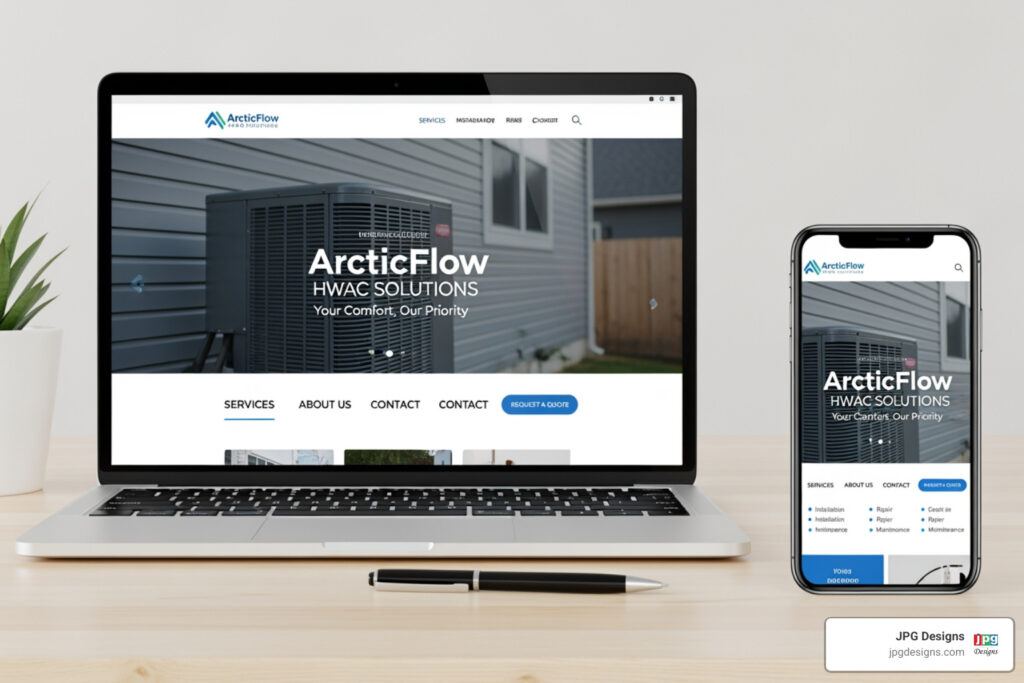
Why Your HVAC Website is Your Most Powerful Business Tool
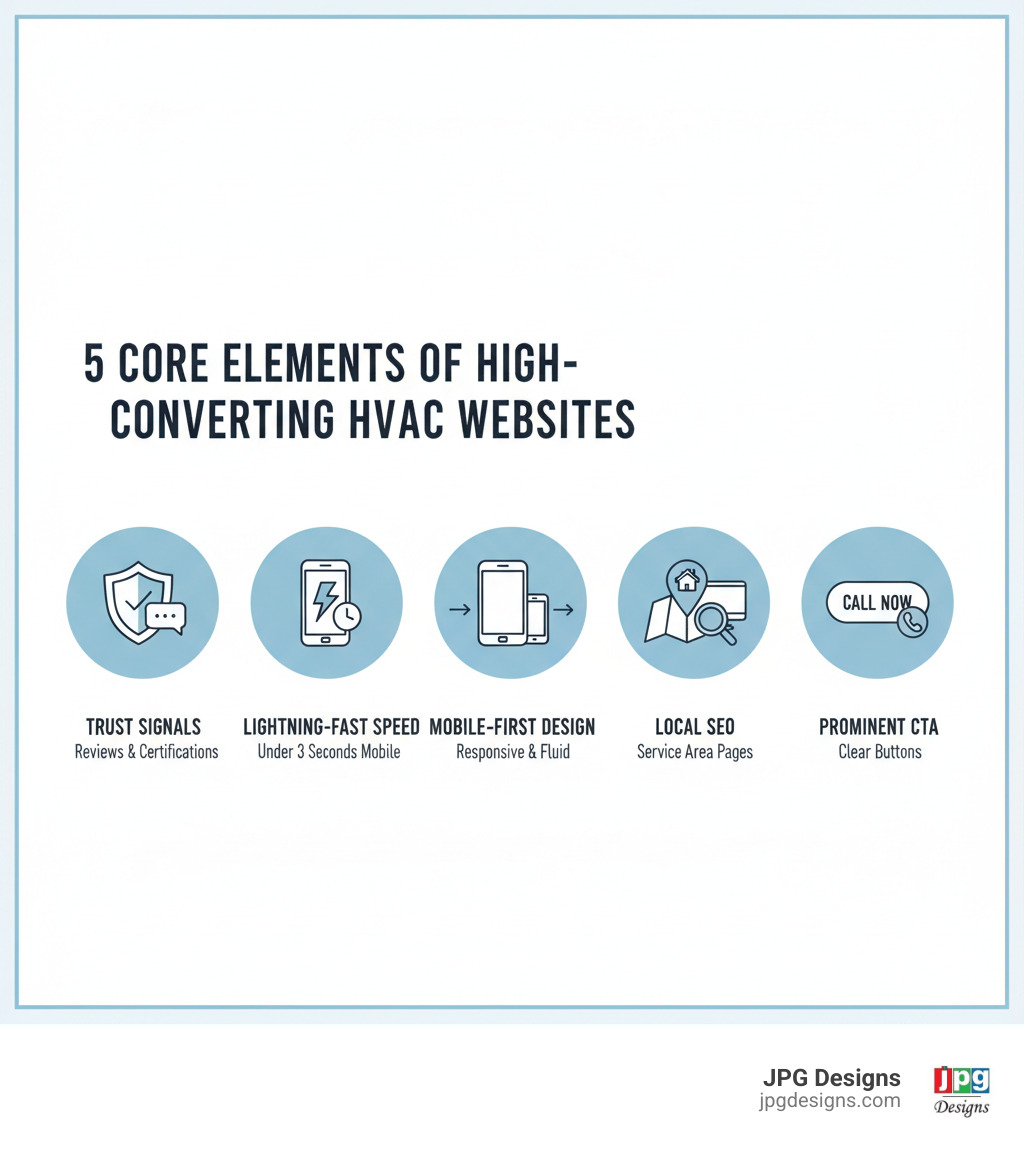
Effective HVAC website design tips are crucial for attracting more customers online. A high-performing HVAC website must include these critical elements:
- Mobile-first responsive design: Over 60% of traffic comes from phones.
- Fast loading speed: Load in under 3 seconds to prevent visitor drop-off.
- Clear calls-to-action: Use prominent “Schedule Service” and click-to-call buttons.
- Trust signals: Display customer reviews, certifications, and team photos.
- Local SEO optimization: Create service area pages and optimize your Google Business Profile.
- Simple navigation: Ensure service information and contact details are easy to find.
- HTTPS security: Protect customer data and improve search rankings.
Imagine a homeowner’s AC breaks on a hot afternoon. They search “AC repair near me,” click on your site, and it loads slowly. They can’t find your number. They hit the back button and call your competitor. This happens daily. The harsh truth is that 75% of people judge a company’s credibility based on its website design, and they form an impression in less than 50 milliseconds.
Your website is your 24/7 salesperson, attracting customers and generating leads around the clock. When a homeowner has an HVAC crisis, they need help immediately. Your website must capture that urgent need or you lose the business.
This guide breaks down the essential HVAC website design tips. We’ll cover building trust, dominating local search, and creating a conversion engine that generates leads while you sleep. These are practical strategies you can implement right away.
I’m Jeff Pratt, owner of JPG Designs. For over 15 years, I’ve helped HVAC contractors build websites that generate revenue. By implementing proven HVAC website design tips, I’ve learned what separates a static site from one that drives consistent, qualified leads.
The Foundation: Building Trust and Credibility Instantly
When a homeowner’s furnace dies on a freezing night, they land on your website looking for reasons to trust you. In a crisis, they make quick decisions about who to invite into their home. Your website has seconds to prove you’re professional, experienced, and reliable.
Since 88% of consumers trust online reviews as much as personal recommendations, your site must instantly build credibility. These HVAC website design tips show you how.
Develop a Professional Brand Identity
Your brand communicates competence before a visitor reads a single word. A memorable logo, consistent color scheme (like cool blues for AC or warm oranges for heating), and clean fonts project reliability. An aesthetically pleasing and consistent design tells visitors you pay attention to detail. This professional look helps them relax and stop questioning your legitimacy, creating familiarity that builds trust.
Showcase Your Team and Work with Custom Photography
Avoid generic stock photos of smiling models pretending to be technicians. Homeowners spot fakes instantly, which erodes trust. Instead, use real photos of your actual team to create a personal connection and humanize your business. When customers see the faces of the technicians who might visit their home, they feel more comfortable.
Before-and-after photos of your installations are even more powerful. They provide tangible proof of your expertise and quality, helping you showcase your work in a way words cannot. Custom photography proves you’re a genuine local business with real people and results, which is a powerful way to build trust. For more on this, see our guide on 10 Things Every Small Business Website Needs.
Display Trust Signals Prominently
Trust signals are the proof points that reassure nervous homeowners. Place customer testimonials and Google reviews on your homepage where they can’t be missed. Reading about your punctuality and quality work helps potential customers picture a positive experience.
Prominently display industry certifications like NATE certification and EPA credentials to show you’re trained and qualified. State licensing information, BBB accreditation, and the Google Guarantee badge are also invaluable. Don’t hide these trust signals; make them visible and easy to find. They do the heavy lifting of building credibility so you can focus on serving customers.
These foundational tips create the trust every successful HVAC website needs. When visitors see professional branding, real photos, and clear trust signals, they stop looking for reasons to leave and start looking for your contact information.
Mobile-First and Lightning Fast: Winning the Race for Mobile Customers
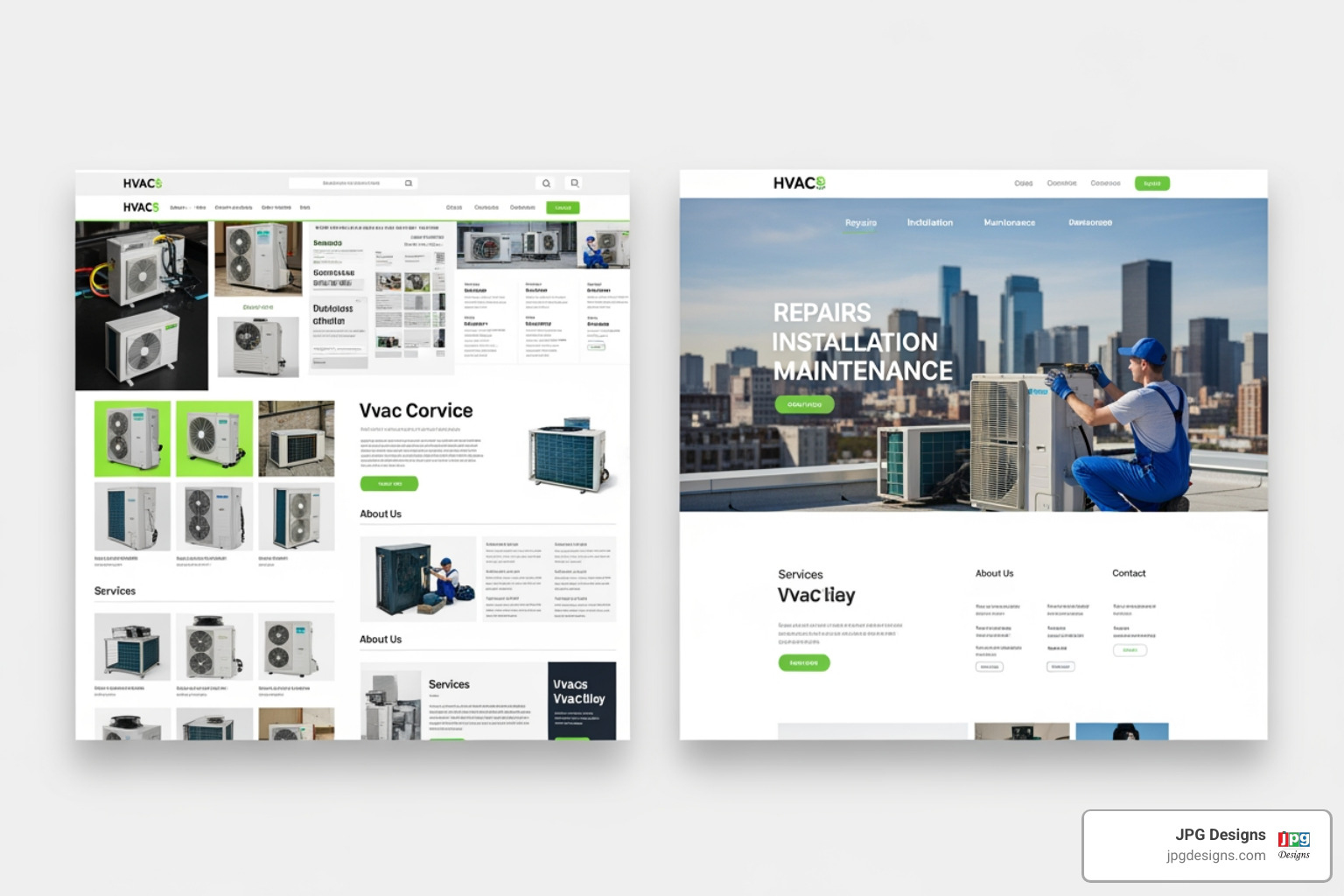
When a homeowner’s furnace stops working, they grab their phone to find help. If your website is slow or broken on mobile, they’ll leave before it even loads. This isn’t hypothetical; it’s happening right now. With more than 60% of website traffic coming from mobile devices and 47% of users leaving a site that takes more than 3 seconds to load, speed and responsiveness are critical.
A slow, non-responsive website costs HVAC businesses thousands in lost leads. That’s why our HVAC website design tips prioritize mobile-first thinking and blazing-fast performance. Your site must work flawlessly on every device and load almost instantly.
Why Mobile-First Design is Non-Negotiable
When a customer’s AC dies in Warwick, they’re on their phone, desperate for help. These are high-intent customers ready to book service immediately. Google knows this, which is why it uses mobile-first indexing, ranking your site based on its mobile performance. A non-mobile-friendly site frustrates users and hurts your search rankings.
Customers in crisis mode will choose the first company that makes it easy to call or book service. A mobile-optimized site is the foundation of your online presence. Our approach to website design for mobile devices ensures you capture these urgent leads.
Actionable Tips for a Blazing-Fast Website
Every second of load time costs you revenue. Here’s how to make your site faster:
- Image optimization: This is the biggest quick win. We compress large image files to load quickly without losing visual quality.
- Minimize code and plugins: Over time, sites accumulate unnecessary code and outdated plugins that slow them down. We streamline your site’s backend, removing digital clutter.
- Reliable hosting service: Cheap hosting costs you leads. We use providers with fast server response times and reliable uptime, so your site is always available.
- Content Delivery Network (CDN): A CDN serves your site from servers closer to your visitors, dramatically reducing load times for everyone in your service area.
We regularly test site speed with tools like PageSpeed Insights to ensure ongoing performance. Speed isn’t a one-time fix; it’s a commitment. When customers can find your number and call with one tap, they become paying customers. That’s the power of responsive web design: a must-have for modern websites that loads at lightning speed.
Strategic Content and Local SEO: Attracting Customers in Your Service Area
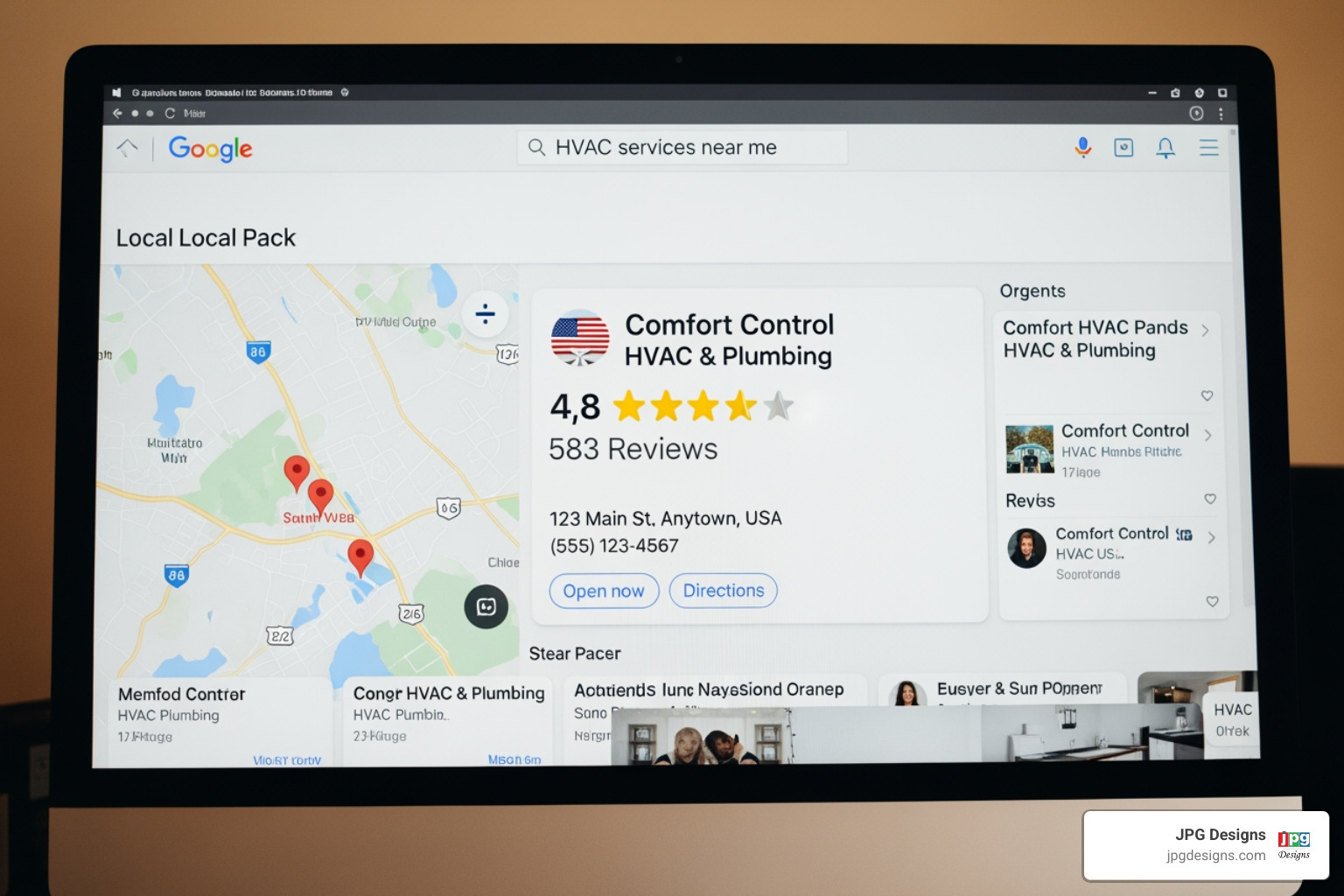
When a furnace fails in Rhode Island, homeowners search for “furnace repair Cranston,” not “best HVAC company in America.” Since nearly half of all internet searches are for local businesses, your website must speak directly to your service area to be visible.
Strategic content and local SEO are game-changers. With the right approach, you can become the go-to HVAC provider in your community. Our HVAC website design tips focus on geographic targeting and helpful content. This is critical because businesses that publish blogs get 67% more leads than those that don’t.
For a deep-dive, read our Comprehensive Guide to Local SEO for Small Business Owners.
Dominate Local Search with Geo-Targeted Pages
Customers search with location in mind, like “AC repair Pawtucket.” To capture this traffic, dedicated service area pages are your secret weapon. We create customized pages for each town you serve—Providence, Cranston, Warwick, and beyond—using city-specific keywords in content that addresses local needs.
Your Google Business Profile is also critical for appearing in the map pack at the top of search results. We optimize your profile with accurate information, compelling photos, and detailed service descriptions, while encouraging customer reviews. Maintaining NAP (Name, Address, Phone) consistency across all online directories is essential. An interactive service map on your site can also instantly show customers if you serve their area. For more on this, see our article on Local SEO with Google My Business.
Become a Resource with High-Quality Content
Your website should be more than a service list; it should be a trusted resource. Content marketing transforms your site into a lead-generating machine by answering the questions your customers are already asking Google, such as “Why is my AC blowing warm air?” or “How can I lower my energy bills?”
Creating blog posts, guides, and FAQs that answer these questions helps potential customers, demonstrates your expertise, and builds trust. Most importantly, it helps you boost your search engine optimization by providing Google with relevant content that serves user intent. We help you develop maintenance tips and energy-saving guides that incorporate keywords while genuinely helping your audience.
Video content explaining common issues or maintenance tasks is another powerful tool that can set you apart and keep visitors on your site longer. Strategic content works 24/7, attracting qualified leads for years to come. Learn more about SEO for home service businesses.
By combining geo-targeted pages with valuable content, your website becomes a destination that customers seek out and trust.
The Conversion Engine: Key hvac website design tips for Turning Visitors into Leads
Your website looks professional, loads fast, and ranks in local search. But when a homeowner with a broken furnace lands on your site, can they easily hire you? Many HVAC websites fail here, acting as digital brochures instead of lead generators. The difference is conversion optimization—making it incredibly easy for visitors to become customers.
We build websites designed to turn traffic into revenue, guiding homeowners toward one goal: scheduling service. For more foundational principles, see our guide on 5 Simple Tips on How to Design a Successful Website.
Master the Call-to-Action: A Core Principle of hvac website design tips
When a customer needs urgent help, they won’t hunt for your contact info. A strong Call-to-Action (CTA) eliminates confusion. Use bold, impossible-to-miss buttons with action-oriented text like “Schedule Now,” “Get Free Estimate,” or “24/7 Emergency Service.” These should be front and center.
For mobile users, click-to-call functionality is essential. One tap should dial your number instantly. We also implement sticky headers or footers that keep your phone number and a “Request Service” button visible as users scroll. Your contact page should be a conversion powerhouse with multiple contact methods.
More hvac website design tips: Simplify the User Journey with Intuitive Navigation
Trying to steer a confusing website is frustrating, especially during an HVAC emergency. Poor navigation costs you money. Intuitive navigation is one of the most critical HVAC website design tips. Your menu should be simple, with logical labels that homeowners understand.
Use clear drop-down menus for services like “Heating Services” and “Cooling Services” so visitors can easily find what they need. A well-structured site helps customers find information quickly and builds trust by showing you’re an organized, professional company.
Streamline Your Business with Online Booking and Financing
Your customers are busy and may research HVAC services late at night. If they can’t book an appointment then and there, you might lose them. Integrated scheduling tools that allow 24/7 booking are game-changers, capturing leads even when your office is closed.
Cost is another major barrier. Since HVAC services are a significant investment, displaying financing options prominently is crucial. It’s known to increase revenue by more than 17% by removing a major objection before the customer even calls. When they see financing is available, they think, “I can afford this.”
By combining online booking with visible financing options, you remove two of the biggest friction points in the customer journey. These are essential HVAC website design tips that directly impact your bottom line.
Technical Essentials: Security, Maintenance, and Performance

Beneath a great-looking website, technical issues can cause major problems. A browser flagging your site as “Not Secure” or poor maintenance hurting your search rankings can cost you customers. These behind-the-scenes elements are critical to your website’s success and are completely preventable.
Neglecting the technical foundation causes even great websites to underperform. For more on common pitfalls, read our guide on Why Your Website is Not Attracting Traffic and How to Fix It.
Secure Your Site and Your Customers’ Trust with HTTPS
Imagine a homeowner is about to fill out your contact form, but their browser displays a “Not Secure” warning. That instantly erodes trust, and they leave. This is the reality of operating without HTTPS encryption.
HTTPS is essential for protecting customer information and your business reputation. It encrypts any data submitted through your site, keeping it safe. Furthermore, Google gives ranking preference to HTTPS websites, so an unsecured site actively hurts your search visibility. Modern browsers flag non-HTTPS sites, telling visitors to stay away.
Implementing an SSL certificate (which changes your site from “http://” to “https://”) adds a reassuring padlock icon to the address bar. This is one of the most important HVAC website design tips because it signals security and professionalism to both search engines and customers.
Measure and Improve with Website Analytics
How do you know if your website is actually working? Website analytics provides the answer. Without data, you’re making business decisions based on gut feelings instead of facts.
We integrate Google Analytics into every site to answer key questions: How many people are visiting? Which pages are they finding? How many are converting into leads? Tracking conversions is where analytics proves its worth, showing you exactly which pages lead to phone calls, form submissions, and online bookings.
Monitoring user behavior reveals important patterns, like where mobile users are dropping off or which content leads to more quotes. These insights allow you to fix what isn’t working and double down on what is. We regularly review this data, identifying popular pages and making data-driven decisions for improvement. This continuous optimization turns your website into a tool that gets better over time, separating it from static sites that don’t generate leads.
Conclusion
When your website works for you, everything changes. Homeowners in crisis find you first, trust you immediately, and book appointments without hesitation. That’s the power of getting your HVAC website design tips right.
This guide covered the essentials: building trust with professional branding and reviews, winning mobile customers with a fast and responsive site, dominating local search with geo-targeted content, and turning visitors into leads with clear calls-to-action.
Your website is your 24/7 sales tool. It works around the clock to answer questions, build trust, and generate leads. An investment in a high-quality, optimized website is an investment in the sustainable growth of your HVAC business.
The homeowners in Rhode Island who need you are searching online right now, making snap judgments on their phones. The question isn’t whether you need a great website, but whether you’re ready to stop losing customers.
At JPG Designs, we’ve spent over 15 years helping HVAC contractors transform their online presence. We specialize in building mobile-first websites that generate revenue because we understand the home services industry.
Your website should work as hard as you do. It should attract the right customers and make it effortless for them to choose your business.
Ready to build an HVAC website that generates leads? Explore our HVAC & Plumbing Web Design services and let’s talk about how we can help your business grow.