

Why Your Mission Isn’t Being Seen Online (And How to Fix It)
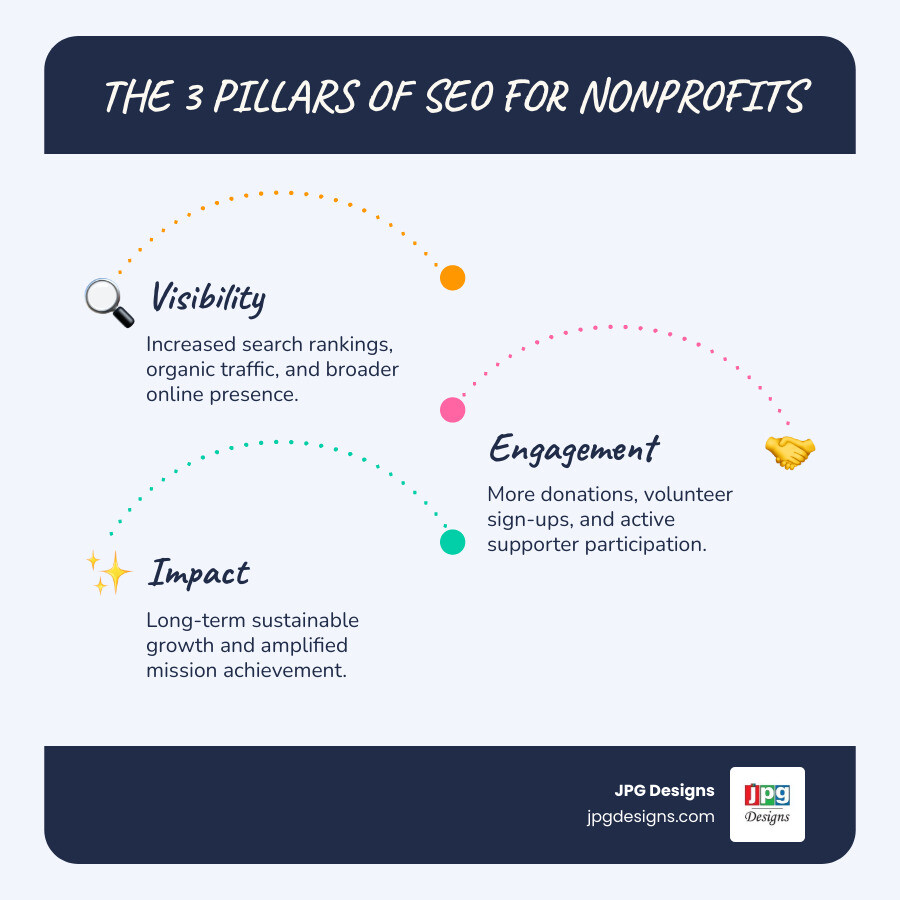
SEO for nonprofits is the process of optimizing your website to rank higher in search results, making it easier for donors, volunteers, and beneficiaries to find you. It’s a powerful tool that:
- Increases visibility when people search for causes like yours
- Attracts qualified supporters actively looking to donate or volunteer
- Offers cost-effective marketing by generating traffic without paying per click
- Builds credibility as higher rankings signal trustworthiness
- Drives long-term growth from investments made today
Your nonprofit has a powerful mission, but if people can’t find you online, they can’t support your work. The statistics are sobering: while 80% of nonprofit professionals agree a strong digital presence is crucial, only 37% actively use a year-round SEO strategy. This creates a major gap, as 95% of Google traffic goes to the first page, with a third going to the very first result. Every day, you’re missing opportunities to connect with people looking for your services.
The good news is that SEO doesn’t require a massive budget. It’s about understanding what your supporters search for, creating helpful content, and ensuring your website is easy for people and search engines to steer. For example, one nonprofit boosted its blog traffic by over 600% with consistent SEO, while another received three large, unsolicited four-figure grants after becoming findable on Google.
I’m Jeff Pratt, owner of JPG Designs, and I’ve spent over 15 years helping organizations in Rhode Island and Massachusetts grow through strategic SEO. In this guide, I’ll show you how to make your nonprofit more visible, attract the right supporters, and amplify your impact with practical SEO strategies.
The Foundation: Building Your Nonprofit’s SEO Strategy

A strong SEO for nonprofits strategy begins with clear goals and an understanding of how SEO works. At its core, SEO communicates your website’s value to search engines like Google, so they show your content to people looking for it. This process drives organic traffic—people finding you naturally, without you paying for every click. It’s a key to long-term digital success. To learn more, explore our guide on What is SEO and How it Works for Small Businesses.
Understanding What Your Supporters Search For
The first step is understanding the language your donors, volunteers, and beneficiaries use. This is keyword research. It’s not just about popular words, but understanding search intent—what someone hopes to achieve. Think about your audience. Are they searching for “volunteer opportunities in Rhode Island,” “food banks near Boston,” or “how to support local animal shelters in Massachusetts”?
Brainstorm mission-related terms by putting yourself in your supporters’ shoes. What problems are they solving? What questions do they have? Use your website analytics and supporter feedback for insights. Free tools like Google Trends and Google Keyword Planner can reveal search volumes and help you find relevant keywords.
Creating Content That Inspires Action
Once you know what your audience is searching for, create content that answers their questions and inspires action. This is about providing genuine value, not just stuffing keywords. Our guide on Content is King: Creating High-Quality SEO Optimized Content is a great starting point.
Google’s E-E-A-T framework (Experience, Expertise, Authoritativeness, Trustworthiness) is paramount for nonprofits.
- Experience: Share real stories of impact.
- Expertise: Showcase your team’s knowledge on issues related to your cause.
- Authoritativeness: Become the go-to source for information in your niche.
- Trustworthiness: Be transparent and provide accurate information.
Storytelling is a powerful tool that makes your mission relatable. Use storytelling to make your content clear and engaging. Highlight success stories and share impact reports. While AI can help with ideas, avoid it for direct content creation. Google prioritizes original, human-generated content that offers unique perspectives and builds trust.
SEO vs. SEM: Choosing the Right Path for Your Goals
Nonprofits often encounter two terms: SEO and SEM. Understanding the difference is key to allocating resources effectively.
SEO (Search Engine Optimization) focuses on earning organic, unpaid traffic. It’s a long-term strategy that builds sustainable credibility.
SEM (Search Engine Marketing) includes SEO and paid advertising (PPC). With paid ads, you bid on keywords to appear in sponsored results, paying for each click.
Here’s a quick comparison:
| Feature | SEO (Organic) | SEM (Paid Ads) |
|---|---|---|
| Visibility | Earned, appears in main search results | Purchased, appears as “Sponsored” or “Ad” |
| Cost | Free per click, but requires time/resource investment | Pay per click (PPC), can be expensive |
| Results | Long-term, compounding, builds authority | Immediate, short-term, instant traffic |
| Credibility | High, seen as more trustworthy by users | Lower than organic, clearly marked as an ad |
| Control | Less direct control over ranking, more over content | High control over ad placement, budget, and targeting |
A significant opportunity for nonprofits is Google Ad Grants, which offers $10,000 of free ad spend monthly. While it provides immediate visibility, it has strict rules and rarely replaces the high-quality traffic from organic SEO. We recommend using organic SEO for nonprofits for long-term authority, supplemented by paid ads (like Google Ad Grants) for specific campaigns. For a comprehensive overview, check out our Digital Marketing Services.
On-Page and Technical SEO for Nonprofits: Optimizing Your Digital Home

Think of your website as your nonprofit’s digital home. It needs to be well-structured and technically sound to be functional and findable. This is where on-page and technical SEO come in. A well-designed website is crucial for making an impact online, as highlighted in our article on the Importance of a Well-Designed Website for Nonprofits.
Mastering On-Page SEO Elements
On-page SEO involves optimizing elements directly on your pages to help search engines understand your content. These are digital signposts for users and crawlers.
- Title Tags: The clickable headline in search results. It should be unique, include your primary keyword, and be compelling. Keep it under 60 characters.
- Meta Descriptions: The short summary under your title tag. While not a direct ranking factor, a good description increases clicks. Aim for under 160 characters. Learn more about writing effective meta descriptions.
- Heading Structure (H1, H2, H3): Use headings to structure content logically. Your H1 is the main title with your primary keyword. H2s and H3s create a clear hierarchy, improving readability.
- Image Alt Text: Descriptive text for images that helps screen readers and search engines. Include relevant keywords naturally.
- URL Optimization: Keep URLs clean and descriptive, including your primary keyword (e.g.,
yournonprofit.org/volunteer-opportunities-rhode-island). - Internal Linking Strategy: Linking between pages on your site helps users and search engines find important content and distributes authority.
Optimizing these elements improves both SEO and user experience. For more guidance, see our article on how to Optimize Your Website for Google.
The Critical Role of a Fast, Mobile-Friendly Website
A fast, mobile-friendly website is essential for SEO for nonprofits. Google uses “mobile-first indexing,” meaning it primarily ranks your site based on its mobile version. This is critical, as 58% of all Google searches are now on mobile devices.
Website speed is also a direct ranking factor. Since 53% of visits are abandoned if a site takes more than 3 seconds to load, a slow site hurts user experience (UX) and your rankings.
To ensure your website is up to par:
- Mobile-Friendliness: Your site must adapt to any screen size. Check it with Google’s Mobile-Friendly Test.
- Page Speed: Compress images, leverage browser caching, and use a Content Delivery Network (CDN). Check your site speed with Google’s tool to find areas for improvement.
- Site Security (HTTPS): Use HTTPS to encrypt data, build trust, and satisfy a Google ranking signal.
These technical aspects are vital for UX, which Google prioritizes. A fast, secure site leads to happier visitors and better rankings. Our Website Maintenance for Small Businesses services can help keep your digital home in top shape.
Expanding Your Reach: Off-Page and Local SEO Strategies
While on-page and technical SEO ensure your website is internally optimized, off-page and local SEO help you expand your reach beyond your own site. This is about building your nonprofit’s authority and connecting with the community in Rhode Island and Massachusetts where you operate.
Building Credibility and Trust with Backlinks
Off-page SEO primarily revolves around backlinks – links from other reputable websites pointing to yours. Think of backlinks as “votes of confidence.” When a high-authority website links to your content, it signals to search engines that your site is valuable and trustworthy, which can significantly boost your rankings.
For nonprofits, building backlinks is an extension of community engagement. Here are effective tactics:
- Partner Collaborations: Ask your corporate partners, sponsors, and collaborating organizations to link to your website when they mention your partnership or joint events.
- Media Outreach and Digital PR: When your nonprofit is featured in local news outlets in Rhode Island or Massachusetts, ask reporters to include a link back to your website.
- Community Partnerships: If you collaborate with other local nonprofits or community groups, ensure there’s a reciprocal linking strategy in place where relevant.
- Resource Creation: Develop valuable, in-depth resources or guides related to your cause. Other organizations will naturally link to these if they find them useful.
The quality of backlinks matters more than quantity. A few links from authoritative sites are more valuable than many from low-quality sources. Our guide on 7 Steps to Promote Your Website Efficiently offers more insights into effective promotion.
A Guide to Local SEO for Nonprofits
For many nonprofits in Rhode Island and Massachusetts, connecting with the local community is paramount. Local SEO is crucial for ensuring people in your area can find you in “near me” searches and on Google Maps.
Here’s how to maximize your local presence:
- Google Business Profile Optimization: This is your most powerful local SEO tool.
- Claim and verify your Google Business Profile (GBP) listing.
- Fill out every section completely: name, address, phone, website, hours, and services.
- Use the “Posts” feature to share updates, events, and calls for donations.
- Encourage supporters to leave positive reviews and respond to them promptly.
Our guide on How to Set Up and Optimize Your Google Business Profile provides a step-by-step walkthrough.
- Local Citations: Ensure your nonprofit’s Name, Address, and Phone number (NAP) are consistent across all online directories (e.g., Yelp, local chambers of commerce).
- Online Reviews: Positive reviews build trust and are a strong local ranking signal. Encourage satisfied beneficiaries and volunteers to share their experiences.
- Location-Specific Keywords: Integrate local keywords into your website content, such as “animal shelter in Providence” or “pet adoption Boston.”
By optimizing your local SEO, you make it easier for community members to find and engage with your work. Find more about the benefits of local search in Why Your Business Can Benefit Greatly From Local SEO.
Measuring Success and Planning for the Future
Investing in SEO for nonprofits is only valuable if you can measure its impact and demonstrate a return on your resources. This section covers how to track progress and adapt to the changing digital landscape.
How to Know if Your SEO is Working
Measuring SEO success involves tracking key performance indicators (KPIs) with free tools from Google.
- Google Analytics: Provides comprehensive data on your website traffic, user behavior, and how people arrive at your site.
- Google Search Console (GSC): Shows how Google sees your site, which keywords you’re ranking for, and your performance in search results (impressions, clicks, average position).
Here are key metrics to track for SEO success:
- Organic Traffic Growth: Are more people finding your site through unpaid search over time?
- Keyword Rankings: How high do you rank for your target keywords? The top three Google search results get 54.4% of all clicks, so improving rank matters.
- Click-Through Rate (CTR): The percentage of people who click your listing in search results. A higher CTR indicates compelling titles and descriptions.
- Conversion Tracking: This is crucial. Track mission-aligned actions like online donations, volunteer sign-ups, newsletter subscriptions, and event registrations.
- Bounce Rate: The percentage of visitors who leave after viewing only one page. A high bounce rate can indicate a poor user experience.
Regularly reviewing these metrics allows you to make data-driven decisions to optimize your SEO for nonprofits strategy.
Staying Ahead of SEO Trends and Algorithm Updates
The world of SEO is constantly evolving with Google’s algorithm updates. Continuous learning and adaptability are key to maintaining your online visibility.
We monitor emerging trends to keep our clients ahead. Key areas to watch include:
- Voice Search: Optimizing for conversational queries (e.g., “how can I donate to a food bank in Massachusetts?”) is increasingly important.
- AI in Search: As Google integrates AI, creating comprehensive, authoritative content that directly answers questions remains vital.
- Video SEO: Optimizing your videos for platforms like YouTube (a massive search engine itself) can significantly extend your reach.
- E-E-A-T (Revisited): Google continues to emphasize Experience, Expertise, Authoritativeness, and Trustworthiness. Consistently publish high-quality, original content to build a strong reputation.
Staying informed by following authoritative sources like Search Engine Land is crucial. SEO for nonprofits is a marathon, not a sprint, but the long-term benefits of sustained organic traffic and a growing supporter base far outweigh the effort.
Frequently Asked Questions about SEO for Nonprofits
We understand you might have more questions about how to implement SEO for nonprofits effectively. Here are some common inquiries we receive:
How long does it take to see results from SEO?
This is one of the most common questions, and the honest answer is: it varies. SEO is a long-term strategy, not a quick fix. Generally, you can expect to see some movement in rankings and site health within four to six months. Significant results, like substantial increases in organic traffic and conversions, often take 6-12 months or even longer.
Several factors influence this timeline, including the competitiveness of your keywords, the authority of your website, and the consistency of your efforts. Think of it like building a reputation in the real world – it doesn’t happen overnight. Patience and consistent effort are key. The investments you make in SEO today will continue to pay off for years to come, providing compounding benefits that far outlast any short-term campaign.
Can we do SEO on a small budget?
Absolutely! While larger budgets might allow for more aggressive campaigns or specialized tools, effective SEO for nonprofits can certainly be achieved with limited resources. We specialize in helping organizations in Rhode Island and Massachusetts maximize their impact without breaking the bank.
Here’s how:
- Focus on High-Impact, Low-Cost Tasks: Prioritize creating high-quality, helpful content that directly addresses your audience’s needs. This is often the most impactful and least expensive aspect of SEO.
- Leverage Google Ad Grants: As mentioned, this program offers qualifying nonprofits $10,000 in free ad spend monthly, providing a boost in visibility without direct cost.
- Prioritize Local SEO: Optimizing your Google Business Profile and ensuring consistent local citations is largely free and can yield significant results for local engagement.
- Use Free Tools: Google provides excellent free tools like Google Analytics, Google Search Console, and Google Keyword Planner, which offer invaluable insights without any cost.
- Internal Expertise: Tap into your team’s knowledge and passion. Your staff and volunteers are experts in your mission; leverage their insights for content creation.
With strategic planning and consistent application of best practices, even nonprofits with tight budgets can achieve significant SEO success. JPG Designs offers resources and support to help you steer these options effectively.
What are the most important first steps for a nonprofit new to SEO?
If you’re just starting your journey with SEO for nonprofits, here are the most critical first steps to lay a strong foundation:
- Define Your Goals: What do you want to achieve? More donations? More volunteers? Greater awareness for a specific cause? Clear goals will guide your SEO strategy.
- Conduct Basic Keyword Research: Start by brainstorming the terms and phrases your audience uses. Use Google Trends and Google Keyword Planner to identify relevant keywords with decent search volume and manageable competition.
- Optimize Your Google Business Profile: Claim and fully optimize your GBP listing, ensuring all information is accurate and up-to-date. This is essential for local visibility, especially for nonprofits with a physical presence in Rhode Island or Massachusetts.
- Create One High-Quality, Helpful Piece of Content: Don’t try to overhaul your entire website at once. Choose one key topic related to your mission and create a comprehensive, valuable piece of content (e.g., a detailed guide, an in-depth FAQ, a powerful success story). Optimize it using your target keywords and share it widely. This initial success can build momentum and demonstrate the power of SEO.
By focusing on these foundational steps, you can begin to open up your nonprofit’s potential for greater online visibility and impact.
Amplify Your Impact with a Powerful Online Presence
Your nonprofit’s mission is too important to remain unseen. A strong online presence, powered by strategic SEO for nonprofits, is no longer optional – it’s fundamental to your success. We’ve explored how SEO can transform your visibility, attract engaged supporters, and drive real-world impact, all while being a cost-effective, long-term investment.
We understand that navigating the complexities of SEO can seem daunting, especially with limited resources. But remember, SEO is a marathon, not a sprint. Every thoughtful step you take today, from understanding your audience’s search intent to optimizing your website’s technical health, builds momentum towards a more findable and impactful future.
At JPG Designs, we are passionate about helping nonprofits in Rhode Island and Massachusetts amplify their voices online. With our expertise in web design and digital marketing, we can help you craft an SEO strategy that aligns with your unique mission and maximizes your reach.
Don’t let your incredible work go unnoticed. Let us help you open up your full potential online. Learn how our web design and marketing services can help your Non-profit Organization succeed.