

What Does a Custom Website Actually Cost? (The Real Numbers)
Custom website development cost ranges widely depending on what you need — but here’s a quick breakdown to give you a realistic starting point:
| Website Type | Typical Cost Range | Timeline |
|---|---|---|
| Basic Business Site (5-15 pages) | $5,000 – $30,000 | 4–8 weeks |
| E-commerce Store | $15,000 – $75,000 | 8–16 weeks |
| Web Application / SaaS MVP | $30,000 – $150,000+ | 12–24 weeks |
| Enterprise Platform | $100,000 – $500,000+ | 6–18 months |
Ongoing costs (hosting, maintenance, security) typically add $1,800 – $12,000+ per year after launch.
You’ve probably gotten a quote for a custom website and thought: “Why does this cost so much?” Or maybe you’ve seen prices ranging from $3,000 to $300,000 for what sounds like the same project, and you have no idea what’s driving the difference.
You’re not alone. Web development pricing is notoriously confusing — even for business owners who are comfortable with technology. There are no standard price lists, scopes vary wildly, and it’s hard to know if you’re getting a fair deal or being overcharged.
The truth is, the price gap is real — and it’s driven by very specific factors: what you’re building, who’s building it, where they’re located, and what happens after launch. Understanding those factors is the key to budgeting with confidence.
I’m Jeff Pratt, owner of JPG Designs — a Rhode Island-based agency that has helped hundreds of businesses across contracting, B2B, nonprofit, and service industries understand and invest in custom website development cost effectively. With over 15 years of hands-on experience scoping and delivering custom web projects, I’ll cut through the noise and give you the real numbers, the hidden costs most agencies don’t mention, and the strategies that get you the most value for your budget.
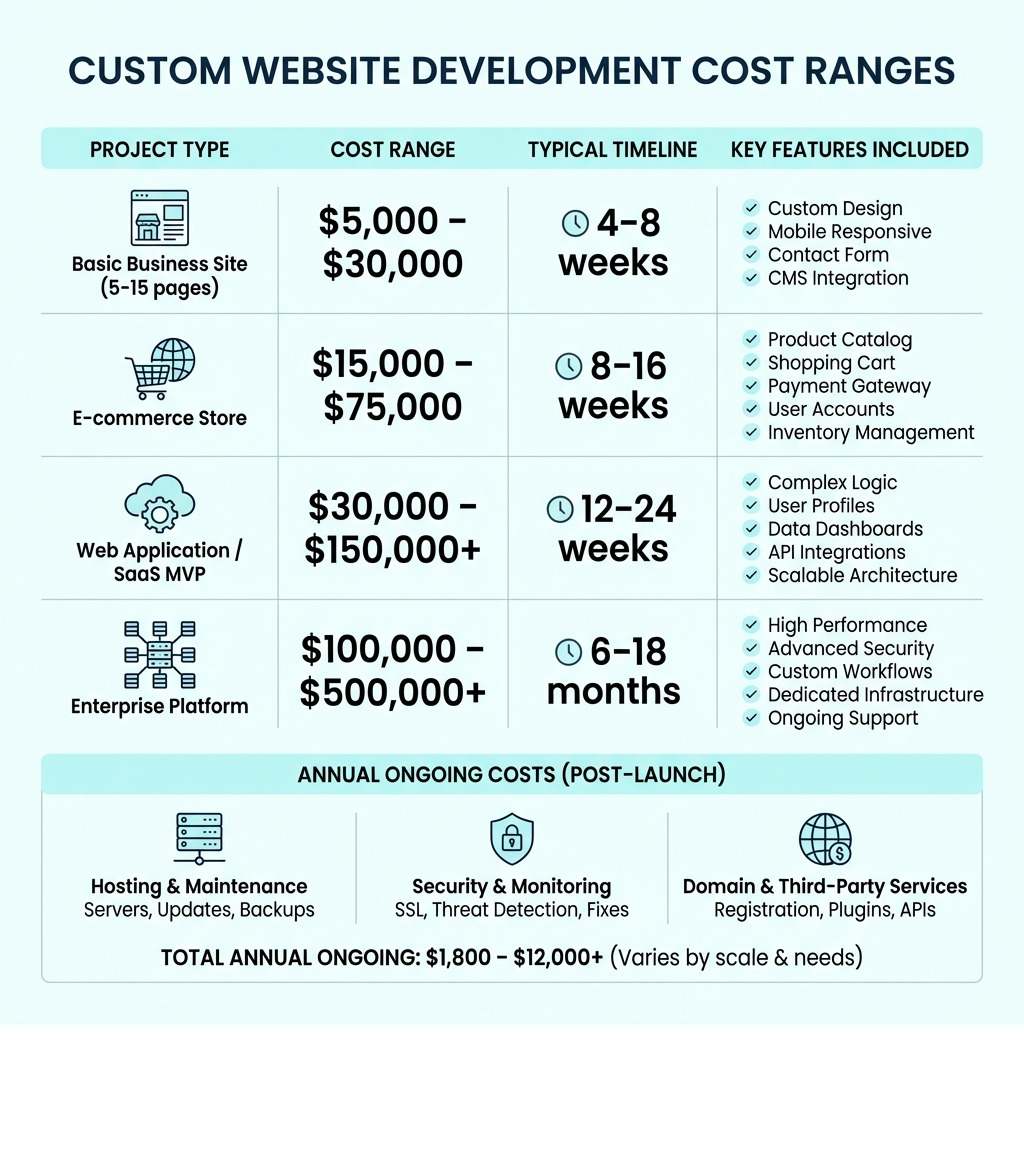
Quick custom website development cost definitions:
Breaking Down the Custom Website Development Cost
When we talk about custom website development cost, we aren’t just talking about a one-time fee for a pretty layout. We are talking about building a digital machine designed to generate revenue. Unlike a template-based site where you fit your business into a pre-made box, a custom build is engineered from the ground up to support your specific workflows.
Several primary drivers influence where your project lands on the price spectrum:
- Project Scope: This is the “how much” of your site. A 5-page brochure site for a local plumber in Rhode Island is a different beast than a 50-page corporate portal with deep service sub-pages.
- Design Complexity: Are we using standard layouts, or do you need custom illustrations, high-end animations, and a unique user interface that sets you apart from every competitor in Massachusetts?
- Tech Stack: The languages and frameworks used (like Next.js or React) impact speed and scalability. Modern stacks can actually be 30-40% faster to build with, which translates to better value for you.
- SEO and Strategy: A site that looks good but can’t be found is a liability. Investing in a solid SEO foundation during development is non-negotiable for local visibility.
For a more detailed look at how these factors intertwine, check out our more info about website pricing.

Essential Components of Your Custom Website Development Cost
To understand the invoice, you have to understand the “ingredients.” Here are the mandatory components that make up the total cost of ownership:
- Domain and Security: Your domain name is your web address, typically costing $10–$20 per year. More importantly, an SSL certificate is essential for encrypting data. While basic SSLs can be $10–$100, many quality hosts now bundle them.
- Hosting and Performance: Your performance needs dictate your hosting plan. Shared hosting ($5–$30/mo) might work for a tiny blog, but a custom business site usually requires a VPS or managed hosting ($25–$200/mo) to ensure fast load times.
- UI/UX Design: This is the blueprint phase. It involves wireframing and high-fidelity designs. For a standard site, this might take 40–100 hours of expert work.
- Frontend and Backend Development: This is where the “coding” happens. Frontend is what the user sees; backend is the logic (like processing a contact form or managing a database).
- Quality Assurance (QA): We don’t just launch and hope. QA involves testing the site on every browser and mobile device to ensure it doesn’t break when a customer tries to use it.
How Partner Choice Impacts Custom Website Development Cost
Who you hire is often the biggest variable in your budget. In the US market, specifically around Rhode Island and Massachusetts, you’ll see a wide range of hourly rates.
- Freelancers: Often the most “budget-friendly” upfront, with US-based rates ranging from $40 to $150 per hour. The risk? You are relying on one person. If they get sick or busy, your project stalls.
- Agencies: Agencies provide a team (Project Manager, Designer, Developer). US agency rates typically fall between $100 and $250+ per hour. While the hourly rate is higher, the project often moves faster and has more rigorous QA.
- Regional Variations: Hiring a firm in a high-cost hub like Boston or Providence will naturally reflect local labor costs, but you gain the benefit of local market knowledge and face-to-face strategy sessions.
For businesses weighing these options, read our more info about hiring a pro.
The Hidden Costs of Post-Launch Maintenance
One of the biggest mistakes we see is businesses spending their entire budget on the build and forgetting about the “gas and oil.” A custom website is living software. It needs:
- Security Patches: Hackers don’t take days off. Regular security monitoring is vital.
- Plugin/Framework Updates: To keep the site fast and functional, the underlying code needs regular updates.
- Content Refreshes: Google loves fresh content. Budgeting for ongoing blog posts or portfolio updates is key for ranking.
- Hosting Renewals: These are recurring annual or monthly costs.
We offer comprehensive plans to handle this—see more info about ongoing support.
Maximizing ROI and Budgeting for Long-Term Success
A custom website isn’t an expense; it’s a digital sales rep that never sleeps. When you invest in custom website development cost, you are buying an asset that should pay for itself through increased conversions and better lead quality.
Strategic Budgeting to Avoid Overspending
You don’t always need the “everything” version of your website on Day 1. We often recommend the MVP (Minimum Viable Product) approach.
- Phase 1: Build the core features that drive revenue (e.g., a high-converting landing page and service descriptions).
- Phase 2: Add advanced features (e.g., a client portal or interactive calculators) once the site is generating cash flow.
- Contingency Buffer: Always set aside 10-15% of your budget for “scope creep” or features you realize you need mid-project.
If you’re ready to see what a strategic build looks like for your business, you can Request a Quote.
Why Custom Solutions Outperform Templates
Why not just use a $50 template? Because templates are heavy, bloated with code you don’t need, and often slow.
- Mobile-First Indexing: This is our bread and butter at JPG Designs. Google now looks at the mobile version of your site first. Templates often “shrink” to fit mobile, but custom sites are built for mobile, leading to better rankings.
- Conversion Rates: Custom UI/UX leads to intuitive journeys. Businesses using custom solutions report up to 83% higher digital success rates.
- Lifespan: A cheap template site usually needs a total redo in 2 years. A well-built custom site can easily last 4-5 years with minor updates.
- First Impressions: It takes about 0.05 seconds for users to form an opinion about your site. 92% of first impressions are design-related.
Understanding the timeline is also part of budgeting. Learn more info about project timelines.
Conclusion: Investing in Your Digital Future
Navigating the custom website development cost landscape doesn’t have to be a mystery. By focusing on your specific business goals—whether that’s dominating local search in Rhode Island or launching a complex e-commerce platform—you can ensure every dollar spent is an investment in growth.
At JPG Designs, we specialize in more than just “making things look pretty.” We focus on the technical backbone that Google loves: mobile-first architecture and high-performance code. Our goal is to move the needle on your Google rankings and turn your visitors into loyal customers.
Ready to stop guessing and start growing? Explore more info about our web design services and let’s build something that works as hard as you do.