
Why Advanced Email Analytics Matter More Than Ever
Advanced email analytics go beyond basic open and click rates to provide deeper insights into true subscriber engagement, campaign performance, and revenue impact. These tools help businesses understand how recipients actually interact with emails—including read time, device usage, inbox placement, and conversion tracking—so marketers can make smarter, data-driven decisions instead of relying on unreliable metrics.
What advanced email analytics include:
- Engagement metrics – Read time, skim vs. read percentage, scroll depth, and forward counts
- Audience insights – Device types, email clients, geolocation, and behavioral patterns
- Performance data – Conversion rates, revenue attribution, ROI calculation, and customer lifetime value
- Visual analytics – Click maps, heatmaps, and link performance tracking
- Deliverability monitoring – Inbox placement rates, spam complaints, sender reputation, and bounce analysis
Why they’re important:
Traditional metrics like open rates have become unreliable due to privacy changes from Apple and Gmail that block tracking pixels. Basic analytics also fail to show why campaigns succeed or fail, leaving marketers to guess what resonates with their audience. Advanced analytics solve these problems by tracking verified actions, filtering out bot activity, and connecting email performance directly to business outcomes.
According to research, brands using advanced email analytics achieve 43% higher ROI than those relying on basic metrics alone. One agency used advanced engagement data to pivot a client’s strategy, resulting in a 35% increase in open rates.
I’m Jeff Pratt, owner of JPG Designs, where I’ve spent over 15 years helping businesses turn their digital marketing into revenue-producing systems through data-driven strategies including advanced email analytics. Throughout my career working with service businesses, B2B companies, and nonprofits, I’ve seen how moving beyond basic metrics transforms email marketing from guesswork into a predictable growth channel.
Why Basic Email Metrics Are No Longer Enough
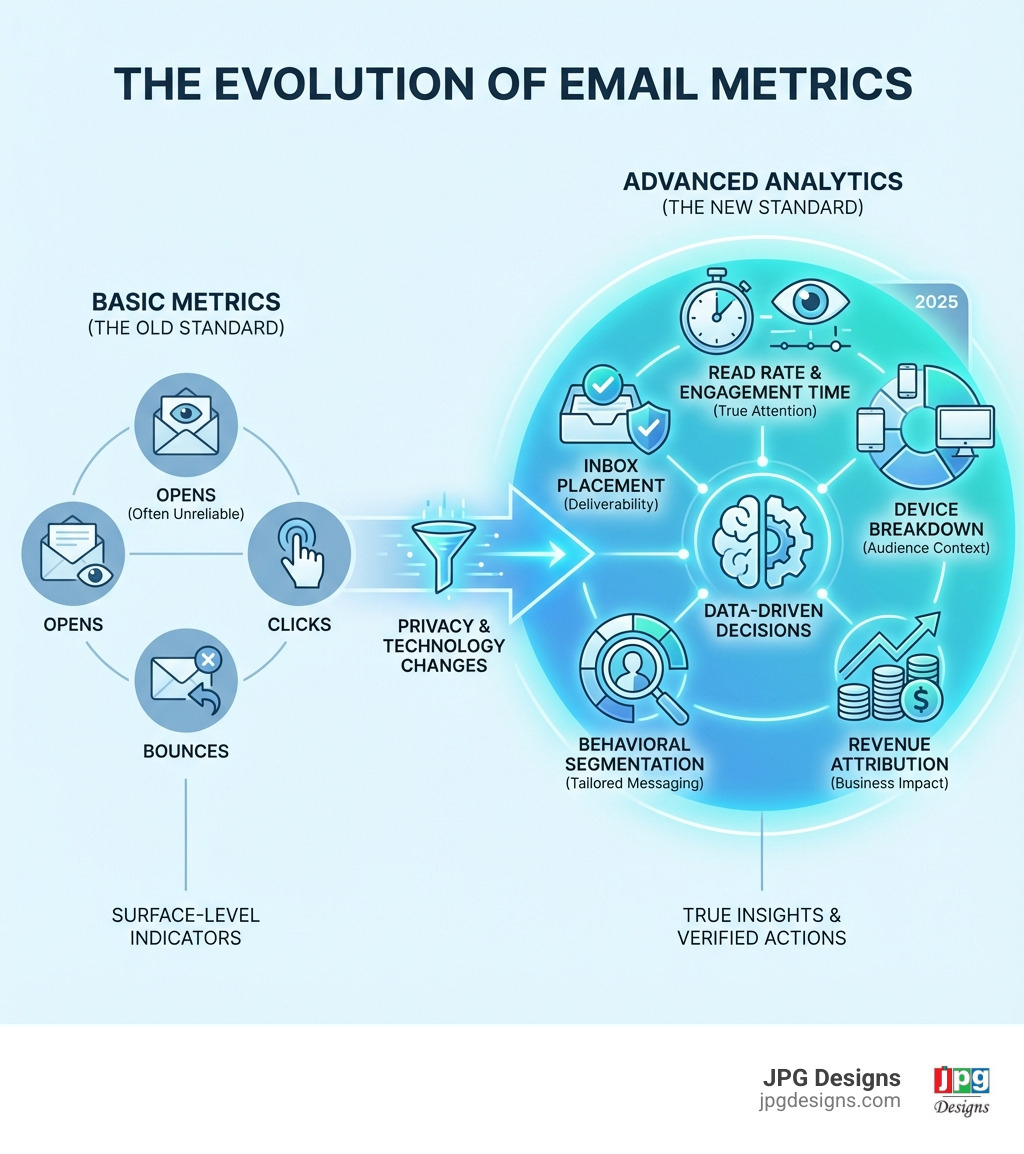
For years, email marketers relied on open rates and click-through rates (CTR) as the gold standard for campaign performance. We’d craft catchy subject lines, hit send, and then eagerly watch those numbers climb. But here’s the kicker: the old way of email performance tracking is broken. Relying solely on these basic metrics today is like trying to steer a dense fog with only a compass – you have a direction, but you’re missing a lot of critical information.
The biggest pain point? Inaccurate open rates. Recent privacy changes, notably Apple’s Mail Privacy Protection (MPP), have fundamentally altered how open rates are tracked. MPP pre-fetches email content, causing emails to appear “opened” even if the recipient never actually viewed them. This means your high open rate might just be a mirage, making it incredibly difficult to truly gauge audience engagement. As one expert noted, “These questions can’t be answered with basic metrics—especially in an era when GDPR cookie policies and new DMARC authentication requirements are reshaping the landscape of email performance data as we’ve known it for years.”
Beyond unreliable open rates, traditional analytics often present siloed data. You might see an email got a lot of clicks, but did those clicks lead to a sale? Did the recipient spend time on your website, or just bounce right off? Basic email service providers (ESPs) often struggle to connect the dots between an email interaction and what happens next in the customer journey. This leaves us with vanity metrics – numbers that look good on paper but don’t tell the full story of business impact.
We need to move beyond simply knowing what is happening (an email was opened) to understanding why it’s happening (the content was compelling, the timing was perfect, the offer was irresistible). This shift from “what” to “why” is crucial for effective optimization. Without it, we’re left guessing, and in the world of digital marketing, guessing is a luxury none of us can afford. For more insights into how these changes impact your overall strategy, explore our resources on online marketing trends.
Key Metrics to Track with Advanced Email Analytics
To truly master your email marketing, we need to dive deeper than basic opens and clicks. Advanced email analytics provide a treasure trove of data that helps us understand our audience, optimize our content, and prove our return on investment.
Here’s a comparison of basic versus advanced metrics:
| Basic Metrics | Advanced Metrics Traditional metrics like open rate, click-through rate (CTR), and conversion rate give us a general overview of campaign performance. However, they don’t tell us the whole story.
Advanced email analytics digs deeper, offering granular insights that empower us to truly understand our audience and optimize our strategies. These include:
- Engagement Metrics:
- Read Time: This metric goes beyond the open rate by measuring how long a recipient actually spends viewing your email. Did they just glance at it (less than 2 seconds), skim it (2-10 seconds), or truly read it (more than 10 seconds)? This helps us understand content stickiness.
- Forward Count: Knowing how many times your email is forwarded indicates its shareability and perceived value.
- Scroll Depth: Similar to website analytics, this shows how far recipients scroll down your email, revealing which content sections capture attention.
- Audience Insights:
- Device Usage: Understanding whether your audience primarily opens emails on mobile, desktop, or tablet is critical for responsive design and ensuring a seamless user experience. As a mobile-first web design company, we know how vital this is for user engagement.
- Email Client Breakdown: Knowing which email clients (e.g., Gmail, Outlook, Apple Mail) your subscribers use helps us optimize for rendering consistency and identify potential display issues.
- Geolocation: Understanding where your subscribers are located allows for localized content, time-zone optimized sending, and targeted promotions.
- Performance Metrics:
- Conversion Tracking: This links email interactions directly to desired actions, such as purchases, sign-ups, or downloads, providing a clear picture of your email’s impact on business goals.
- Revenue Attribution: The holy grail for many businesses, this metric attributes specific revenue directly back to individual email campaigns, helping us prove the true ROI.
- Customer Lifetime Value (CLV) Impact: How do your emails influence the long-term value of a customer? Advanced analytics can help uncover this.
- Visual Analytics:
- Heatmaps and Click Maps: These visual tools show exactly where recipients are clicking (or not clicking!) within your email. They highlight “hot spots” and areas of disinterest, providing invaluable feedback for layout and call-to-action (CTA) placement.
- Scroll Depth Maps: Similar to heatmaps, these visualize how far down the email users scroll, indicating content engagement.
By tracking these more sophisticated metrics, we gain a holistic view of our email performance, moving from vague assumptions to concrete, actionable insights. Just as understanding user behavior on your website is crucial, so is understanding it within your emails. For a deeper dive into general website analytics, check out our guide on everything you need to know about Google Analytics.
Leveraging Analytics to Boost Your Email Strategy
Moving from raw data to actionable insights is where the magic of advanced email analytics truly happens. It’s not enough to collect the numbers; we need to interpret them to refine our campaigns and lift our entire email marketing strategy. This transition allows us to optimize every touchpoint, ensuring our emails are not just sent, but truly seen, engaged with, and acted upon.
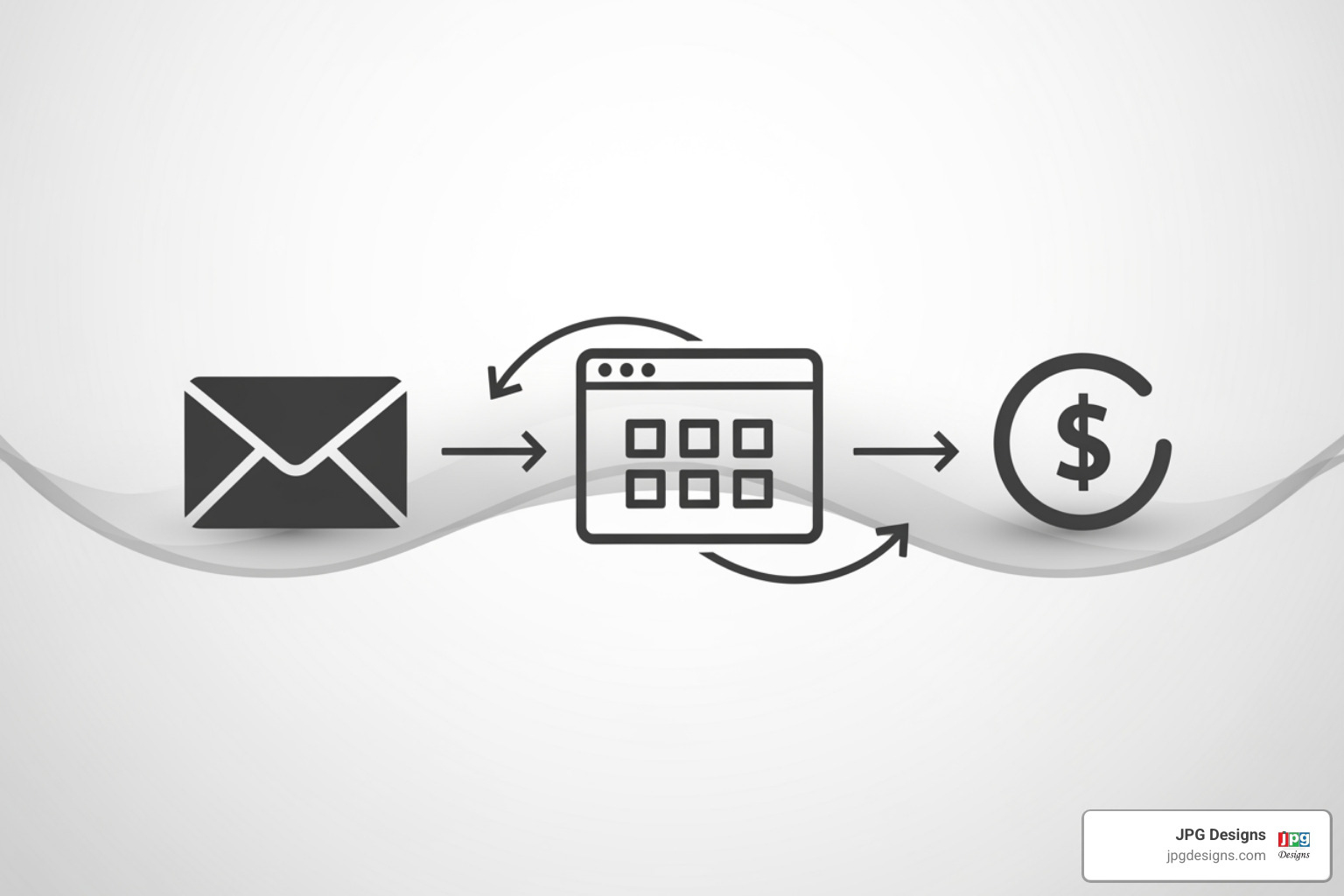
From understanding audience preferences to improving deliverability, advanced analytics provides the roadmap to success. By continuously learning from our data, we can make incremental improvements that lead to significant gains in engagement and, ultimately, revenue. If you’re looking to turn these insights into tangible results, exploring strategies that will help increase your sales is a great next step.
How to use advanced email analytics to understand audience behavior
Understanding our audience is the cornerstone of effective marketing. Advanced email analytics provides the granular data we need to move beyond generic messaging and truly connect with our subscribers.
- Audience Segmentation: We can segment our audience not just by demographics, but by their behavior within our emails. Who are our “readers” versus our “skimmers”? Who consistently clicks on product links versus blog content? This allows us to create highly targeted segments for personalized campaigns.
- Behavioral Data & Preference Identification: By analyzing read times, click patterns, and even scroll depth, we can infer what topics, formats, and offers resonate most with different segments. If a user consistently engages with emails about web design tips, we know to send them more of that content.
- Personalization: With these deep insights, we can personalize email content, subject lines, and even send times. Imagine sending an email about a new responsive web design service to a segment that frequently opens on mobile devices and has shown interest in design-related content. That’s personalization powered by data.
- Tailoring Content & Enhancing Customer Experience: When we know our audience’s preferences, we can tailor our content to be more relevant and valuable. This improves their overall experience with our brand, fostering loyalty and engagement.
- Cross-Device Optimization & Mobile-First Approach: Given that many users check emails on the go, understanding device usage is paramount. Our expertise at JPG Designs in building responsive web design and adhering to a mobile-first approach means we can ensure your emails look fantastic and function flawlessly, no matter the screen size. This directly impacts engagement and conversion rates.
Optimize content creation and A/B testing strategies
Content is king, but only if it’s hitting the mark. Advanced email analytics gives us the insights to refine our content creation and lift our A/B testing strategies from guesswork to scientific precision.
- Content Performance & Link Insights: We can analyze which links within our emails receive the most clicks, identifying “hot spots” and popular content themes. This directly informs our content strategy, allowing us to create more of what our audience loves. If a specific blog post link consistently outperforms others, we know to produce more content around that topic.
- Identifying ‘Hot Spots’: Heatmaps and click maps visually highlight the most engaging areas of our emails. This feedback is invaluable for optimizing layout, image placement, and call-to-action (CTA) visibility. Perhaps our CTA is too far down, or an image is drawing attention away from our primary message.
- Informing Content Strategy: By understanding which content drives the most engagement and conversions, we can allocate our resources more effectively. We can move from creating content based on assumptions to developing content based on proven audience interest. Learn more about creating high-quality content that performs.
- Split Testing (A/B Testing): Advanced analytics allows for more sophisticated A/B testing. Instead of just testing subject lines, we can test different content blocks, image styles, CTA wording, and even email layouts. For example, by pivoting a client’s email strategy based on engagement data, one agency saw a remarkable 35% increase in open rates. This demonstrates the power of data-driven testing. Using tools that allow testing up to 5 variations of a template can reveal effective subject lines, content, and CTAs.
Identify and mitigate deliverability issues
Even the most perfectly crafted email is useless if it doesn’t reach the inbox. Deliverability is the bedrock of email marketing success, and advanced email analytics provides the crucial tools to monitor, diagnose, and mitigate issues that could land your messages in the spam folder.
- Deliverability Monitoring & Inbox Placement: Advanced platforms track your inbox placement rates across various email providers. They can tell us if our emails are consistently landing in the primary inbox, promotions tab, or worse, the spam folder. This is often achieved through sophisticated internal checks across dozens of sending areas.
- Spam Trap Monitoring & Sender Reputation: We monitor for interactions with spam traps, which are email addresses used to identify spammers. Hitting a spam trap can severely damage your sender reputation. Analytics help us identify and remove these from our lists. Protecting our sending reputation is paramount for long-term success.
- Blocklist Alerts: Advanced tools provide real-time alerts if our sending IP addresses or domains get added to blocklists, allowing for immediate action to resolve the issue.
- DMARC Performance: DMARC (Domain-based Message Authentication, Reporting & Conformance) helps protect against email spoofing. Monitoring DMARC performance is crucial for ensuring our emails are authenticated and trusted by receiving servers.
- Analyzing Bounce Rates: High bounce rates indicate problems with our email list. Advanced email analytics differentiates between soft bounces (temporary issues) and hard bounces (permanent delivery failures), allowing us to clean our lists effectively and prevent future issues.
- Complaint Rates: When recipients mark our emails as spam, it hurts our sender score. We track complaint rates closely, often pairing them with unsubscribe rates. If complaint rates spike more than unsubscribes, it could indicate a serious content or relevance issue.
- The good news is that with dedicated focus on deliverability and leveraging advanced tools, businesses can see significant improvements. Research shows that 95% of Bird customers outperform the industry average in email delivery rates, highlighting the impact of robust deliverability insights.
Choosing a Platform and Proving the Value of Your Efforts
Selecting the right advanced email analytics platform is a critical decision. It needs to integrate seamlessly with your existing tools and provide clear pathways to demonstrating the financial impact of your email marketing efforts.
Integrating with your stack
For many businesses, email marketing isn’t a standalone operation; it’s part of a larger ecosystem of tools. Your advanced email analytics platform should play nice with your customer relationship management (CRM) system, marketing automation platform, and other data sources.
- CRM Integration: A robust integration allows for a 360-degree view of your customer. Email engagement data (opens, clicks, conversions) can be passed directly to your CRM, enriching customer profiles and enabling even deeper segmentation and personalized interactions across all channels. This holistic view helps sales teams understand customer interest before making contact.
- API Access: For businesses with custom needs or complex tech stacks, API access is invaluable. It allows us to pull raw email performance data into business intelligence tools, data warehouses, or custom dashboards for bespoke analysis. This flexibility ensures that the insights you need are always available, regardless of your existing infrastructure.
- Choosing the right tools for your business is key, and we often guide our clients through this process. For a comprehensive overview of options, you might find our guides on email marketing software helpful.
Key features to look for in an advanced email analytics platform
When evaluating different platforms, we look for features that empower us to gain deep insights and act on them effectively.
- Real-time Dashboards: Instant access to performance data allows for quick adjustments and proactive problem-solving. We don’t want to wait days to see if a campaign is underperforming.
- Custom Reporting: The ability to create custom reports that focus on the metrics most relevant to our specific business goals is essential. Generic reports often miss the nuance we need.
- Bot Filtering: As mentioned, automated bots can inflate open rates. A good platform will identify and filter out bot activity to provide true human engagement data.
- Data Export: The flexibility to export raw data in various formats (e.g., CSV) is crucial for further analysis in external tools or for sharing with stakeholders.
- PII Compliance: Data privacy is non-negotiable. We ensure the platform actively promotes PII (Personally Identifiable Information) compliance and prevents the collection of personal information by default, adhering to regulations like GDPR. This is a critical consideration for any business operating in Rhode Island or Massachusetts, given the increasing emphasis on consumer data protection.
- Security and Compliance: Beyond PII, the platform should have robust security measures in place to protect your sensitive data and ensure compliance with relevant industry standards.
How to prove the ROI of your email marketing
Proving the return on investment (ROI) of email marketing is often challenging, but with advanced email analytics, it becomes much clearer. We can move beyond anecdotal evidence to hard numbers that justify our efforts and budget.
- Connecting Email to Revenue & Attributing Sales: The most direct way to prove ROI is to connect email campaigns directly to sales and revenue. This involves tracking conversions from email clicks to purchases on your website. When we can say, “This email campaign generated $X in revenue,” that’s powerful. One remarkable example saw an “impressive $965 million boost in email-generated revenue” for Zillow through optimized deliverability and timing, showing the immense potential.
- Customer Lifetime Value (CLV): Beyond immediate sales, we analyze how email marketing influences the long-term value of a customer. Do customers acquired through email have a higher CLV? Do engagement campaigns increase repeat purchases?
- Executive-Ready Reports: Advanced platforms allow us to create clear, concise reports that highlight key performance indicators and, most importantly, the financial impact. These reports are designed to be understood by stakeholders who may not be email marketing experts.
- Visualizing Business Impact: Graphs and charts that visually connect email efforts to business outcomes (e.g., revenue generated, customer acquisition cost reduction) are far more impactful than raw data tables.
- Research confirms the value: brands that use advanced email analytics achieve a 43% higher ROI than those that don’t. This statistic alone is a compelling argument for investing in these capabilities. Understanding and maximizing your ROI across all digital channels is something we specialize in, including with SEO and Google Ads.
The impact of AI and machine learning on the future of email analytics
The future of advanced email analytics is undeniably intertwined with artificial intelligence (AI) and machine learning (ML). These technologies are not just buzzwords; they are actively changing how we analyze data and optimize our email strategies.
- Future of Email Analytics: AI and ML are moving us towards more predictive and prescriptive analytics. Instead of just telling us what happened, they can predict what will happen and even recommend actions.
- Predictive Analytics: AI can analyze vast datasets to predict optimal send times for individual subscribers, forecast campaign performance, or identify which customers are most likely to churn. This allows for proactive rather than reactive strategy adjustments.
- Automated Optimization: Machine learning algorithms can continuously optimize elements like subject lines, content personalization, and send frequencies based on real-time engagement, without constant manual intervention. This means our campaigns are always learning and improving.
- AI-Native Platforms & Adaptive Technology: Many modern advanced email analytics platforms are now “AI-native,” meaning AI is built into their core functionality. They use adaptive technology to automatically adjust and optimize various aspects of email delivery and content based on learned patterns and real-time feedback. This could include automatically optimizing inbox placement based on current ISP algorithms.
- These advancements represent the next frontier in email marketing, enabling levels of personalization and efficiency that were previously unimaginable. To stay ahead, it’s crucial to keep an eye on emerging tech trends that influence marketing strategies.
Frequently Asked Questions about Advanced Email Analytics
We know that diving into advanced email analytics can bring up a lot of questions. Here are some of the most common ones we encounter:
What is the most important advanced email metric?
This is a trick question! There isn’t one single “most important” advanced email metric. The most important metric always depends on your specific campaign goals.
- If your goal is to gauge actual engagement beyond vanity opens, read rate is crucial.
- If your goal is direct sales, then conversion rate and revenue per email will be your north stars.
- If you’re focused on long-term customer value, then metrics influencing CLV are paramount.
The true power of advanced email analytics lies in looking at a combination of metrics that tell a complete story about your email performance and its impact on your business objectives.
How do I start using advanced analytics if my ESP is basic?
Don’t despair if your current email service provider (ESP) only offers rudimentary reporting! You have several options:
- Use Third-Party Analytics Tools: Many specialized advanced email analytics platforms (like Litmus or Parcel) are designed to integrate with various ESPs. They provide deeper insights, even if your ESP’s native analytics are limited.
- Integrate a Tracking Code: These third-party tools often provide a tracking code that you embed in your emails. This code captures the detailed engagement data you’re looking for, independent of your ESP’s basic tracking.
- Export Data to BI Tools: If your ESP allows data export, you can pull raw data into business intelligence (BI) tools (like Google Data Studio, Tableau, or even advanced Excel spreadsheets) for deeper analysis and custom reporting. This requires a bit more technical know-how but offers immense flexibility.
The key is to proactively seek out solutions that fill the gaps left by basic ESPs.
How do advanced analytics platforms handle data privacy?
Data privacy is a major concern, especially with regulations like GDPR and CCPA. Advanced email analytics platforms are built with privacy in mind:
- PII Compliance by Default: Reputable platforms actively promote PII compliance. They are designed to prevent the collection of personally identifiable information unless explicitly configured otherwise, or they anonymize user data where possible. For instance, Litmus states it “actively promotes PII compliance and prevents the collection of personal information by default.”
- Anonymizing User Data: Many platforms use anonymized or pseudonymized identifiers to track engagement, meaning individual users cannot be directly identified from the analytics data itself.
- Filtering Bot Activity: As part of data accuracy, these platforms often include features to detect and filter out bot opens and clicks, which not only cleans your data but also prevents unintended collection of data from non-human entities.
- Adhering to Regulations: They are built to help you adhere to regulations like GDPR and CCPA, which are vital for any business operating in areas like Rhode Island and Massachusetts where consumer data protection is taken seriously.
It’s always important to review the privacy policy and data handling practices of any analytics platform you consider using.
Conclusion
In today’s dynamic digital landscape, merely sending emails and glancing at basic open rates is no longer sufficient. We’ve seen how privacy changes have rendered traditional metrics unreliable, leaving marketers in the dark about what truly resonates with their audience. The pain point is clear: without deep, actionable insights, email marketing becomes a shot in the dark.
The solution lies in embracing advanced email analytics. By delving into metrics like read time, conversion rates, and deliverability, and leveraging visual tools like heatmaps, we gain a comprehensive understanding of our audience’s behavior and the true impact of our campaigns. This shift empowers us to move beyond vanity metrics, optimize content, personalize experiences, and ensure our messages consistently reach the inbox.
At JPG Designs, we believe in data-driven strategies that turn insights into tangible business growth. Our expertise in mobile-first web design and improving Google rankings complements a robust email marketing strategy, ensuring your entire digital presence works in harmony. We’re dedicated to helping businesses like yours leverage the power of advanced email analytics to refine their approach, improve customer engagement, and ultimately, prove a significant return on investment.
Ready to transform your email marketing from guesswork to a predictable growth engine? Let us help you open up the full potential of your campaigns.