
Why Social Media Brand Building Is Essential for Your Business
Brand building on social media is the strategic process of developing a strong, recognizable, and consistent identity across social platforms to connect with your audience, build trust, and drive business growth. Here’s what you need to know to get started:
Core Steps for Effective Social Media Brand Building:
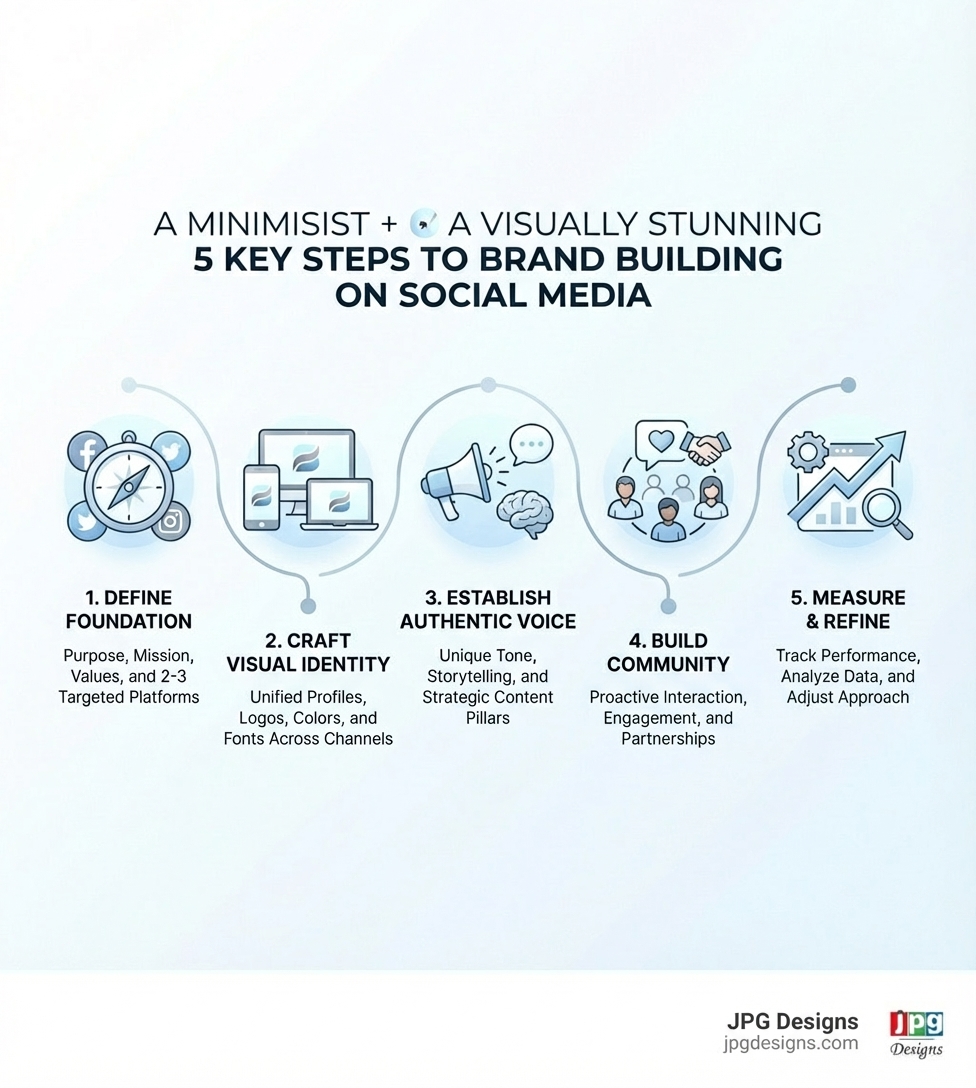
- Define Your Foundation – Establish your brand’s purpose, mission, values, and choose 2-3 platforms where your audience lives
- Create Visual Consistency – Develop unified profiles with consistent logos, colors, fonts, and messaging across all channels
- Establish Your Voice – Define a unique, authentic tone that resonates with your target audience
- Build Strategic Content – Use content pillars, storytelling, and the 70-20-10 rule (70% value, 20% shared content, 10% promotion)
- Engage and Measure – Foster community through proactive interaction and track performance to refine your approach
The challenge is real: with over 59% of the world’s population on social media, the “throw stuff at the wall” approach doesn’t work, especially when 82% of U.S. consumers say social media influences their buying decisions. The solution isn’t about being everywhere; it’s about being intentional and building a recognizable identity that people trust and choose.
Brand consistency isn’t just aesthetic—it increases revenue by 10-20%. When your audience sees the same colors, voice, and values across Instagram, LinkedIn, or Facebook, you’re building memory structures. You’re creating a brand people recognize before they even read your name.
Many miss a key distinction: social media branding isn’t marketing. Branding is who you are—your personality and promise. Marketing is how you get known—the tactics to reach people. You need both, but branding must come first to avoid being just noise.
This guide provides a clear roadmap for building a brand that lasts—from defining your purpose to measuring what matters. No fluff, just a proven process.
I’m Jeff Pratt, owner of JPG Designs, and over 15 years I’ve helped businesses across industries—from contractors and B2B manufacturers to nonprofits and service providers—build digital systems that drive real growth. Through strategic brand building on social media, we’ve helped clients move from inconsistent posting to recognizable, revenue-producing online identities that connect with the right audiences and support long-term business goals.
The Foundation: Understanding Social Media Branding
Brand building on social media is the intentional process of shaping your company’s public perception across social platforms. It’s about crafting a distinct identity—influenced by design and copy—that creates a recognizable and memorable presence.
Unlike traditional brand building, social media is a two-way street where consumers influence perceptions. Early digital strategies often created noise without building lasting connections. Our goal is to move beyond short-term spikes and build a strategic, long-term relationship with our audience. The key components of social media branding include:
- Brand Identity: Your visual elements (logo, colors, fonts) and overall aesthetic.
- Brand Voice: How you communicate, your personality, and your tone.
- Brand Values: The core beliefs and principles that guide your business.
- Community: The engaged group of followers who connect with your brand and each other.
By focusing on these elements, we create a consistent brand perception that resonates. Brand consistency isn’t just a nice-to-have; it’s a revenue driver. One study found that brand consistency increases revenue by 10-20%. This means that maintaining a unified look and feel across platforms directly impacts your bottom line. For a deeper dive into effective strategies, explore our guide on Strategies for Effective Social Media Marketing.
Define Your Purpose, Mission, and Values
Before posting, ask: Why does our company exist? This isn’t a philosophical question; it’s the bedrock of your brand. Your purpose is the “Why” behind your business—the problem you solve or the goal you aim to achieve.
From there, we craft our:
- Vision Statement: Where we hope our company will be in a given timeframe (next year, five years, ten years).
- Core Values: How we behave as a company, how our employees treat each other, and the principles that guide our decisions.
These elements form the foundation of our brand story. When our purpose, mission, and values align with our target audience’s needs, we create a powerful connection that goes beyond just products or services.
Choose the Right Social Media Platforms
Spreading ourselves too thin is a recipe for burnout and inconsistent branding. Instead, we need to strategically choose the platforms where our target audience is most active and where our content can shine.
Consider the following:
- Audience Demographics: Where does your ideal customer hang out online? For instance, Pew Research indicates that 68% of U.S. adults use Facebook, while 47% use Instagram. If we’re targeting a younger demographic, TikTok and Instagram might be priorities. For B2B audiences in Rhode Island or Massachusetts, LinkedIn is often indispensable.
- Platform Strengths: Each platform has unique strengths. Instagram and TikTok are visual powerhouses. Facebook is excellent for community building. LinkedIn is ideal for professional networking and thought leadership.
- Content Alignment: What type of content do we plan to create? If we’re heavy on educational videos, YouTube is a must. If we have stunning visuals, Pinterest and Instagram are key.
Our advice? Start with 2-3 core platforms. Master them, build our social media muscles, and then consider expanding. This focused approach allows us to maintain a consistent brand identity without sacrificing quality.
Step 1: Crafting a Consistent Brand Identity
Once we understand our brand’s core and chosen our battlegrounds, the next step is to ensure our online presence is instantly recognizable and cohesive. This means maintaining a consistent brand identity across all platforms.
Consistency is crucial. Every visual element—logo, colors, fonts, imagery—contributes to your brand’s perception. A strong visual identity helps you stand out, builds trust, and ensures customers immediately recognize your content. For more insights on this, check out our guide on How to Boost Your Brand Identity.
Profile Optimization:
- Username: Keep it consistent and easy to find across all platforms.
- Profile Picture: Use the same high-resolution logo or branded image.
- Bio: Craft a concise, compelling bio that clearly states what you do, who you help, and includes a clear call to action. Tailor it slightly for each platform, but maintain the core message.
By creating a unified look and feel, we make it easy for our audience to recognize and connect with us, no matter where they encounter our brand online. This is crucial for building memory structures and ensuring our message cuts through the digital clutter.
Understanding Your Target Audience for Effective Brand Building on Social Media
We can’t build a brand for everyone. To truly connect, we need to know who we’re trying to reach. Understanding your target audience is paramount. Without this insight, you’re shouting into the void. Knowing your audience allows you to create content they will engage with, turning fans into loyal customers.
Here’s how we approach it:
- Audience Personas: We develop detailed profiles of our ideal customers, considering demographics (age, location, income), psychographics (interests, values, lifestyle), pain points, and motivations. For example, a retail brand might create personas for “luxury buyers” vs. “budget-conscious shoppers.”
- Social Listening: We monitor conversations around our industry, competitors, and keywords. This reveals what people are saying, what questions they’re asking, and what problems they’re trying to solve.
- Analyzing Demographics and Interests: Social media analytics tools provide insights into who our followers are, where they live (relevant for our local clients in Rhode Island and Massachusetts!), and how they interact with our content. This data allows us to refine our strategy and target ads more effectively.
Knowing our audience’s pain points allows us to create truly helpful and resonant content. For further guidance on this, explore our article on Understanding and Adapting to Reach Your Target Audience.
Establish a Unique and Authentic Tone of Voice
Your brand’s tone of voice is its personality—how you communicate beyond visuals. Establishing a unique tone of voice on social media means being consistent in how you speak, whether you’re friendly, professional, humorous, or inspirational.
Consider this: a pharmaceutical company likely needs a formal, authoritative voice. A wellness brand, however, might opt for a more casual, encouraging tone. Our tone should reflect our brand’s core values and resonate with our target audience.
To define our brand voice, we ask:
- If our brand were a person, how would they speak? (e.g., witty, empathetic, direct)
- What emotions do we want our audience to feel when they read our content? (e.g., informed, entertained, inspired)
- How do our competitors communicate, and how can we differentiate ourselves?
We then create a simple voice and tone guide that outlines specific words and communication styles to use (and avoid). This ensures everyone creating content for our brand speaks with a unified voice, building trust and making our brand more relatable.
Step 2: The Core of Brand Building on Social media: Your Content Strategy
Content fuels your social media, but it requires a strategic approach to contribute effectively to brand building on social media.
Our content strategy revolves around:
- Content Pillars: These are 3-5 core topics your brand will own. They define what you want to be known for, simplify planning, and help establish expertise. For example, a digital marketing agency’s pillars might be “SEO best practices,” “web design trends,” and “social media strategy.”
- Content Calendar: A well-organized calendar helps plan, schedule, and execute posts consistently. Tools like Sprout, Later, and Hootsuite can connect to social media and allow us to schedule across different networks.
- The 70-20-10 Rule: A guideline for content distribution:
- 70% of content should build your brand’s persona by educating, entertaining, or inspiring.
- 20% should be sharing others’ posts (with credit) to foster community.
- 10% can be promotional, directly selling your products or services.
- Brand Storytelling: Humanize your brand by telling stories about your company’s journey, team, and customer successes. This creates emotional connections.
- Providing Value: Your content must offer value, whether it’s information, entertainment, or inspiration. Valuable content gets noticed, shared, and remembered.
When we focus on quality, relevance, and value, our content becomes a powerful tool for brand building on social media. And don’t forget to consider the Best Times Post Social Media for maximum impact!
Leveraging Visuals and Short-Form Video for Maximum Impact
In a visually-driven world, your visual content is often the first impression. Leveraging visual content like photos, videos, and infographics for brand building is non-negotiable, as it fosters the most audience engagement.
- Visual Identity: This includes your brand colors, fonts, and image style. Consistency makes your brand instantly recognizable.
- High-Quality Imagery: Professional photos and graphics convey credibility.
- Infographics: These are excellent for breaking down complex information into shareable visuals.
- Short-Form Video: This is a game-changer. The significance of short-form video content in modern brand building cannot be overstated. Platforms like TikTok, Instagram Reels, and YouTube Shorts dominate attention. A recent study found that repurposing video content across multiple platforms can increase engagement rates by up to 30%.
- Stories & Reels: Perfect for quick tips, behind-the-scenes glimpses, and engaging with trends.
- Behind-the-Scenes Content: Showing the faces behind our brand builds authenticity.
- Jumping on Trends: Participating in relevant trends can significantly increase reach.
We encourage our clients to accept short-form video. It’s dynamic, engaging, and highly effective. For more tips on using video, check out 5 Easy Ways to Promote Your Small Business with Video and Social Media.
Creating a Unique Hashtag and Repurposing Content
A unique hashtag is a digital rallying cry for your brand. Creating and using a unique hashtag improves your presence by:
- Increasing Findability: It makes your content searchable and centralizes conversations.
- Fostering Community: It encourages user-generated content and participation.
- Reinforcing Identity: It acts as a memorable secondary slogan.
When brainstorming a hashtag, aim for something memorable, easy to spell, and reflective of your brand’s mission. Also, research existing hashtags to ensure yours is truly unique.
Repurposing Content:
Repurposing high-performing content is a smart strategy to maximize its reach. Adapt existing successful pieces into different formats for various platforms.
| Original Content (e.g., Blog Post) | Repurposed Formats | Platforms |
|---|---|---|
| Long-form Blog Post | Carousel post | Instagram, LinkedIn |
| Short-form video | TikTok, Reels, Shorts | |
| Quote cards | Instagram, X (Twitter), Pinterest | |
| Infographic | Pinterest, Instagram, LinkedIn | |
| Thread/Tweetstorm | X (Twitter) |
This approach ensures our valuable message reaches a wider audience in formats they prefer, making it an efficient and effective method for consistent brand building on social media.
Step 3: From Followers to Fans: Building a Thriving Community
Social media is for conversation, not just broadcasting. Building a community around your brand on social media transforms passive followers into active advocates and loyal fans.
The benefits of building a community are immense:
- Increased Loyalty: Engaged members feel a deeper connection.
- Valuable Feedback: Get direct insights on products and services.
- Organic Reach: Members amplify your message by sharing content.
- Social Proof: A vibrant community signals trust to new customers.
- Brand Ambassadors: Happy customers become advocates.
We achieve this through:
- Proactive Engagement: We don’t just post; we respond to comments, answer DMs, and participate in relevant conversations. Responding to comments within 1 hour can increase engagement by 30%.
- User-Generated Content (UGC): Encouraging and sharing content created by customers is powerful social proof.
- Using Polls and Questions: Brands can use audience polls and questions to gather insights for brand building by directly asking what content they want to see or what problems they face. This gathers valuable data and makes your audience feel heard.
By fostering genuine interactions, we solidify our brand. Dive deeper into this topic with our insights on Brand Engagement with Social Media Management.
Positioning as an Authority and Leveraging Partnerships
To stand out, your brand must be seen as a leader. Using social media to position a brand as an authority in its niche involves consistently sharing valuable insights, demonstrating expertise, and leading conversations.
- Thought Leadership: Publish original research, share expert opinions, and create in-depth content (like webinars or guides) to build credibility.
- Hosting Webinars or Live Sessions: These interactive events allow us to share expertise directly and engage with our audience in real-time.
- Collaborations and Partnerships: Influencer marketing and brand partnerships play a significant role in social media brand building.
- Influencer Marketing: We collaborate with influencers whose audience aligns with ours. Micro-influencers often generate 60% higher engagement rates than mega-influencers.
- Brand Partnerships: We team up with complementary brands for joint campaigns or content, expanding our reach to new, relevant audiences.
- Social Customer Service: Customer service on social media directly contributes to brand building. Using platforms like X (Twitter) or Facebook Messenger to promptly address customer inquiries demonstrates care and builds a positive brand image.
By combining thought leadership with strategic partnerships and excellent customer service, we solidify our reputation as a trusted authority. This also contributes to our overall online visibility and can even improve our SEO. Read more about this in How Social Media Improves Your SEO.
Step 4: Measuring Performance and Navigating Challenges
Even with a solid strategy, brand building on social media has its challenges. You must be prepared and constantly analyze your efforts to stay on track.
Challenges and Potential Pitfalls:
- Inconsistency: Sporadic posting or a fluctuating brand voice can confuse your audience.
- Being Too Promotional: Over-promoting without providing value leads to unfollows. Remember the 70-20-10 rule!
- Handling Negative Feedback: Have a plan for addressing negative comments gracefully and constructively.
- Maintaining an Active Presence: Without a dedicated team or plan, social media can become a “ghost town.”
- C-Suite Buy-in: Educate upper management on the ROI and strategic importance of social media to secure investment.
- Influencer Risks: Carefully vet influencers, as your brand risks being implicated if they are “canceled.”
Communicating a Rebrand:
If you refresh your brand identity, use social media to communicate these efforts. Involve your audience by sharing behind-the-scenes glimpses and asking for feedback to build excitement and connection.
Scheduling Tools and Best Practices:
Tools like Sprout, Later, and Hootsuite are invaluable for scheduling content and ensuring consistency. Best practices include:
- Consistent Posting: Set a realistic schedule and stick to it.
- Value-Driven Content: Prioritize content that educates, entertains, or inspires.
- Engagement: Regularly interact with your audience.
- Adaptability: Be ready to pivot your strategy based on trends and performance.
If your social media feels like a “ghost town,” it’s time to re-evaluate. Our article Is Your Social Media a Ghost Town? offers solutions to breathe life back into your channels.
Analyzing Your Social Media Brand Building Efforts
We can’t improve what we don’t measure. Analyzing social media brand performance is crucial for refining your strategy.
Key Performance Indicators (KPIs) to track include:
- Reach: Unique users who saw your content.
- Engagement Rate: Likes, comments, shares, and clicks relative to audience size.
- Follower Growth: The rate of audience expansion.
- Share of Voice: Brand mentions compared to competitors.
- Website Referrals: Traffic driven to your website from social media.
- Conversions: Leads or purchases generated from social media.
Use built-in or third-party analytics tools to gather data. Analyze these insights weekly to understand audience preferences, optimize posting times, and identify top-performing content.
Competitor Analysis: We also keep a close eye on our competitors. What content performs well for them? What strategies are they employing? This helps identify opportunities and differentiate our approach. By connecting social metrics to our overall business goals, we demonstrate the tangible value of our brand building on social media efforts.
Frequently Asked Questions about Social Media Brand Building
What is the difference between social media branding and social media marketing?
It’s crucial to understand the distinction:
- Social Media Branding is about who you are. It’s defining and communicating your company’s core identity—its values, personality, and mission—to build a recognizable and trusted reputation.
- Social Media Marketing is about how you get known. It’s the tactics used to promote your brand, drive traffic, and generate leads, including ads, content, and campaigns.
Think of it this way: branding is the foundation, and marketing is the action. You need a strong brand before your marketing can be truly effective. For a deeper dive into marketing tactics, check out The Benefits of Organic and Paid Social Media Advertising.
How long does it take to build a brand on social media?
Building a brand on social media is a marathon, not a sprint. Sustainable brand building on social media requires consistent effort. You can expect to see noticeable progress within 6 to 12 months, but establishing a powerful, trusted identity can take several years.
The timeline depends on your industry, consistency, and engagement levels. The key is to focus on long-term growth and avoid chasing fleeting trends.
Can a small business effectively build a brand on social media?
Absolutely. Social media levels the playing field, giving small businesses in Rhode Island and Massachusetts powerful, low-cost tools to compete with larger brands. Authenticity and community are your biggest advantages. A unique personality and direct connection with your audience can build a loyal following that larger corporations struggle to achieve.
Small businesses can thrive by:
- Focusing on a Niche: Become the go-to expert for a specific audience.
- Leveraging Authenticity: Share your story and connect on a personal level.
- Building Community: Prioritize engagement to make customers feel valued.
Social media is a vital tool for local businesses looking to build their presence and drive traffic. Learn more about this in Online Marketing Strategies to Improve Local Business Traffic.
Conclusion
Brand building on social media is no longer optional; it’s a cornerstone of modern business success. We’ve explored the essential steps: from defining our brand’s core purpose and selecting the right platforms, to crafting a consistent visual identity and an authentic voice, and building a content strategy that educates, entertains, and inspires. We’ve emphasized the power of community, the importance of strategic partnerships, and the necessity of measuring our efforts to continuously refine our approach.
The power of a strong online identity is immense. It builds trust, fosters loyalty, and directly impacts our revenue. This isn’t about chasing viral trends or getting lost in the noise; it’s about intentional, consistent effort that creates lasting connections.
At JPG Designs, we understand the nuances of digital marketing and specialize in creating mobile-first strategies that improve online visibility and drive real results for businesses. If you’re ready to move beyond inconsistent posting and craft a powerful online identity that resonates with your audience, we’re here to help.
Take the next step to lift your online presence with our Digital Marketing Services.