

Why Plumbing Business Growth Stalls — and How to Fix It
Plumbing business growth is one of the most searched topics among trade contractors — and for good reason. The U.S. plumbing industry is projected to generate $169.8 billion in revenue, yet most plumbing businesses operate on razor-thin margins of just 2% to 3%. Industry leaders, by contrast, consistently hit 20% or higher.
So why the gap?
Here are the core reasons plumbing businesses struggle to grow — and what to do about each:
| Pain Point | What’s Really Happening | What to Do |
|---|---|---|
| Revenue stalls around $300K–$600K | Owner is the bottleneck | Delegate, document, build systems |
| Thin profit margins | Underpricing and high overhead | Use flat-rate pricing with a real price book |
| Feast-or-famine cycles | Over-reliance on referrals | Build proactive lead generation systems |
| Missed calls = missed revenue | No after-hours coverage | Automate responses; speed to lead matters |
| Cash flow problems | Slow invoicing and no recurring revenue | Add maintenance agreements and digital payments |
| Growth feels chaotic | No documented processes | Build SOPs before adding more trucks or staff |
The businesses that break through aren’t necessarily the most skilled plumbers in their market. They’re the most organized. They build systems first — then scale.
Think of it this way: one owner described adding a second truck, watching revenue climb, but somehow ending up working more hours with thinner margins and no clear picture of where the money went. Sound familiar? That’s not a lead problem. That’s a systems problem.
This guide will walk you through exactly how to fix it — from pricing and hiring to digital marketing and recurring revenue.
I’m Jeff Pratt, owner of JPG Designs, a Rhode Island-based digital agency with over 15 years of experience helping home service businesses — including plumbing companies — build revenue-producing websites and marketing systems that support real plumbing business growth. My team works directly with contractors who are ready to stop guessing and start scaling with purpose.
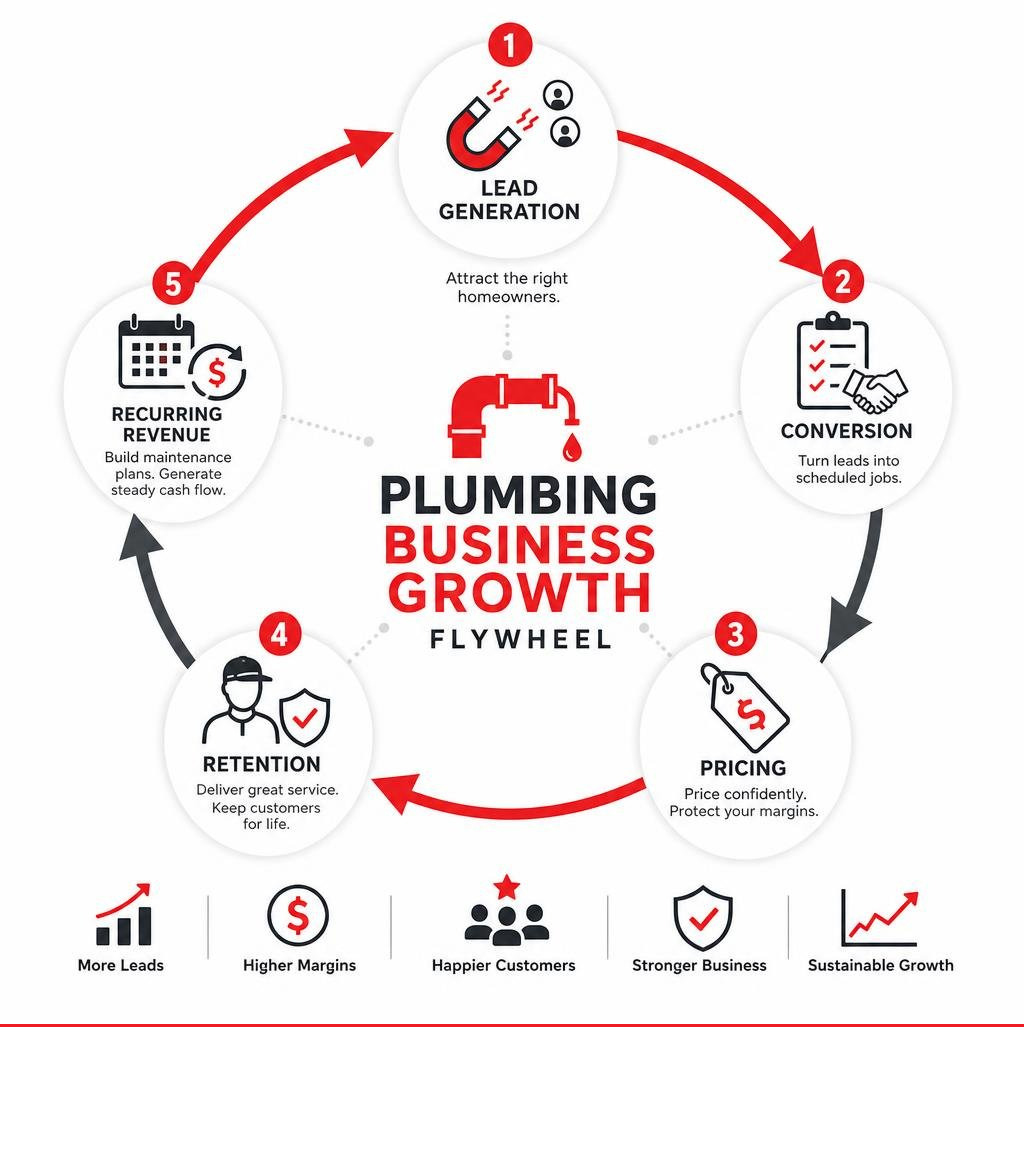
Similar topics to plumbing business growth:
The Blueprint for Sustainable Plumbing Business Growth

To scale past a single truck or break out of a revenue plateau, we need a repeatable blueprint. True plumbing business growth isn’t about running faster on the treadmill; it’s about building a machine that runs without you.
Scaling requires aligning four core operational levers: lead conversion, ticket optimization, recurring revenue, and systematic team scaling. When these systems are integrated, they protect your cash flow and keep your schedule full. If you try to scale your marketing without fixing your internal operations first, you will simply spend more money to expose the cracks in your foundation. We always recommend starting with a clear Plumbing Marketing Plan to align your operational capacity with your marketing budget.
Why Most Shops Stall: Overcoming the $300K–$600K Ceiling
Most plumbing business owners in New England—whether operating in Rhode Island, Massachusetts, or Maine—hit a hard wall between $300,000 and $600,000 in annual revenue. This is the “owner ceiling.”
At this stage, you are likely playing the role of lead technician, dispatcher, bookkeeper, and marketing manager. You rely almost entirely on word-of-mouth referrals. While referrals are excellent for getting started, they are highly unpredictable and unscalable. You cannot schedule truck acquisitions or hiring decisions around an unpredictable referral pipeline.
This operational chaos leads to undercapitalization. Because margins are thin, there is no cash reserve to invest ahead of demand. Real-world local examples, such as the growth of ROMAN HYDRO Plumbing & Heating – The University of Rhode Island or successful transitions like the Established Plumbing & Heating Firm in Maine – SOLD, prove that breaking through this ceiling requires moving away from reactive, solo operations toward documented, automated workflows.
Mastering the Math: Pricing for Plumbing Business Growth
You cannot build a highly profitable business by guessing your rates or copying your local competitor’s pricing. To achieve a target net profit margin of 20%+, you must calculate your true hourly cost of doing business, which includes non-billable hours, vehicle wear and tear, licensing, insurance, and office overhead.
If you bill strictly by the hour, you penalize your fastest, most experienced technicians. This is why transitioning to flat-rate pricing is vital.
| Pricing Model | Pros | Cons | Impact on Business Growth |
|---|---|---|---|
| Hourly Billing | Easy to explain to customers upfront. | Penalizes efficiency; creates client anxiety over slow work; limits profit margins. | Stalls growth. Techs have no incentive to work faster, and profit is capped by hours worked. |
| Flat-Rate Pricing | Rewards fast, skilled labor; eliminates pricing surprises; increases average ticket size. | Requires upfront work to build an accurate price book. | Accelerates growth. Allows you to scale revenue per truck independently of hours spent on-site. |
To maximize your revenue per job, we recommend using a “Good/Better/Best” options pricing strategy on estimates. When presented with three clear tiers (e.g., a basic repair, a standard replacement, or a premium system upgrade with an extended warranty), residential customers choose the middle or top option up to 60% of the time. This simple pricing shift can increase your average ticket size by 18% to 32% without requiring a single new lead. For a deeper dive into this framework, explore How to Grow a Plumbing Business: The 4 Revenue Levers That Take a $500K Shop to $1M Without Adding More Leads and see how these stages apply to your operations in How to Grow a Plumbing Company: The 3-Stage Revenue Framework From $250K to $1M+ Per Truck.
Transitioning from Plumber to CEO: Working On the Business
To scale, you must transition from working in the business to working on the business. This means putting down the wrench and picking up the financial dashboard.
Start by documenting your Standard Operating Procedures (SOPs). How should the phone be answered? What is the step-by-step process for truck dispatching? How do technicians present options to homeowners? When these processes are written down, you can hire into a system rather than into chaos.
Investing in Field Service Management (FSM) software like FieldPulse or Simpro is a game-changer. These platforms centralize scheduling, dispatching, and invoicing. Plumbing companies adopting FSM software report up to a 77% increase in productivity and a 23% boost in profitability within the first year. For practical strategies on making this mental shift, check out How to Grow Your Plumbing Business – Brentwood Growth and the actionable steps in How to Grow a Plumbing Business Playbook – phonestaffer.com.
Digital Marketing and Systems for Plumbing Business Growth

When you are ready to pour fuel on your systems, digital marketing is your primary engine. However, today, you cannot rely on a basic, outdated website. Over 60% of local service searches happen on mobile devices, and more than 50% of customers hire the first business that actually answers their inquiry.
To turn your online presence into a lead-generating asset, we focus on several key pillars:
- Google Business Profile (GBP) & Local SEO: Fully optimizing your GBP is the highest-ROI free marketing activity available. Consistently gathering high-quality, local reviews from your service areas in Rhode Island or Massachusetts helps you dominate the local Google Map Pack, which captures 40% to 60% of search clicks.
- Google Local Services Ads (LSAs): These pay-per-lead ads appear at the very top of Google search results with the “Google Guaranteed” badge. They put you directly in front of high-intent searchers looking for emergency services.
- A Mobile-First Website: Your website must load in under two seconds, display click-to-call buttons prominently above the fold, and offer instant online booking. If your site is slow or hard to navigate on a phone, you are wasting your ad spend.
- Automating “Speed to Lead”: Implementing missed-call text-back automation ensures that if you miss a call while under a sink, the prospect instantly receives a text message: “Sorry we missed you! How can we help you today?” This keeps them from clicking on your competitor.
To build a high-performing digital platform, leverage our comprehensive Plumbing Website Design Guide, and discover our specialized local optimization tactics in our guides on SEO for Plumbers and the Plumbing SEO Marketing Ultimate Guide. For additional local lead generation blueprints, see the Growth Strategy For Plumbing: Scale & Win Local Clients and the National Plumbing Marketing Blueprint | L3ad Solutions.
Building Recurring Revenue with Maintenance Agreements
The secret to stabilizing your cash flow during the shoulder seasons is recurring revenue. By selling annual or monthly plumbing maintenance agreements, you build a financial floor for your business.
A basic residential membership plan (for example, $15 to $25 per month) can include:
- An annual water heater flush and safety inspection.
- Priority scheduling for emergency calls.
- A 10% discount on all standard repairs.
If you build a base of 300 maintenance members, you establish a predictable stream of monthly recurring revenue. More importantly, these inspections allow your technicians to identify potential issues (like aging water heaters or corroded valves) before they become emergencies, filling your schedule with high-margin, proactive replacement work during slower months. This consistent revenue also significantly increases the overall valuation of your business if you ever decide to sell. To understand how to budget for these digital customer retention systems, read our guide on Investing in Your Online Presence What to Expect for Plumber Website Design Costs.
Scaling the Team: Hiring and Onboarding Systems
You cannot scale your billable hours without scaling your team, but hiring in New England’s competitive trade market requires a strategic approach. According to labor trends, the plumbing industry faces ongoing workforce shortages, with nearly 25% of the existing workforce approaching retirement age.
To attract and retain top-tier talent:
- Always Be Recruiting: Do not wait until you are drowning in work to post a job ad. Keep a continuous pipeline of candidates.
- Build a Clear Career Ladder: Show apprentices a defined path to becoming service plumbers, senior technicians, and eventually field managers.
- Streamline Onboarding: Create a repeatable onboarding routine so new hires learn your company’s customer service standards, safety protocols, and pricing systems before they ever step foot in a customer’s home.
For insights into managing licensing requirements and navigating trade regulations in our region, reference The Future of Massachusetts Plumbing – At Leisure License.
Conclusion: Partnering for Long-Term Expansion
Scaling a plumbing business is not about working harder; it’s about working smarter. By fixing your conversion systems, optimizing your pricing math, building recurring revenue, and automating your digital marketing, you can build a highly profitable business that operates smoothly with or without you in the field.
At JPG Designs, we specialize in helping plumbing and home service contractors throughout Rhode Island, Massachusetts, Connecticut, Maine, and New Hampshire dominate their local markets. We build lightning-fast, mobile-first websites designed to capture emergency leads, and we implement local SEO strategies that keep your trucks dispatched year-round.
Ready to take your business to the next level?
- Explore our dedicated solutions for HVAC & Plumbing Web Design.
- Let’s build your growth engine together—Contact JPG Designs today for a customized digital blueprint review.