
Why Smart Small Business Owners Are Asking: Is SEO Worth It?
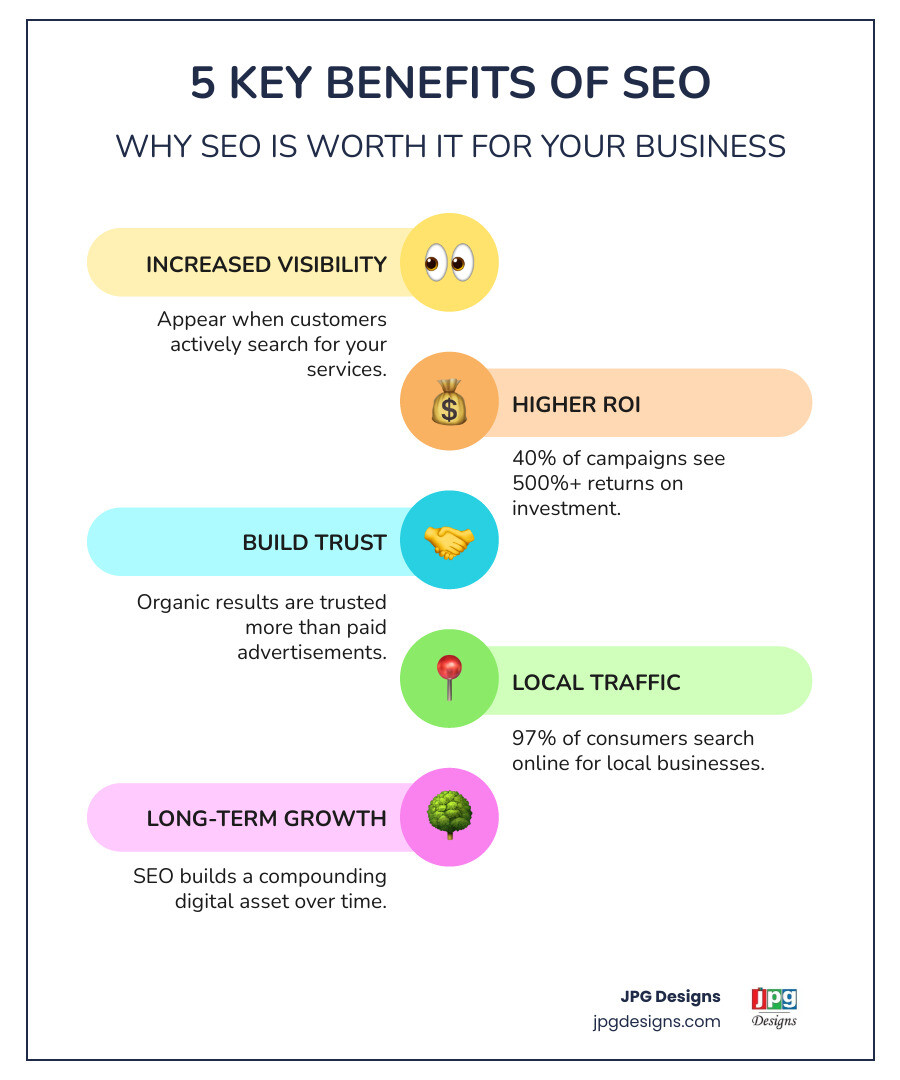
Is seo worth it for small business? Yes, SEO is absolutely worth it for small businesses. Research shows that nearly 40% of local SEO campaigns see returns of 500% or more, organic search drives 53.3% of all website traffic, and 97% of consumers search online for local businesses. Unlike paid ads, SEO builds a long-term asset that continues generating qualified leads without ongoing ad spend.
Here’s the quick breakdown:
- High ROI: Almost 40% of local SEO campaigns deliver 500%+ returns
- Dominant Traffic Source: Organic search drives more than half of all website traffic
- Customer Behavior: 97% of people search online to find local businesses
- Cost-Effective: The U.S. International Trade Administration confirms organic search delivers double the ROI of paid search
- Long-Term Value: SEO builds a digital asset that compounds over time, while paid ads stop working when you stop paying
We get it. You’re busy running your business. Your budget is tight. And you’re being pitched a dozen different marketing strategies every week. Between Google Ads, Facebook campaigns, email marketing, and now AI-powered tools, it’s hard to know where to invest your limited time and money.
Many small business owners view SEO as a luxury they can’t afford or a mysterious technical process they don’t understand. The truth is simpler: your customers are searching for what you offer right now. If your business doesn’t show up when they search, they’re finding your competitors instead.
The digital landscape has fundamentally changed how customers find and choose businesses. 68% of all online experiences start with a search engine. For local businesses, the numbers are even more compelling: nearly half of all Google searches have local intent, and more than half of “near me” queries lead to an in-person visit within a day.
This isn’t hype or theory. It’s backed by data showing that SEO optimization, Google advertising, and social media advertising all have measurable effects on annual profit—but organic search consistently delivers the highest return on investment. Nearly 80% of users ignore paid ads in search results, choosing to trust organic rankings instead.
The real question isn’t whether SEO works. It’s whether you can afford to ignore it while your competitors build their digital presence and capture the customers actively searching for your services.
I’m Jeff Pratt, and I’ve spent over 15 years helping small businesses answer the question “is seo worth it for small business” by building SEO strategies that actually deliver leads and revenue. I’ve seen how the right approach to search visibility transforms struggling businesses into thriving ones—and I’ve learned what works (and what doesn’t) for companies with real-world constraints and budgets.
Explore more about is seo worth it for small business:
- what is seo and how it works for small businesses
- how to seo optimize
- best seo services for small business
Why SEO Is No Longer an Optional Expense
In today’s digital-first world, your website isn’t just a brochure; it’s your digital storefront, often the first (and sometimes only) impression potential customers have of your business. If that storefront isn’t visible when people are looking, it’s like having a beautiful shop tucked away on a street with no signage. For small businesses in Rhode Island, where local competition can be fierce, visibility is everything.
The simple truth is, organic search is still, by far, the largest marketing channel. A staggering 53.3% of all website traffic comes from organic searches. This means more than half of your potential customers are looking for you on Google, Bing, or Yahoo. If you’re not optimized for these search engines, you’re missing out on the biggest slice of the pie. We believe that understanding What is SEO and How It Works for Small Businesses is the first step to open uping this potential.
This isn’t just about general searches; it’s local. Nearly half of all Google searches have local intent, meaning people are specifically looking for businesses “near me” or “in Providence RI.” They’re not just browsing; they’re ready to buy, eat, or hire. This makes Why Your Business Can Benefit Greatly From Local SEO an essential read for any local business owner.
The Modern Customer Journey Starts with a Search
Think about your own habits. When you need a new restaurant in Newport, a plumber in Cranston, or a web designer in Providence, where do you start? Probably Google. Our research shows that 68% of all online experiences begin with a search engine. This isn’t just a trend; it’s how consumers operate.
For local small businesses, this behavior is even more pronounced. Nearly half of all Google searches have local intent. These “near me” queries are powerful: more than half of them lead to an in-person visit within a day. Furthermore, 76% of people who search on their smartphones for something nearby visit a business within a day, and 28% of those searches result in a purchase. This means local searchers aren’t just curious; they’re actively looking to convert. Implementing effective Online Marketing Strategies to Improve Local Business Traffic is crucial to capture these ready-to-buy customers.
Build Trust Before the First Click
We’ve all seen the paid ads at the top of search results. While they can provide immediate visibility, our experience and industry data tell us something important: nearly 80% of users ignore paid ads in search results. Why? Because organic results are perceived as more trustworthy and authoritative.
When your business ranks organically for relevant search terms, it signals to potential customers that Google (and by extension, the internet at large) considers you a reputable, relevant source. This builds brand credibility and authority before a customer even clicks on your website. It’s about earning trust, not buying it. And that trust is invaluable for small businesses. Understanding How Google Ranking Can Help Your Business is key to leveraging this trust factor.
The Tangible ROI: SEO vs. Paid Advertising
Many small business owners grapple with the choice between SEO and paid advertising. While both have their place, understanding their fundamental differences in terms of return on investment (ROI) is crucial.

SEO is an investment in a long-term asset, much like investing in your physical property or equipment. It’s about building a foundation that continues to deliver value over time, with compounding results. Paid ads, on the other hand, are more like renting attention. They provide immediate results, but the moment you stop paying, the visibility disappears. Our goal is always to help you Maximize Your ROI With SEO & Google Ads by understanding how they complement each other, but also recognizing SEO’s inherent long-term value. We firmly believe that Marketing Should Be Viewed as a Growth Opportunity and Not an Expense, and SEO perfectly embodies this philosophy.
Here’s a quick comparison:
| Metric | SEO | Paid Ads (PPC) |
|---|---|---|
| Cost Model | Investment (builds asset) | Expense (rents attention) |
| Time to Results | Long-term (months for significant ROI) | Immediate (results as soon as ads run) |
| Trust Factor | High (perceived as earned authority) | Lower (perceived as paid promotion) |
| Longevity | Lasting (compounding, evergreen) | Temporary (stops when budget runs out) |
| Cost Per Lead | Lower over time | Higher, ongoing |
| ROI | Double that of paid search | Immediate, but requires continuous spend |
Building a Digital Asset vs. Renting Attention
When we talk about SEO building a digital asset, we mean creating a website that consistently attracts organic traffic because it’s deemed valuable by search engines and users. This involves optimizing your site, creating high-quality, relevant content, and earning reputable backlinks. This asset provides sustainable traffic and builds your website’s authority, making it easier to rank for new keywords over time. This is the True Value Website: Small Business philosophy in action.
Think of it this way: once your SEO efforts help you rank for a key term like “best coffee shop Providence RI,” that ranking continues to drive traffic to your site 24/7, without you having to pay for each click. This evergreen content and sustained visibility become a valuable part of your business, compounding its benefits over months and years. With paid ads, the traffic stops the moment your budget runs out. You’re constantly dependent on continuous spending to maintain visibility.
Is SEO worth it for small business in terms of financial return?
Absolutely. The financial return on SEO for small businesses, especially local ones, can be incredibly significant. Research shows almost 40% of local SEO campaigns see returns of 500% or more. That’s a number that speaks volumes about the power of targeted, organic visibility.
This high ROI is driven by several factors:
- Lower Customer Acquisition Cost (CAC): While there’s an initial investment in SEO, the cost per lead generally decreases over time as your rankings improve and traffic becomes consistent. This makes it far more cost-effective than constantly paying for clicks on ads.
- Qualified Leads: People searching on Google have intent. They’re often looking for a specific product or service, or a solution to a problem. This means organic traffic tends to be highly qualified, leading to higher conversion rates and better sales outcomes.
- Brand Building: Ranking high for relevant terms builds brand awareness and credibility, contributing to long-term customer loyalty and repeat business.
If you’re wondering Do You Know the ROI of Your Website?, focusing on SEO metrics like organic traffic, lead generation, and conversion rates will give you a clear picture of its financial impact.
Your Roadmap to High-Impact Local SEO
Now that we’ve established that is seo worth it for small business is a resounding “yes,” especially for local businesses in Rhode Island, let’s talk about how to actually do it. We’ve developed a roadmap for high-impact local SEO that focuses on actionable strategies and foundational steps. For a more in-depth look, check out our Turbocharge Your Local Business: A Comprehensive Guide to Local SEO for Small Business Owners and SEO Tips for Small Businesses.
Step 1: Claim Your Digital Storefront with Google Business Profile
Your Google Business Profile (GBP) is arguably the single most important local SEO tool. It’s your free digital storefront on Google Search and Maps, and it directly impacts whether customers in places like Warwick, Pawtucket, or East Greenwich can find you.
- Complete and Accurate Information: Ensure your business name, address, phone number (NAP), website, hours of operation, and services are all correct and consistent. Inaccurate information is a common pain point for customers and a red flag for Google.
- Encourage Customer Reviews: Reviews are gold for local businesses. They build trust and signal to Google that your business is active and valued. Actively ask happy customers for reviews and, crucially, respond to all reviews, positive or negative, with professionalism and gratitude.
- Photos and Posts: Keep your GBP vibrant with high-quality photos of your business, products, and services. Use the “Posts” feature to share updates, offers, and events. This keeps your profile fresh and engaging.
- Local Map Pack Visibility: An optimized GBP is your ticket to appearing in the coveted local map pack (the top 3 business listings with a map). This is where most local searchers click.
For a detailed walkthrough, read our guide on How to Setup and Optimize Your GMB (Google My Business).
Step 2: Optimize Your Website for Local Customers
Your website needs to speak Google’s language, but also resonate with your local customers. This means incorporating local keywords and ensuring your site is technically sound.
- Local Keywords: Research and use keywords that include your services and specific Rhode Island locations (e.g., “HVAC repair Woonsocket RI,” “web design Newport RI,” “pizza delivery North Providence”).
- Dedicated Service and City Pages: If you serve multiple areas or offer various services, create dedicated pages. For example, instead of one “Services” page, have separate pages like “/plumbing-services-cranston-ri” and “/drain-cleaning-coventry-ri.” This signals strong local relevance to Google.
- Mobile-First Design: This is critical. Google now primarily uses the mobile version of your content for indexing and ranking. Your website must be fast, responsive, and easy to use on smartphones. As experts in What is Mobile-First Indexing?, we can’t stress this enough for local businesses.
- On-Page SEO Fundamentals: Beyond local keywords, ensure your page titles, meta descriptions, header tags (H1, H2, etc.), and image alt text are all optimized. These elements tell Google what your page is about. Our 7 Tips to Get the Best On-Page SEO Results can help you get started.
Step 3: Create Content That Answers Local Questions
Content isn’t just for big brands. For small businesses, it’s a powerful way to connect with your community, build authority, and answer the specific questions your local customers are asking.
- Address Customer Pain Points: What problems do your customers in Lincoln or Cumberland face that your business solves? Create blog posts or FAQ sections that directly answer these questions. For example, a roofer in Pawtucket could write “Signs You Need a Roof Repair Before Winter in Rhode Island.”
- Local Blog Topics: Think about topics relevant to your specific locale. A restaurant might blog about “Best Brunch Spots in East Greenwich” (and naturally feature their own). A landscaper could write “Native Plants That Thrive in Rhode Island’s Climate.” This builds topical authority for your region.
- Showcase Local Expertise: Use your content to demonstrate your expertise, experience, authoritativeness, and trustworthiness (E-E-A-T) within your local community. Share success stories, local events you sponsor, or tips relevant to Rhode Island residents.
Content Is King: Creating High-Quality SEO Optimized Content and knowing How to Write Content for Your Small Business Website are fundamental to attracting and engaging your target audience.
Is SEO worth it for small business? Answering Your Biggest Concerns
It’s natural to have questions and concerns when considering an investment in SEO. We often hear these common fears from small business owners in Rhode Island. It’s why we always recommend you It’s Time to Reevaluate Your SEO Strategy and address these head-on.
“I need results now!” – The SEO Timeline Explained
This is perhaps the most common concern, and it’s completely understandable. When you’re running a small business, every dollar and every day counts. We wish we could tell you SEO delivers overnight success, but that’s simply not how it works. SEO is a marathon, not a sprint.
Here’s a realistic timeline:
- Months 1-3: Groundwork and Setup: This phase involves auditing your site, setting up Google Business Profile, conducting keyword research, fixing technical issues, and beginning content creation. You might see some initial ranking improvements for less competitive keywords.
- Months 3-6: Early Traction: You’ll start to see more meaningful shifts in rankings, an increase in organic traffic, and potentially your first new leads from SEO. This is where the initial efforts begin to pay off.
- Months 6-12+: Sustainable Growth and Compounding Results: This is where the magic happens. Your authority builds, more pages rank, and traffic continues to grow. The results start compounding, delivering a consistent stream of qualified leads.
While this might feel slow, SEO builds a long-term asset. The payoff is substantial and continues long after the initial investment, unlike paid ads that stop when your budget does.
“Is SEO dead because of AI?” – Adapting to the Future of Search
With the rise of AI in search, particularly Google’s AI Overviews, some business owners worry that traditional SEO is obsolete. We can confidently tell you: SEO is not dead; it’s evolving, and quality SEO is more important than ever.
AI-driven overviews, the newest layer of search, still lean on the same local data: your business profile, your reviews, and the accuracy of your website. If that information isn’t strong, you’ll be left out of both the traditional map pack and the AI-generated results. AI aims to provide the best, most authoritative, and trustworthy answers. This means that businesses focusing on E-E-A-T (Expertise, Experience, Authoritativeness, Trustworthiness) in their content and overall online presence are actually rewarded by AI.
We call this “Generative Engine Optimization” (GEO). If you’re already doing solid, user-focused SEO, you’re likely already doing GEO. The key is to create helpful, well-organized content that answers real questions, build trust with backlinks and mentions, and dive deep into specific topics. Our expertise in Optimize Website Semantic Search helps ensure your content is understood by both humans and AI.
“Can I do this myself?” – DIY vs. Hiring an Agency
This is a common dilemma for small business owners. The thought of saving money by doing SEO yourself is appealing, but the reality can be complex.
- DIY SEO: It’s certainly possible to learn the basics of SEO. Resources are abundant, and tools can help. However, effective SEO requires significant time, continuous learning, and a diverse skillset (technical, content, link building, analytics). For a busy small business owner, finding that time and mastering those skills can be a huge challenge. There’s also the risk of making mistakes that could harm your rankings.
- Hiring an Agency: Partnering with an experienced agency like JPG Designs means you’re leveraging a team of experts who live and breathe SEO. We have the tools, the knowledge of algorithm changes, and the time to dedicate to your strategy. This accelerates your growth, ensures best practices are followed, and allows you to focus on what you do best: running your business. While there’s an investment, it often translates into faster, more effective results and a better ROI in the long run. Consider Best SEO Services for Small Business and why Why Hiring Professional Web Design Is Always Better Than Going DIY can apply to SEO too.
Frequently Asked Questions about SEO for Small Businesses
How do I know if my SEO is working?
Measuring the success of your SEO efforts is crucial to understanding your ROI. We track several key performance indicators (KPIs):
- Organic Traffic: This is the number of visitors coming to your site from search engines. You should see a steady increase over time.
- Keyword Rankings: Monitor where your target keywords rank on Google. Improved rankings directly correlate with increased visibility.
- Lead Generation/Conversions: Are you getting more phone calls, form submissions, or sales directly attributable to organic search? This is the ultimate measure of success.
- Google Analytics & Search Console: These free tools are indispensable. Google Analytics helps you understand user behavior on your site, while Search Console shows you how Google sees your site, including search queries, crawl errors, and mobile usability. Learn more with Everything You Need to Know About Google Analytics.
What are the most important SEO tasks for a local business?
For local businesses in Rhode Island, we prioritize these three tasks:
- Google Business Profile Management and Review Generation: Keep your GBP optimized, updated, and actively encourage and respond to customer reviews. This is your foundation for local visibility.
- Creating Location-Specific Service Pages: Develop unique, optimized pages for each service you offer in each of your primary service areas (e.g., “Web Design Providence RI,” “Digital Marketing Newport RI”).
- Building Local Citations and Backlinks: Ensure your business information (NAP) is consistent across online directories (citations) and actively seek mentions and links from other reputable local businesses, community organizations, and news outlets.
How much should a small business budget for SEO?
The cost of SEO for a small business can vary widely depending on your goals, competition, and whether you choose DIY, freelance, or agency solutions.
- DIY: This is the cheapest in terms of direct cost, but the most expensive in terms of your time and potential learning curve. You’ll still need to invest in some tools.
- Freelancer: Rates typically range from $70-$150 per hour. This can be a good option for specific tasks or limited budgets.
- Agency: For comprehensive SEO services, small businesses typically budget between $500 and $2,500 per month. This investment covers strategy, content, technical optimization, link building, and reporting.
The key is to view SEO as an investment in your business’s future, not just another expense. The returns, as we’ve shown, can be substantial and long-lasting. If you’re facing How to Continue Marketing When Faced With Budget Cuts, SEO often proves to be the most resilient and rewarding channel.
Stop Guessing and Start Growing Your Business
So, is seo worth it for small business? Our answer, backed by data, experience, and the undeniable shift in consumer behavior, is a resounding yes. SEO is no longer a luxury; it’s a fundamental necessity for any small business in Rhode Island looking to thrive in the digital age.
It’s an investment that builds a long-term digital asset, generates highly qualified leads at a lower cost, and builds trust and authority that paid advertising simply can’t match. While it requires patience and consistent effort, the compounding returns make it one of the most powerful and sustainable growth strategies available.
Don’t let your competitors capture the customers who are actively searching for your products and services right now. With JPG Designs, we specialize in crafting robust SEO strategies, leveraging our expertise in mobile-first indexing and local optimization, to ensure your business stands out and attracts the right audience. We’re here to help you steer the complexities of search and turn online searches into loyal customers.
Ready to turn searches into customers? Explore our expert Digital Marketing Services and find how we can build a powerful SEO strategy for your business.